
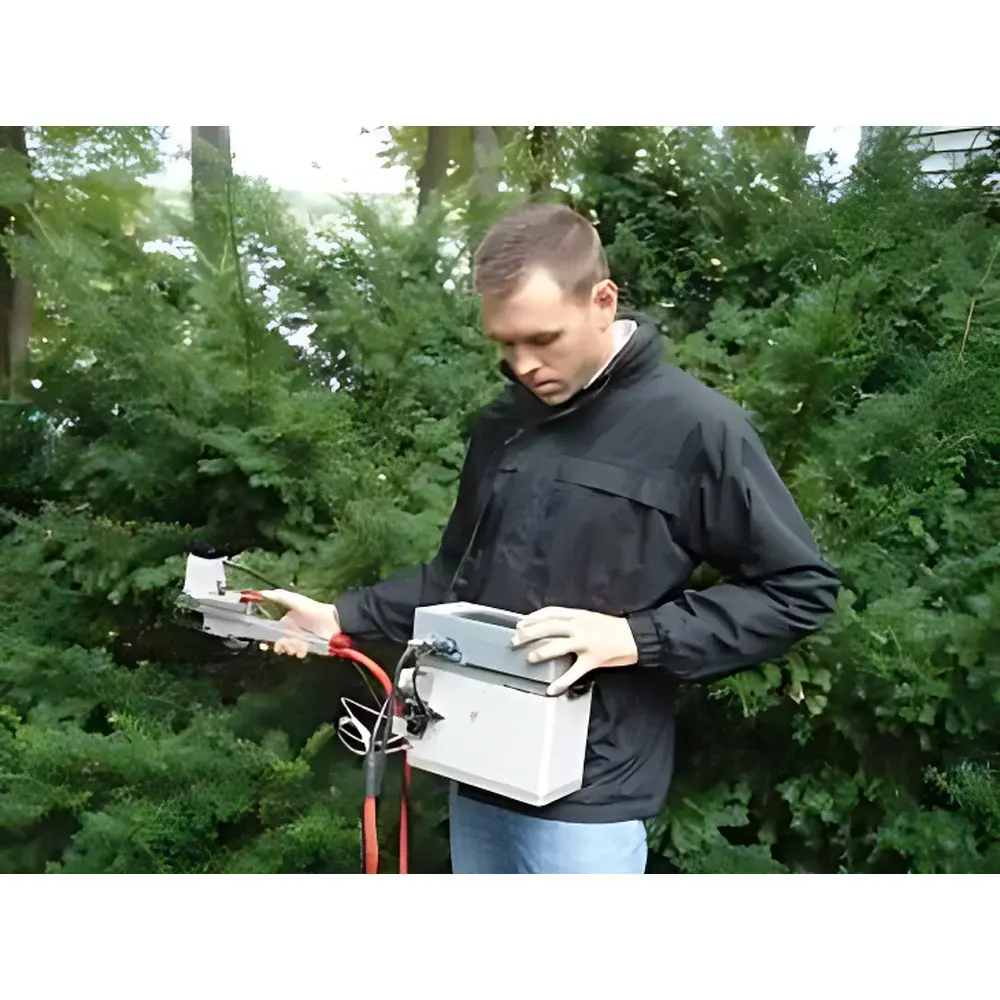
ADC Bio iFL Portable Photosynthesis-Fluorescence Dual Measurement System
| Brand | ADC Bio |
|---|---|
| Origin | United Kingdom |
| Manufacturer Type | Authorized Distributor |
| Import Status | Imported |
| Model | iFL Portable |
| Pricing | Available Upon Request |
Overview
The ADC Bio iFL Portable Photosynthesis-Fluorescence Dual Measurement System is an integrated, field-deployable instrument engineered for simultaneous, co-located acquisition of gas exchange and chlorophyll fluorescence parameters from the same leaf area under identical environmental conditions. It operates on the dual principles of infrared gas analysis (IRGA) for real-time CO2 and H2O vapor concentration measurement, and pulse-amplitude modulated (PAM) fluorometry for quantification of photosystem II (PSII) photochemical efficiency. This concurrent measurement architecture eliminates temporal and spatial mismatch—common sources of error in sequential or standalone assessments—and enables robust mechanistic interpretation of plant photosynthetic performance under dynamic field conditions. Designed specifically for plant ecophysiology and climate response research, the iFL system supports high-fidelity characterization of carbon assimilation kinetics, electron transport dynamics, and stomatal–mesophyll coordination across diverse species and stress regimes.
Key Features
- Simultaneous, synchronized measurement of net CO2 assimilation rate (An), stomatal conductance (gs), transpiration (E), intercellular CO2 concentration (Ci), and PSII quantum yield (ΦPSII), non-photochemical quenching (NPQ), and photochemical quenching (qP)
- Advanced biochemical parameter derivation: CO2 compensation point (Γ*), light-respired CO2 (Rd), mesophyll conductance (gm), and chloroplast CO2 concentration (Cc) via iterative fitting of Farquhar–von Caemmerer–Berry (FvCB) model constraints
- Integrated optical calibration: On-the-fly measurement of leaf absorptance (α) and transmittance (τ) using dual-beam spectral referencing—aligned with the Flexas protocol to correct for leaf optical artifacts in gm estimation
- Three configurable quenching analysis models: Hendrickson, Kramer–Lake, and Puddle—enabling taxon-specific optimization of NPQ partitioning and energy dissipation pathway inference
- Modular operational mode: Fully independent operation of IRGA and PAM modules, or seamless synchronized acquisition with shared time stamps and environmental logging
- Field-optimized ergonomics: Total system mass of 5.2 kg; integrated shoulder harness; ruggedized IP54-rated enclosure; internal rechargeable Li-ion battery supporting ≥8 hours of continuous operation at 25°C
- Intuitive 7-inch capacitive color touchscreen interface with on-device data visualization, real-time parameter trending, and context-sensitive help menus
- Removable SD card storage (microSDHC Class 10) supporting >100,000 measurement records per card; timestamped, metadata-embedded .csv export compliant with FAIR data principles
Sample Compatibility & Compliance
The iFL system accommodates intact leaves ranging from 1.5 cm² to 12 cm² in surface area, including broadleaf angiosperms, conifer needles, and grass blades—subject to standard leaf chamber sealing protocols. All gas exchange measurements conform to ISO 16634:2016 (determination of photosynthetic parameters using closed-system IRGA) and ASTM E2912-21 (standard guide for plant physiological measurements in field settings). Fluorescence protocols adhere to the consensus definitions established by the International Society of Photosynthesis Research (ISPR) and are traceable to NIST-calibrated reference standards. Data integrity meets GLP-compliant audit requirements, with full electronic record retention, user-access logs, and immutable timestamping aligned with FDA 21 CFR Part 11 Annex 11 expectations for regulated environmental physiology studies.
Software & Data Management
Data acquisition, configuration, and post-processing are managed via ADC Bio’s proprietary iFL Control Suite v3.2—a Windows-based desktop application supporting offline calibration validation, FvCB model fitting, gm sensitivity analysis, and batch processing of multi-site datasets. Raw sensor outputs (CO2, H2O, PAR, temperature, fluorescence induction curves) are stored in open-format HDF5 containers with embedded metadata (sensor IDs, firmware versions, calibration dates, operator credentials). Export options include MIAME-compliant .txt, .csv, and .xlsx formats compatible with R (photosynthesis package), Python (PlantPhysIO), and MATLAB-based modeling workflows. Firmware updates are delivered via secure HTTPS channel with SHA-256 signature verification.
Applications
- Plant acclimation and phenotypic plasticity assessment across elevational, latitudinal, and edaphic gradients
- Mechanistic evaluation of abiotic stress responses—including drought, heat, salinity, and ozone exposure—via coupled An/ΦPSII/gm trajectories
- Carbon sink/source attribution in natural and agroecosystems through diurnal Ci–An response curve analysis
- Genotype-by-environment interaction screening for crop improvement programs targeting Rubisco efficiency and mesophyll limitation mitigation
- Validation of terrestrial biosphere models (e.g., CLM, ORCHIDEE) using empirically derived Γ*, Rd, and gm inputs
- Long-term monitoring of forest canopy physiology under climate change scenarios (IPCC AR6 Tier 2 protocols)
FAQ
Does the iFL system require external power sources in the field?
No—the system operates exclusively on its internal rechargeable Li-ion battery, rated for ≥8 hours of continuous measurement at ambient temperatures between 5–35°C.
Can gm be calculated without measuring leaf absorptance and transmittance?
While conventional gm estimation methods rely on assumed optical properties, the iFL’s integrated α/τ measurement eliminates this source of systematic bias and is required for accurate Cc derivation per Flexas et al. (2013) and Warren (2019).
Is the FvCB model fitting performed onboard or only in post-processing software?
Initial parameter estimation occurs in real time during measurement; full iterative FvCB fitting—including uncertainty propagation and residual diagnostics—is executed in iFL Control Suite v3.2.
Are firmware and software updates provided free of charge after purchase?
Yes—ADC Bio provides lifetime access to firmware and software updates, including regulatory compliance patches and new quenching model integrations, via registered user portal.
What level of technical support is available for academic users conducting multi-year field campaigns?
ADC Bio offers dedicated application scientist support, remote troubleshooting, on-site training workshops, and custom protocol development assistance under institutional service agreements.
Related Products



