
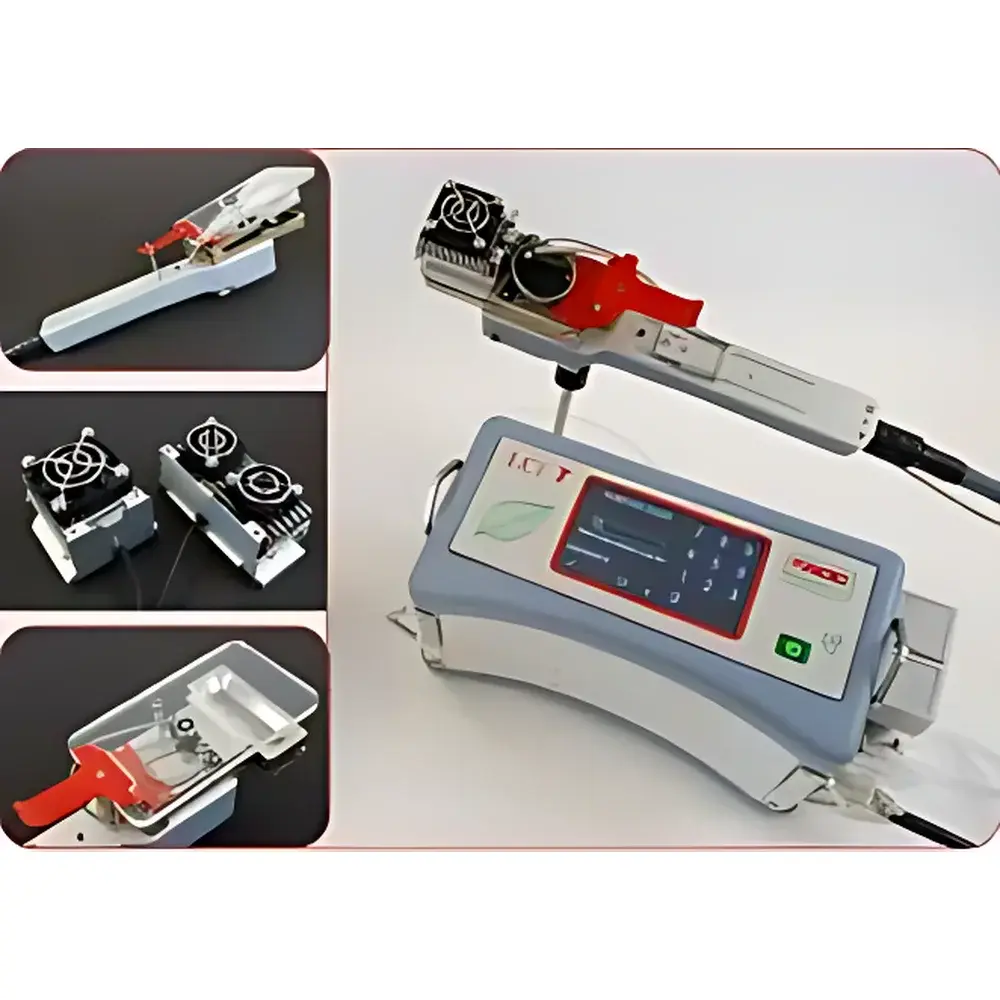
ADC Bio LCi T Portable Photosynthesis System
| Brand | ADC Bio |
|---|---|
| Origin | United Kingdom |
| Model | LCi T |
| CO₂ Range | 0–2000 ppm (0.1 ppm resolution, ±1% accuracy, 0.25 s response) |
| H₂O Range | 0–75 mbar (0.1 mbar resolution, 0.5% RH repeatability) |
| PAR Range | 0–3000 µmol·m⁻²·s⁻¹ (silicon photodiode, ±5 µmol·m⁻²·s⁻¹) |
| LED Light Sources | RGB (0–2400 µmol·m⁻²·s⁻¹) or White (0–2500 µmol·m⁻²·s⁻¹) |
| Leaf Chamber Temp | −5 to 50 °C (±0.2 °C) |
| Airflow | 100–500 mL/min (±2% FS) |
| Battery Life | ~10 h (12 V, 2.8 Ah sealed lead-acid) |
| Weight | 2.4 kg (main unit), 0.6 kg (standard chamber) |
| Dimensions | 240 × 125 × 140 mm (unit) |
| Data Storage | Removable SD card (up to 32 GB) |
| Compliance | ASTM E2912-13 (gas exchange instrumentation), ISO 17025 traceable calibration protocols, GLP-compliant data logging with timestamp, GPS geotagging (latitude/longitude/elevation) |
Overview
The ADC Bio LCi T Portable Photosynthesis System is a field-deployable, open-path gas exchange instrument engineered for high-fidelity measurement of leaf-level photosynthetic and transpirational physiology under natural environmental conditions. It operates on the principle of differential open-path infrared gas analysis (IRGA), integrating a miniature, in-chamber CO₂ sensor with dual-laser-tuned, fast-response water vapor detection. This architecture eliminates sample line lag and enables real-time quantification of net photosynthetic rate (An), stomatal conductance (gs), transpiration rate (E), and intercellular CO₂ concentration (Ci)—all derived from first-principles mass balance calculations governed by Fick’s law and coupled energy balance models. The system is calibrated against NIST-traceable standards and incorporates automatic temperature and pressure compensation, ensuring metrological integrity across altitudinal gradients and ambient humidity extremes—from arid steppe to tropical understory.
Key Features
- Ultra-portable form factor (2.4 kg main unit) with ergonomic design for extended field deployment in rugged terrain.
- In-chamber micro-IRGA and dual-laser water vapor sensor deliver sub-second (<0.25 s) CO₂ response and <0.1 mbar H₂O resolution—critical for capturing diurnal dynamics and stress-induced transient responses.
- Dual LED light source options: programmable RGB array enabling spectral tuning (R:G:B ratio control) for photobiological studies, or high-output white LED for broad-spectrum PAR delivery up to 2500 µmol·m⁻²·s⁻¹.
- Integrated GPS module records geospatial metadata (WGS84 latitude, longitude, elevation) with each measurement—essential for spatially explicit ecological modeling and cross-site comparisons.
- Industrial-grade housing and conformal-coated electronics rated for operation in high-humidity (>95% RH) and particulate-laden environments (e.g., dust storms, canopy fog drip zones).
- Modular chamber system with eight interchangeable configurations—including narrow-leaf, conifer needle, Arabidopsis whole-plant, soil respiration, and fruit chambers—each optimized for gas-tight sealing, thermal stability, and minimal boundary layer disturbance.
- Capacitive touchscreen interface with intuitive icon-driven workflow; supports on-device parameter configuration, real-time graphing, and immediate annotation without external computing.
Sample Compatibility & Compliance
The LCi T accommodates diverse plant morphologies via application-specific leaf chambers, all fabricated from low-permeability, IR-transparent polymers (e.g., UV-stabilized acrylic, fluorinated ethylene propylene) to prevent CO₂/H₂O diffusion artifacts. Each chamber integrates precision thermistors for leaf and air temperature monitoring, with thermal mass minimized to ensure rapid equilibration. The system adheres to ASTM E2912-13 for portable photosynthesis instrumentation validation and supports GLP-compliant data acquisition: all measurements include embedded timestamps, operator ID fields, and audit-trail-capable SD card logging. Raw sensor outputs (analog voltage, digital serial packets) are preserved alongside calculated physiological variables, enabling retrospective reprocessing using updated algorithms or correction factors. Calibration routines follow ISO/IEC 17025 guidelines, with zero/span verification traceable to certified gas standards (NIST SRM 1662a for CO₂, NIST SRM 2800 for humidity).
Software & Data Management
Data acquisition and post-processing are managed via ADC Bio’s proprietary LCi Studio software (Windows/macOS), which imports native .csv and binary .lci formats directly from the SD card. The platform implements automated quality control flags—including dew point violation alerts, flow rate deviation thresholds (>±5%), and CO₂ signal noise filtering (10-Hz low-pass)—to identify and quarantine compromised datasets. Export modules support FAIR-aligned metadata embedding (ISO 19115 schema), direct upload to TRY Plant Trait Database, and batch conversion to NetCDF-4 for integration with ecosystem models (e.g., SIPNET, CLM). All firmware updates and calibration coefficients are digitally signed and version-controlled, satisfying FDA 21 CFR Part 11 requirements for electronic records in regulated research environments.
Applications
- Field-based drought tolerance phenotyping across crop germplasm collections (e.g., sorghum, tomato, Jatropha), correlating An/gs kinetics with osmotic adjustment markers.
- Altitudinal transect studies of *Quercus ilex* and *Rhododendron ferrugineum*, quantifying acclimation of Ci/Ca ratio and photosynthetic nitrogen use efficiency (PNUE) across thermal gradients.
- Soil-plant-atmosphere continuum (SPAC) modeling, where simultaneous soil respiration (via dedicated chamber) and leaf gas exchange constrain carbon partitioning estimates.
- Urban forestry assessments measuring stomatal regulation in street trees exposed to NOx and PM2.5, leveraging GPS-tagged time-series to map pollution-responsive gs suppression.
- Education and training: validated curricula for undergraduate plant physiology labs, emphasizing first-principles derivation of An = gs(Ca−Ci) and energy balance closure validation.
FAQ
What is the measurement principle underlying the LCi T’s CO₂ and H₂O detection?
It employs differential open-path IRGA for CO₂ (4.26 µm absorption band) and dual-laser wavelength modulation spectroscopy (WMS) for H₂O (1.39 µm overtone band), both referenced against internal zero-gas baselines and compensated for ambient T/P drift in real time.
Can the LCi T operate unattended overnight?
Yes—when paired with an external 12 V power bank (≥10 Ah) and weatherproof enclosure, it supports continuous logging at 10-s intervals for >24 h; internal battery limits standalone duration to ~10 h.
Is fluorescence integration supported?
Yes—the optional Fluorescence Adapter provides optical coupling for fiber-optic chlorophyll fluorometers (e.g., OS-5p), enabling concurrent An, gs, ΦPSII, and NPQ calculation without temporal misalignment.
How is chamber leakage quantified and corrected?
Leak testing is performed pre-deployment using synthetic air (0 ppm CO₂, 0% RH) at 300 mL/min; measured drift rates (<0.05 ppm/s) are applied as linear corrections during data reduction.
Are calibration gases included with shipment?
No—users must procure certified zero air (CO₂-free, dry) and span gases (e.g., 370 ppm CO₂ in N₂, 10 mbar H₂O in N₂) from accredited suppliers (e.g., Linde, Air Liquide); ADC Bio provides detailed SOPs for two-point calibration validation.





