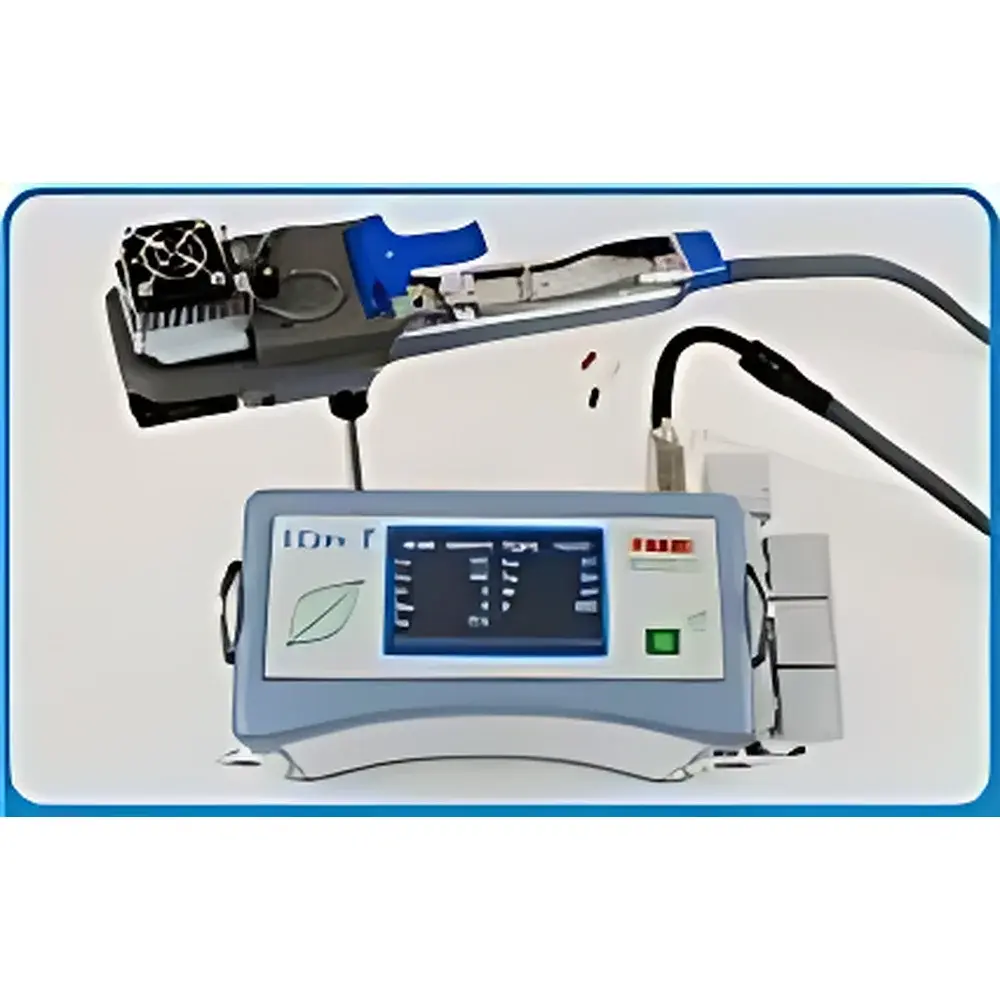
ADC Bio LCpro T Portable Photosynthesis System
| Brand | ADC Bio |
|---|---|
| Origin | United Kingdom |
| Model | LCpro T |
| CO₂ Measurement Range | 0–3000 ppm (±1% accuracy, 0.1 ppm resolution, dual-beam IRGA) |
| H₂O Measurement Range | 0–75 mbar (0.1 mbar resolution, dual-laser tunable hygrometer) |
| PAR Range | 0–3000 µmol·m⁻²·s⁻¹ (cosine-corrected Si photodiode, ±5 µmol·m⁻²·s⁻¹) |
| Leaf & Chamber Temperature | −5 to 50 °C (±0.2 °C) |
| Air Flow Rate | 100–500 mL·min⁻¹ (±2% FS) |
| Response Time (CO₂) | 0.25 s |
| Auto-Zero Cycle | 4 s |
| Battery Life | Up to 16 h (12 V, 7.5 Ah Li-ion) |
| Weight | 4.1 kg (main unit), 0.8 kg (handle) |
| Dimensions | 230 × 110 × 170 mm (unit), 300 × 80 × 75 mm (handle) |
| Data Storage | Removable SD card (up to 32 GB) |
| Environmental Operating Range | 5–45 °C |
| Optional Leaf Chambers | Broadleaf (6.25 cm²), Narrowleaf (5.2 cm²), Conifer (175 cm³), Arabidopsis/Small-Leaf (16 mm Ø), Mini-Canopy (≤55 mm height), Whole-Plant Arabidopsis, Fruit Chamber (1 L), Soil Respiration Chamber (1 L), Fluorescence Adapter (compatible with OS-5p) |
Overview
The ADC Bio LCpro T Portable Photosynthesis System is a field-deployable, closed-system gas exchange analyzer engineered for high-fidelity measurement of leaf-level photosynthetic physiology under natural or controlled conditions. It operates on the principle of non-dispersive infrared gas analysis (NDIR IRGA) coupled with dual-laser tunable diode absorption spectroscopy (TDLAS) for simultaneous, real-time quantification of CO₂ and H₂O vapor concentrations within the leaf chamber. Unlike conventional systems relying on external gas lines, the LCpro T integrates the IRGA sensor directly into the measurement handle—eliminating transport lag, minimizing gas-phase dispersion, and preventing water vapor condensation or CO₂ adsorption artifacts common in long-path tubing configurations. This architecture ensures sub-second response dynamics (CO₂ t₉₀ < 0.25 s), critical for capturing transient stomatal responses to rapid environmental perturbations such as light flecks or humidity shifts. The system conforms to ISO 17025 traceability frameworks for gas concentration metrology and supports GLP-compliant data acquisition through timestamped, audit-trail-enabled logging.
Key Features
- Integrated dual-beam IRGA and TDLAS hygrometer co-located within the chamber handle for zero-latency gas exchange measurement
- Four-second automated zeroing cycle for CO₂ and H₂O sensors, maintaining calibration stability across multi-day field deployments
- Independent, programmable control of four environmental variables: CO₂ (0–2000 ppm via internal cylinder), H₂O (humidification/dehumidification), temperature (±15 °C relative to ambient via Peltier), and photosynthetically active radiation (PAR) up to 2500 µmol·m⁻²·s⁻¹ using RGB or white LED arrays
- Full-color capacitive touchscreen interface with real-time graphical display of A/Ci curves, time-series traces, and parameter overlays (An, E, gs, Ci)
- GPS-integrated georeferencing module recording latitude, longitude, elevation, and UTC timestamp for each measurement point
- Ergonomic shoulder harness and balanced weight distribution (4.1 kg total) enabling extended operator use without fatigue
- Modular chamber ecosystem supporting 10 interchangeable configurations—including broadleaf, narrowleaf, conifer, Arabidopsis, mini-canopy, whole-plant, fruit, soil respiration, and fluorescence-compatible variants
- Energy-optimized design featuring adaptive screen brightness, low-power sensor electronics, and intelligent battery management yielding >16 h continuous operation on a single charge
Sample Compatibility & Compliance
The LCpro T accommodates diverse plant morphologies through its standardized chamber interchange system, validated per ASTM E2912-13 (Standard Practice for Calibration of Photosynthesis Systems). Chamber materials—including fused quartz windows and low-permeability polymer gaskets—are selected to minimize CO₂ diffusion artifacts and water vapor sorption. Each chamber type undergoes factory verification for seal integrity, thermal uniformity, and optical transmission (>92% at 400–700 nm). The system meets IEC 61000-4-2 (ESD immunity) and IP54 ingress protection ratings, permitting reliable operation in high-humidity (>95% RH) and particulate-laden environments typical of tropical forests, arid shrublands, or agricultural field sites. All firmware and data handling protocols comply with FDA 21 CFR Part 11 requirements for electronic records and signatures when configured with audit trail logging enabled.
Software & Data Management
Data acquisition is managed via embedded ARM-based firmware supporting both manual and script-driven protocols—including automated A/Ci, light-response, and dynamic environmental ramp sequences. Raw sensor outputs (voltage, temperature, pressure) are logged at 10 Hz alongside derived physiological parameters. Export occurs via Mini-B USB 2.0 or RS-232 (9600 baud) to Windows/Linux platforms. ADC Bio’s proprietary LCpro Software (v5.2+) provides post-acquisition tools for baseline correction, leak-rate compensation, conductance modeling (Ball–Berry, Farquhar–von Caemmerer–Berry), and export to CSV, Excel, or MATLAB-compatible formats. All datasets include embedded metadata: GPS coordinates, atmospheric pressure, chamber volume, leaf area, and user-defined treatment tags—ensuring FAIR (Findable, Accessible, Interoperable, Reusable) data practices aligned with NSF and ERC reporting guidelines.
Applications
The LCpro T serves as a primary instrument in plant ecophysiology, crop stress phenotyping, forest carbon cycling studies, and climate change impact assessment. Published applications include quantifying stomatal limitations under drought (Carvalho et al., Acta Physiol. Plant. 2011), evaluating glyphosate-induced reductions in gs and An in resistant soybean (Zobiole et al., Plant Soil 2010), characterizing diurnal isoprenoid emission coupling to photosynthetic performance in Quercus ilex (Seco et al., Acta Physiol. Plant. 2011), and assessing hydraulic constraints on photosynthetic WUE in Betula pendula crowns (Sellin et al., Ecol. Res. 2011). Its portability and environmental robustness make it suitable for longitudinal monitoring across gradients—from alpine treelines to coastal mangroves—and for validation of eddy covariance flux towers.
FAQ
What chamber types are compatible with the LCpro T?
The system supports ten interchangeable chambers: broadleaf (6.25 cm²), narrowleaf (5.2 cm²), conifer (175 cm³), Arabidopsis/small-leaf (16 mm Ø), mini-canopy (≤55 mm height), whole-plant Arabidopsis, fruit (1 L), soil respiration (1 L), and fluorescence adapter modules.
How is CO₂ calibration maintained during extended field use?
The integrated 4-second auto-zero cycle references ambient air drawn through a dedicated zero-air path; optional span calibration with certified gas standards can be performed at user-defined intervals.
Does the LCpro T meet regulatory requirements for GLP/GMP studies?
Yes—when audit-trail mode is activated, all parameter changes, calibration events, and data exports are timestamped and user-logged in accordance with FDA 21 CFR Part 11 and ISO/IEC 17025 Annex A.2.
Can fluorescence measurements be synchronized with gas exchange?
Yes—the fluorescence adapter provides fiber-optic coupling to third-party fluorometers (e.g., Opti-Sciences OS-5p) and triggers simultaneous acquisition of Fv/Fm, ΦPSII, and NPQ alongside An and gs.
What is the maximum operating altitude?
The system compensates for barometric pressure from sea level to 3000 m ASL using an onboard absolute pressure transducer (±0.1 kPa accuracy).