
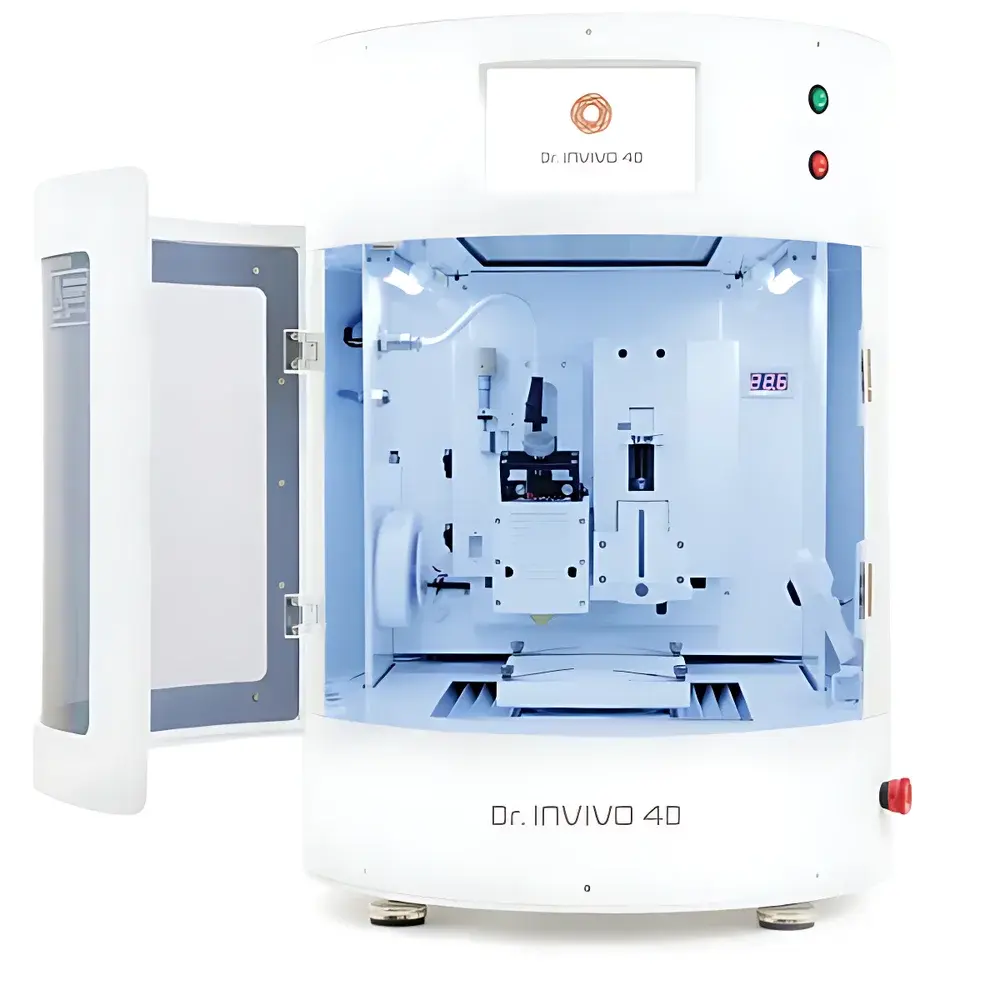
Adelphi INVIVO 4D Biological 3D Printer
| Brand | Adelphi |
|---|---|
| Origin | South Korea |
| Manufacturer Type | Authorized Distributor |
| Origin Category | Imported Equipment |
| Model | INVIVO 4D |
| Pricing | Available Upon Request |
Overview
The Adelphi INVIVO 4D Biological 3D Printer is an advanced biomanufacturing platform engineered for spatially and temporally controlled deposition of living cells, biomaterials, and bioactive agents. Unlike conventional additive manufacturing systems, the INVIVO 4D integrates dynamic environmental modulation—such as programmable temperature gradients, humidity control, and real-time perfusion—to enable time-resolved structural evolution (the “4th dimension”) in printed constructs. It operates on a multi-modal extrusion-based architecture, supporting simultaneous or sequential dispensing of hydrogels, thermoresponsive bioinks, filamentous scaffolds, particulate composites, and paste-like viscoelastic formulations. Designed specifically for translational regenerative medicine research, the system delivers high positional fidelity (<50 µm XY resolution) and layer-wise consistency under sterile, ISO Class 5–compatible laminar flow enclosures. Its core application domain spans from in vitro tissue mimicry to preclinical implant fabrication, with emphasis on reproducible, GMP-aligned process development.
Key Features
- Multi-material, multi-nozzle extrusion system supporting up to six independent printheads with pressure- and piston-driven actuation
- Integrated environmental chamber with precise control of temperature (4–40 °C), relative humidity (30–95% RH), and CO₂ concentration (0–10%) for live-cell printing
- Real-time monitoring via integrated HD stereo camera and optional non-invasive impedance sensing for construct maturation tracking
- Modular build volume configuration (standard: 120 × 120 × 100 mm; expandable to 200 × 200 × 150 mm) with autoclavable print beds and removable biocontainment trays
- Tool-free nozzle interchangeability and automatic tip calibration for rapid protocol switching between hydrogel, melt-electrospun fiber, and granular matrix deposition
- Compliance-ready firmware architecture supporting audit trails, user access levels, and electronic signature capture per FDA 21 CFR Part 11 requirements
Sample Compatibility & Compliance
The INVIVO 4D accommodates a broad spectrum of biologically relevant feedstocks, including natural and synthetic hydrogels (e.g., alginate, gelatin-methacryloyl, hyaluronic acid derivatives), cell-laden bioinks (>95% viability post-printing), sacrificial fugitive materials (Pluronic F127, carbohydrate glass), microcarriers, ceramic and polymer powders (e.g., β-TCP, PCL), and semi-solid pastes (e.g., decellularized extracellular matrix hydrolysates). All wetted components are fabricated from USP Class VI-certified polymers or electropolished 316L stainless steel. The system meets ISO 13485:2016 design controls for medical device manufacturing support and aligns with ASTM F2792 and ISO/ASTM 52900 definitions of additive manufacturing technologies. It supports GLP-compliant documentation workflows for preclinical study reporting under OECD guidelines.
Software & Data Management
Controlled via INVIVO Studio—a validated, Windows-based software suite—the printer enables full parametric definition of print paths, crosslinking triggers (UV, thermal, ionic), and time-dependent morphological transitions. The software includes built-in DICOM import for patient-specific anatomical model conversion, mesh repair tools compliant with ISO/IEC 17025 validation standards, and export options for STL, 3MF, and AMF file formats. All print logs—including environmental telemetry, pressure profiles, and motor encoder data—are timestamped, digitally signed, and stored in encrypted SQLite databases with configurable retention policies. Integration with LIMS platforms (e.g., LabVantage, Thermo Fisher SampleManager) is supported through RESTful API endpoints and HL7-compliant metadata tagging.
Applications
- Bioprinting of vascularized 3D tissue constructs for drug metabolism and toxicity screening (aligned with ICH S7B and S9 guidance)
- Fabrication of personalized osteochondral implants with graded mechanical properties and embedded growth factor gradients
- Development of organ-on-a-chip devices integrating endothelialized microchannels and parenchymal cell layers
- High-throughput fabrication of micropatterned spheroid arrays for stem cell differentiation studies
- Formulation testing of sustained-release drug depots using printable polymer-ceramic composites
- Educational deployment in biomedical engineering curricula for hands-on instruction in biomanufacturing principles and regulatory science
FAQ
Does the INVIVO 4D support sterile, closed-system operation?
Yes—the system features a Class II biological safety cabinet-integrated enclosure with HEPA-filtered laminar airflow and UV-C sterilization cycles between runs.
Can it print with primary human cells without compromising viability?
Validated protocols demonstrate >92% post-print viability for primary hepatocytes, chondrocytes, and mesenchymal stromal cells when using optimized shear-thinning bioinks and low-shear extrusion parameters.
Is remote monitoring and troubleshooting available?
Remote diagnostics and firmware updates are enabled via secure TLS 1.3–encrypted connections; on-site service dispatch is coordinated through Adelphi’s global support network with SLA-backed response windows.
What regulatory documentation is provided with the system?
Each unit ships with a Device Master Record (DMR)-aligned technical file, EU Declaration of Conformity (CE-IVD applicable for research-use-only configurations), and IQ/OQ documentation templates compliant with ISO 13485 and GAMP 5.
Are custom printhead geometries or material delivery modules available?
Adelphi offers co-engineering services for application-specific tooling, including coaxial nozzles for core-shell bioprinting, piezoelectric microdispensers for nanoliter droplet control, and integrated electrospinning modules.



