
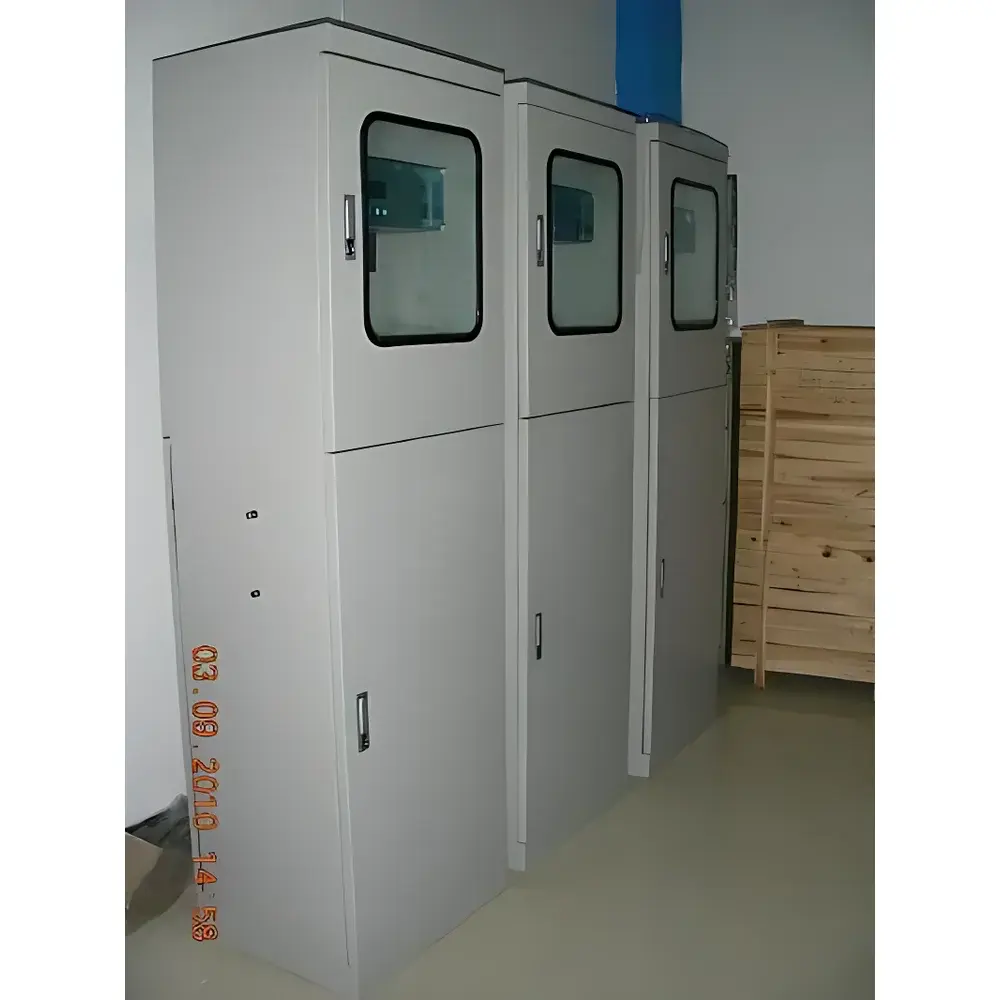
ADEV 7600R Online Calorific Value Analyzer for Coke Oven, Blast Furnace & Converter Gases
| Brand | ADEV |
|---|---|
| Model | 7600R |
| Origin | Beijing, China |
| Instrument Type | Continuous In-situ Gas Analysis System |
| Measurement Principle | Paramagnetic O₂ + Thermal Conductivity (H₂, CH₄, CO) + NDIR (CO₂) |
| Gas Matrix | Coke oven gas, blast furnace gas, converter gas, non-ferrous metallurgical gas |
| Sample Temperature Range | 20–800 °C |
| Dust Load Tolerance | ≤600 g/Nm³ |
| Pressure Range | −10 to +10 kPa |
| Response Time (T₉₀) | <15 s |
| Accuracy | ≤±1% FS |
| Dust Filtration Precision | ≤0.1 µm |
| Output Signals | 4–20 mA (isolated), relay alarms (220 VAC, 1 A), digital display |
| Cabinet Configuration | Integrated “turnkey” analyzer cabinet with pre-assembled sampling preprocessing, control, and analysis modules |
| Power Supply | 220 V AC ±10%, 50 Hz ±10% |
| Utility Requirement | Oil-free, dry nitrogen (0.4–0.6 MPa) |
| Maintenance Interval | >180 days (field-dependent) |
| Compliance | Designed for GLP/GMP-aligned operation |
Overview
The ADEV 7600R Online Calorific Value Analyzer is an industrial-grade, continuous in-situ gas analysis system engineered for real-time determination of higher heating value (HHV) and lower heating value (LHV) in coal-derived process gases—including coke oven gas (COG), blast furnace gas (BFG), basic oxygen furnace (BOF) gas, and non-ferrous metallurgical off-gases. Unlike laboratory-based calorimetry or empirical estimation methods, the 7600R calculates calorific value indirectly but with traceable metrological rigor by quantifying key combustible components—hydrogen (H₂), methane (CH₄), carbon monoxide (CO), and carbon dioxide (CO₂)—using a multi-sensor fusion architecture. The system employs thermal conductivity detection (TCD) for H₂ and CH₄, paramagnetic detection for O₂ (critical for combustion stoichiometry), and non-dispersive infrared (NDIR) for CO₂. All measurements are synchronized, temperature- and pressure-compensated, and mathematically combined via ASTM D1826–94 and ISO 6976–2016-compliant algorithms to deliver calibrated HHV (MJ/m³ at standard conditions) and LHV outputs. Its design addresses the fundamental challenge in metallurgical and coking plants: maintaining safe, efficient, and energy-optimized combustion processes where even minor deviations in gas composition directly impact furnace efficiency, refractory life, and emission compliance.
Key Features
- Robust dry-sampling architecture with electrically heated probe and stainless-steel/PTFE-wetted components, eliminating condensation-induced measurement drift and corrosion in high-humidity, high-acid-gas environments.
- Triple-stage particulate filtration (≤0.1 µm final precision), integrated sulfur/naphthalene/tar/acid mist removal, and active nitrogen-purged dew point suppression ensure long-term sensor integrity under dust loads up to 600 g/Nm³.
- PLC-based intelligent control unit enabling fully automated sample line and probe back-purge cycles, fault diagnostics, and self-calibration sequence management—reducing manual intervention and operator dependency.
- Turnkey cabinet-integrated design: all critical subsystems—including gas conditioning, analyzer modules, power distribution, and safety interlocks—are factory-assembled, functionally tested, and pre-calibrated prior to shipment.
- Real-time T₉₀ response <15 seconds from sample inlet to validated output, meeting dynamic process control requirements for BOF lance positioning, coke oven heating regulation, and BFG-to-boiler ratio optimization.
- Configurable alarm logic with programmable thresholds for individual gas species, calorific value deviation, and system health parameters—outputting isolated 4–20 mA signals and dry-contact relays (220 VAC, 1 A) compatible with plant-wide DCS and emergency shutdown systems.
Sample Compatibility & Compliance
The 7600R is validated for continuous operation in harsh process streams characterized by temperatures from 20 °C to 800 °C, pressures ranging from −10 kPa to +10 kPa (gauge), and aggressive contaminant profiles including hydrogen sulfide, ammonia, naphthalene, tar aerosols, and fine iron oxide particulates. Its dry-sample path eliminates water-phase interference—critical for accurate thermal conductivity measurement—and avoids catalytic poisoning of sensors. The system conforms to mechanical and electrical safety standards IEC 61000-6-2 (immunity) and IEC 61000-6-4 (emissions), and its functional architecture supports integration into quality management frameworks aligned with ISO 9001, ISO 14001, and OHSAS 18001. When deployed with time-stamped, user-access-controlled data logging and electronic signature capability, it satisfies documentation requirements under FDA 21 CFR Part 11 for regulated metallurgical QA/QC applications.
Software & Data Management
The embedded controller provides local HMI with large-format LCD display showing real-time H₂, CO, CH₄, CO₂, O₂ concentrations, computed HHV/LHV, and system status flags. All analog outputs (4–20 mA) are galvanically isolated and linearized per NIST-traceable calibration curves. Digital communication interfaces include RS-485 (Modbus RTU) for connection to third-party SCADA or DCS platforms. Optional firmware upgrades enable CSV export of historical trend logs (1-second resolution), configurable alarm event timestamps, and audit trail generation—including operator login, parameter modification, and calibration execution records. Data retention complies with internal QA protocols and supports retrospective analysis for energy balance reconciliation and environmental reporting (e.g., GHG Protocol Scope 1 fuel combustion inventories).
Applications
- Real-time calorific value monitoring for coke oven heating control—preventing underfiring (carbon deposition) or overfiring (refractory damage).
- Dynamic BOF gas recovery optimization: triggering hood descent/lift based on instantaneous CO concentration and energy content to maximize clean gas capture.
- Blast furnace top-gas recycling control: ensuring consistent energy input to hot stoves while avoiding explosive limits during mixing with auxiliary fuels.
- Non-ferrous smelting off-gas valorization: validating syngas suitability for on-site steam generation or chemical synthesis feedstock.
- Regulatory compliance tracking: generating auditable records for national energy efficiency standards (e.g., China’s GB 30252–2013) and carbon emission reporting frameworks.
- Process troubleshooting: correlating sudden shifts in H₂/CH₄ ratio with coke quality degradation or blast air humidity anomalies.
FAQ
What gas components does the 7600R measure directly, and how is calorific value calculated?
The system directly measures H₂, CH₄, CO, CO₂, and O₂ using TCD, NDIR, and paramagnetic sensors. Calorific value is computed in real time using standardized thermodynamic equations (ISO 6976) based on measured concentrations, temperature, and pressure—no empirical correlation or lab reference required.
Can the 7600R operate without external cooling water or refrigerated dryers?
Yes. It uses a fully dry, heated sample path with passive and active nitrogen-purged moisture removal—eliminating dependence on chilled water or compressor-based dryers that fail in high-ambient-temperature environments.
How often does the system require calibration, and what standards are used?
Factory calibration is performed with NIST-traceable certified gas mixtures. Field verification is recommended every 90 days; full recalibration interval exceeds 180 days under typical metallurgical duty cycles, supported by automated zero/span checks.
Is the 7600R suitable for multi-point sampling networks?
Yes. With optional multiplexer integration, it supports up to eight remote sampling points in a time-shared configuration, with programmable dwell times and cycle sequencing optimized for process dynamics and maintenance scheduling.
What level of cybersecurity hardening is implemented in the control unit?
The PLC firmware includes password-protected configuration access, disabled default accounts, and configurable network port lockdown—meeting baseline requirements for OT environments per IEC 62443-3-3 SL1. Full TLS/SSL encryption requires upstream gateway integration.







