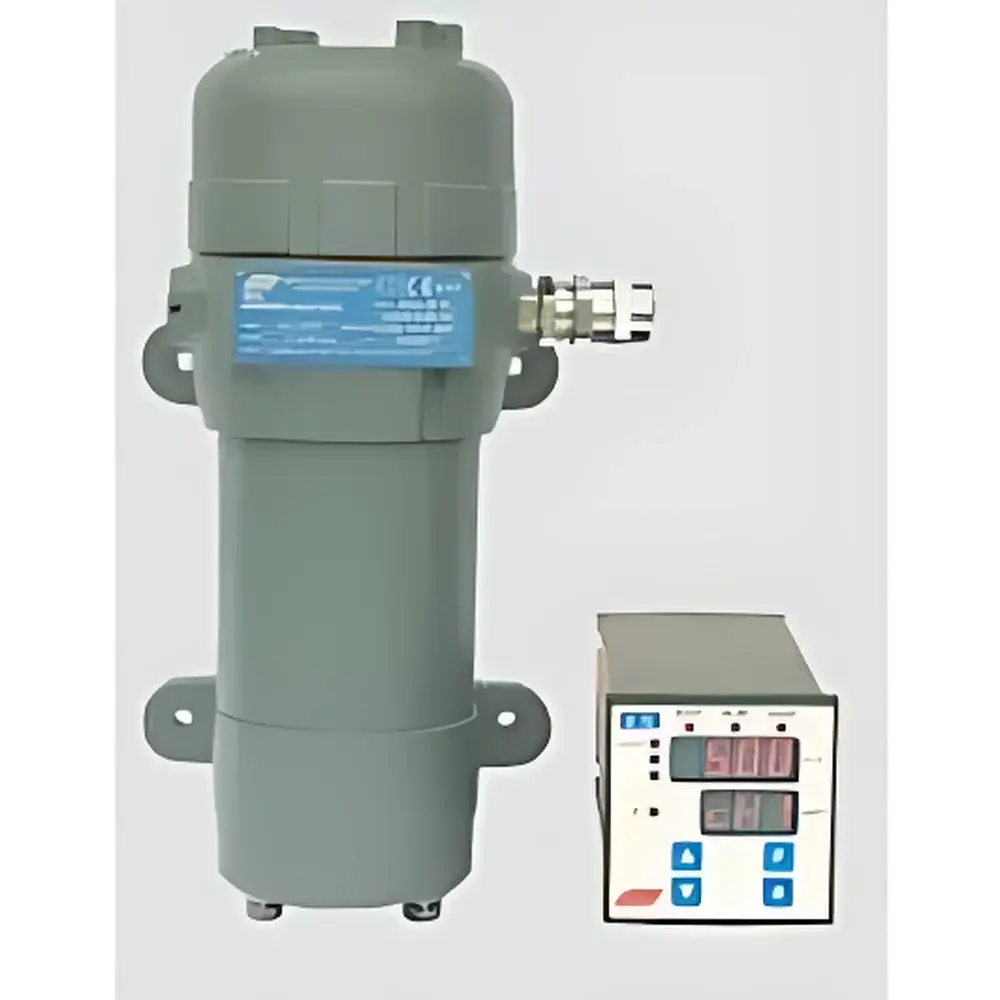
ADEV 8864 Explosion-Proof Zirconia Oxygen Analyzer
| Brand | ADEV |
|---|---|
| Origin | Italy |
| Model | 8864 |
| Measurement Principle | Electrochemical Zirconia Oxidation Potential |
| Sensor Type | Built-in Heated Zirconia Cell |
| Range Options | 0–100 ppm / 0–1000 ppm / 0–1% / 0–2% / 0–5% / 0–10% / 0–25% / 50–100% / 80–100% / 90–100% / 95–100% / 98–100% |
| Display | 0.75″ (19.05 mm) High-Brightness LCD |
| Accuracy | ±1% FS |
| Response Time (T90) | <15 s |
| Warm-up Time | ~2 min |
| Operating Temperature | 5–45 °C |
| Output Signals | RS-232, 4–20 mA (500 Ω load), 0–10 VDC (also configurable as 0–1 VDC or 0–5 VDC) |
| Alarm Outputs | 2 SPDT relays, programmable for high/low limit |
| Sample Flow Rate | 250–1000 mL/min |
| Sample Connection | 1/4″ or 6 mm compression fitting |
| Power Supply (Transmitter) | 115/230 VAC, 50/60 Hz, 50 VA |
| Power Supply (Display Controller) | 115/230 VAC, 50/60 Hz |
| Enclosure Rating | II GD EEx-d IIC T6 IP65 |
| Max Surface Temperature | ≤85 °C |
| Weight (Explosion-Proof Version) | 8.5 kg |
| Warranty | 1 year |
Overview
The ADEV 8864 Explosion-Proof Zirconia Oxygen Analyzer is a field-deployable, intrinsically robust process analyzer engineered for continuous, real-time oxygen concentration measurement in hazardous industrial environments. It operates on the principle of high-temperature electrochemical oxygen partial pressure sensing using a stabilized zirconium dioxide (ZrO₂) solid electrolyte cell. When heated to approximately 700 °C, the zirconia element becomes conductive to oxygen ions; the resulting electromotive force (EMF) across the cell—generated by the difference in oxygen partial pressure between the reference air and the process sample—is directly proportional to the logarithm of the O₂ concentration. This Nernst-based measurement delivers high reproducibility, minimal drift, and stable calibration over extended operational cycles. Designed specifically for Zone 1 and Zone 2 classified areas per IEC 60079-0 and ATEX 2014/34/EU directives, the 8864 integrates both sensor and transmitter within a single certified explosion-proof housing (II GD EEx-d IIC T6), eliminating external junction boxes and reducing installation complexity.
Key Features
- Integrated explosion-proof enclosure rated II GD EEx-d IIC T6 IP65—certified for use in flammable gas atmospheres including methane, hydrogen, and ethylene groups
- Fast thermal stabilization: full operational readiness achieved within ≈2 minutes due to optimized heater control and low thermal mass sensor design
- Multi-range capability: user-selectable measurement spans from trace-level (0–100 ppm) to high-concentration (98–100 % vol) applications without hardware modification
- High-brightness 0.75″ LCD display with dual-color LED status indicators (green = normal operation / yellow = fault condition) and dedicated alarm LEDs for relay outputs
- Sub-15-second T90 response time enables dynamic monitoring of rapid oxygen transients—critical for purge verification, inerting validation, and safety interlock support
- Wide sample flow tolerance (250–1000 mL/min) accommodates diverse extraction systems and bypass configurations without requiring precision flow controllers
- Flexible analog and digital output architecture: isolated 4–20 mA (500 Ω max load), 0–10 VDC (configurable to 0–1 VDC or 0–5 VDC), and RS-232 serial interface for integration into DCS, PLC, or SCADA platforms
Sample Compatibility & Compliance
The ADEV 8864 is compatible with non-corrosive, dry, and particulate-free process gases—including natural gas, nitrogen, argon, helium, synthetic air, and mixed industrial gases. Condensable vapors, halogenated compounds, sulfur species, and heavy hydrocarbons must be removed upstream via appropriate filtration and conditioning (e.g., coalescing filters, refrigerated dryers, or catalytic scrubbers) to ensure sensor longevity and measurement fidelity. The analyzer complies with international standards for hazardous area instrumentation, including IEC 60079-1 (flameproof enclosure), IEC 60079-0 (general requirements), and EN 61326-1 (EMC for industrial environments). It supports documentation traceability required under ISO 9001 and quality system alignment with GMP-relevant process validation protocols where oxygen purity is a critical quality attribute (CQA).
Software & Data Management
While the 8864 operates as a stand-alone instrument with local display and relay logic, its RS-232 interface enables bidirectional communication with host supervisory systems for remote configuration, real-time data logging, and event-triggered diagnostics. All parameter settings—including range selection, alarm thresholds, damping coefficients, and zero/span calibration dates—are stored in non-volatile memory. The unit maintains an internal audit trail of operational events (e.g., power cycles, alarm activations, calibration actions), supporting basic GLP-compliant recordkeeping. For enterprise-level integration, Modbus RTU protocol conversion is achievable via third-party gateways, facilitating compatibility with systems adhering to ISA-88/ISA-95 frameworks.
Applications
- Natural gas processing: real-time O₂ purity verification downstream of membrane or PSA nitrogen generators to prevent pipeline corrosion and ensure specification compliance (e.g., ASTM D1945, ISO 8573-1 Class 2)
- Inert gas blanketing: continuous monitoring during tank purging, reactor sparging, or powder conveying to maintain sub-100 ppm O₂ thresholds
- Controlled atmosphere heat treatment: closed-loop feedback for furnace atmosphere management in annealing, brazing, and sintering processes
- Medical gas production: verification of oxygen concentration in bulk O₂ delivery lines and nitrogen-oxygen blending stations
- Chemical synthesis reactors: detection of air ingress during vacuum or inert-gas pressurization sequences
- Biogas upgrading facilities: monitoring residual oxygen prior to membrane separation or amine scrubbing units
FAQ
Is the ADEV 8864 certified for use in Zone 1 hazardous locations?
Yes—the instrument carries ATEX and IECEx certification for Group II, Category 1G (EEx-d IIC T6), permitting installation in Zone 1 gas-hazardous areas where explosive atmospheres are likely to occur periodically.
Can the analyzer measure oxygen in wet or corrosive gas streams?
No. The zirconia sensor requires clean, dry, non-acidic sample gas. Moisture condensation or acidic components (e.g., HCl, SO₂, NOₓ) will accelerate electrode degradation and cause irreversible calibration drift. Sample conditioning is mandatory.
What maintenance intervals are recommended for long-term reliability?
Annual verification of zero/span accuracy and visual inspection of the sampling filter and inlet fitting are recommended. Under typical industrial conditions, the zirconia sensor exhibits service life exceeding 24 months when operated within specified temperature and contaminant limits.
Does the device support digital communication for integration into Industry 4.0 architectures?
It provides RS-232 serial output as standard; Modbus TCP or OPC UA integration requires an external protocol converter. No embedded web server or Ethernet port is included.
How is calibration performed, and is it traceable to national standards?
Calibration uses certified span gas (e.g., NIST-traceable O₂ in N₂) and ambient air for zero. The instrument stores calibration date, gas concentration, and operator ID—enabling traceability in accordance with ISO/IEC 17025 documentation practices.