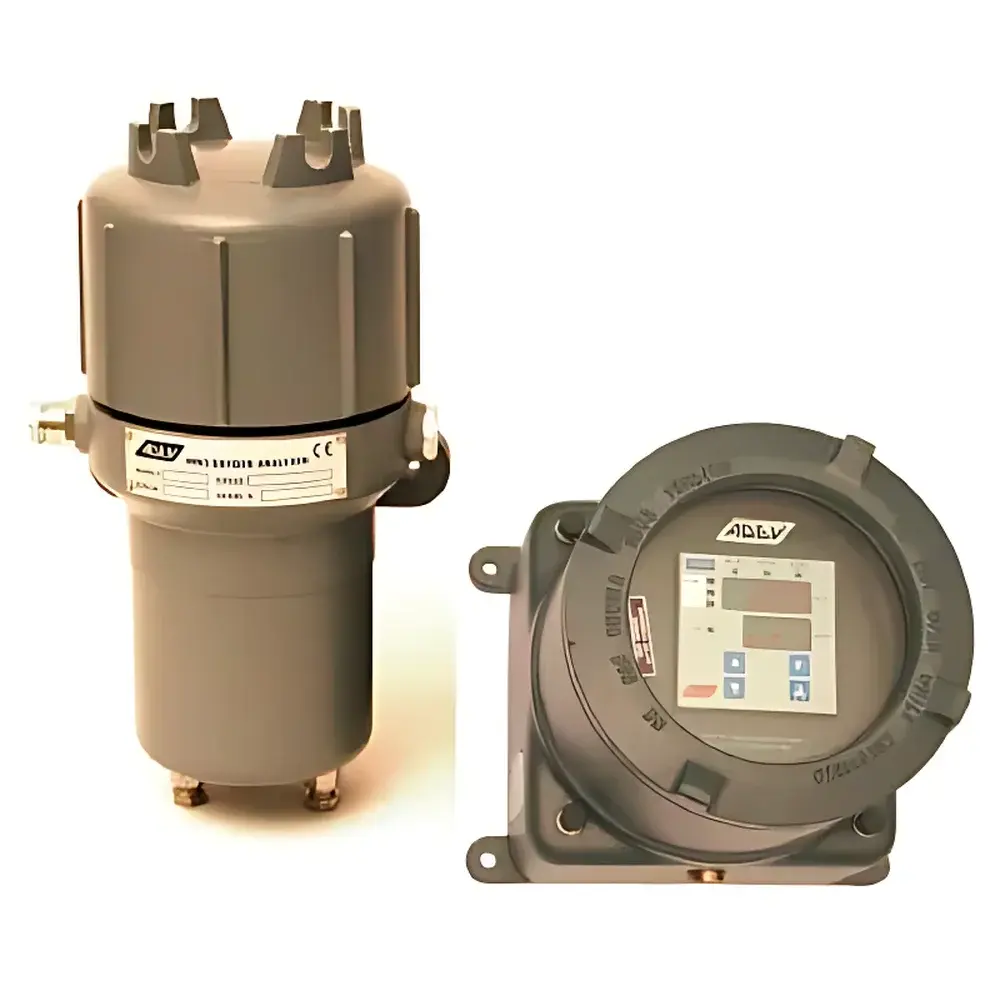
ADEV 8867 Zirconia Oxygen Analyzer
| Brand | ADEV |
|---|---|
| Origin | United Kingdom |
| Model | 8867 |
| Detection Principle | High-Temperature Electrochemical Zirconia Cell |
| Measurement Range | 0.1 ppm to 100% O₂ (auto-ranging) |
| Display | 6-digit LCD, 12.7 mm character height |
| Resolution | 0.01 ppm (0–4.99 ppm), 0.1 ppm (5–49.9 ppm), 1 ppm (50–499 ppm), 10 ppm (500–4999 ppm), 0.01% (10–100%) |
| Accuracy | ±0.2 ppm (0.1–9.9 ppm), ±1 ppm (10–99 ppm), ±2% of reading (100 ppm–100% O₂) |
| Stability | Better than ±2% of reading or ±0.5 ppm/month (whichever is greater) |
| Response Time (t₉₀) | <0.5 s (step from air to inert), <5 s (100 ppm → 10 ppm), <30 s (<100 ppm) |
| Sample Flow Rate | 100–300 mL/min (optimal) |
| Sample Inlet Pressure | 10 mbar (min) to 8 bar (max), un-pumped |
| Sample Temperature at Analyzer | ≤100 °C |
| Housing | 19″ rack-mount, 3U height (133 mm), depth 270 mm |
| Power Supply | 110/120 V or 220/240 V, 50/60 Hz, ≤80 VA |
| Ambient Operating Temperature | ≤45 °C |
| Analog Output | Standard 0–5 V DC |
| Alarm Outputs | 2 independent SPDT relays (48 V AC/DC, 0.5 A, normally closed) |
| Sample System Materials | Nickel, brass, aluminum, stainless steel (316), platinum, zirconia, PTFE, nitrile rubber |
| Sample Connection | Compression ferrule fitting for 6 mm (¼″) OD tubing |
Overview
The ADEV 8867 Zirconia Oxygen Analyzer is a high-stability, electrochemical process analyzer engineered for continuous, real-time measurement of oxygen concentration in clean, dry, non-corrosive gas streams across an exceptionally wide dynamic range—from trace levels of 0.1 ppm up to 100% volume oxygen. At its core lies a high-temperature, thimble-type yttria-stabilized zirconia (YSZ) sensor operating at approximately 700 °C, enabling Nernst potential-based quantification of O₂ partial pressure with minimal cross-sensitivity to CO₂, CO, H₂, CH₄, and other common background gases. Unlike paramagnetic or optical methods, the zirconia cell provides inherent selectivity for molecular oxygen without requiring optical alignment, consumable filters, or frequent calibration drift correction—making it especially suitable for long-term unattended operation in controlled atmospheres, inert gas blanketing systems, glove boxes, semiconductor purge lines, and high-purity nitrogen generation monitoring.
Key Features
- True auto-ranging 6-digit LCD display with 12.7 mm character height—supports simultaneous readout of measured O₂ concentration and configuration parameters during setup mode
- Patented dual-heater zirconia cell architecture delivering rapid thermal stabilization (<60 s warm-up), extended sensor lifetime (>24 months typical in clean service), and consistent low-concentration response fidelity
- Two independently configurable alarm channels with programmable setpoints, hysteresis, and time-delayed activation (0–10 s)—each equipped with fail-safe SPDT relay contacts rated for 48 V AC/DC and 0.5 A
- User-selectable analog output (standard 0–5 V DC; optional 4–20 mA) mapped to any of seven factory-defined spans: 0–5 ppm, 0–50 ppm, 0–500 ppm, 0–5000 ppm, 0–5%, 0–25%, or 0–100% O₂
- Rack-mount 19″ 3U chassis (133 mm H × 483 mm W × 270 mm D) with front-panel accessible calibration and configuration interface—designed for integration into centralized control cabinets or standalone panel installations
- Sample interface compliant with ISO 8573-1 Class 2 particulate and dew point requirements when paired with appropriate pre-conditioning accessories
Sample Compatibility & Compliance
The 8867 is validated for use with chemically stable, non-condensing sample gases—including N₂, Ar, He, H₂, CO₂, and synthetic air—provided total hydrocarbon content remains below 10 ppm C₁ equivalent and no halogenated compounds, sulfur species, or silicones are present. Sample inlet pressure must be maintained between 10 mbar (absolute) and 8 bar (gauge); inlet temperature must not exceed 100 °C at the analyzer’s rear-panel fitting. All wetted materials—including sampling valves, flow restrictors, and internal sensor housings—are constructed from inert, low-outgassing alloys and polymers: 316 stainless steel, nickel, platinum, zirconia, PTFE, and nitrile rubber. The instrument complies with CE marking directives (EMC 2014/30/EU, LVD 2014/35/EU), meets IEC 61000-6-2/6-4 immunity/emission standards, and supports documentation traceability aligned with ISO/IEC 17025 and ASTM D3176-22 for oxygen purity verification protocols.
Software & Data Management
While the 8867 operates as a fully self-contained hardware analyzer without embedded firmware updates or PC connectivity, its analog output and relay interfaces are designed for seamless integration into distributed control systems (DCS), programmable logic controllers (PLCs), and SCADA architectures. The 0–5 V or 4–20 mA signal is linear across the selected span and referenced to earth ground, supporting direct connection to data acquisition modules compliant with IEEE 11073 or Modbus RTU via external signal conditioners. For regulated environments, the device supports GLP/GMP audit trails when used in conjunction with third-party historian software that logs timestamped analog inputs and relay state changes—fully compatible with FDA 21 CFR Part 11 requirements when deployed with validated electronic record systems.
Applications
- Monitoring residual oxygen in high-purity nitrogen or argon supply lines for semiconductor wafer fabrication and thin-film deposition processes
- Leak detection and integrity verification in vacuum furnaces, inert atmosphere gloveboxes, and pharmaceutical lyophilization chambers
- Quality assurance of modified-atmosphere packaging (MAP) headspace gases in food processing facilities
- Control of deoxygenation efficiency in boiler feedwater treatment and power plant condensate polishing loops
- Verification of oxygen scavenging performance in catalyst regeneration and hydrogenation reactor purge cycles
- Calibration reference standard for field-portable electrochemical O₂ sensors in environmental emission monitoring stations
FAQ
What is the minimum detectable oxygen level, and how is resolution maintained across such a wide range?
The analyzer achieves 0.01 ppm resolution in the 0–4.99 ppm sub-range through adaptive gain switching and digital oversampling of the Nernst voltage signal—enabling precise differentiation of ultra-low concentrations without manual range selection.
Can the 8867 be used with wet or corrosive sample streams?
No. It requires clean, dry, non-acidic, non-oxidizing gas. Optional sample conditioning systems—including refrigerated dryers, particulate filters, and catalytic hydrocarbon scrubbers—are available from Hitech Instruments to extend compatibility to industrial off-gas applications.
Is sensor replacement a field-serviceable procedure?
Yes. The zirconia cell module is designed as a plug-in cartridge with standardized electrical and pneumatic interfaces—replacement can be completed in under 15 minutes using basic hand tools and does not require recalibration if performed per ADEV’s documented procedure.
Does the unit support remote diagnostics or digital communication protocols?
The base model features analog and relay I/O only. For Modbus TCP or HART integration, ADEV offers the 8867-D variant with optional digital interface board—contact technical support for configuration guidance and firmware version compatibility.
How frequently should calibration be performed in routine operation?
Under stable conditions with certified zero and span gases (e.g., N₂ balance + 100 ppm O₂ in N₂), quarterly verification is recommended. Drift compensation may be applied via front-panel offset adjustment if deviation exceeds ±0.5 ppm in the 0–10 ppm range or ±1% in higher ranges.
Related Products