
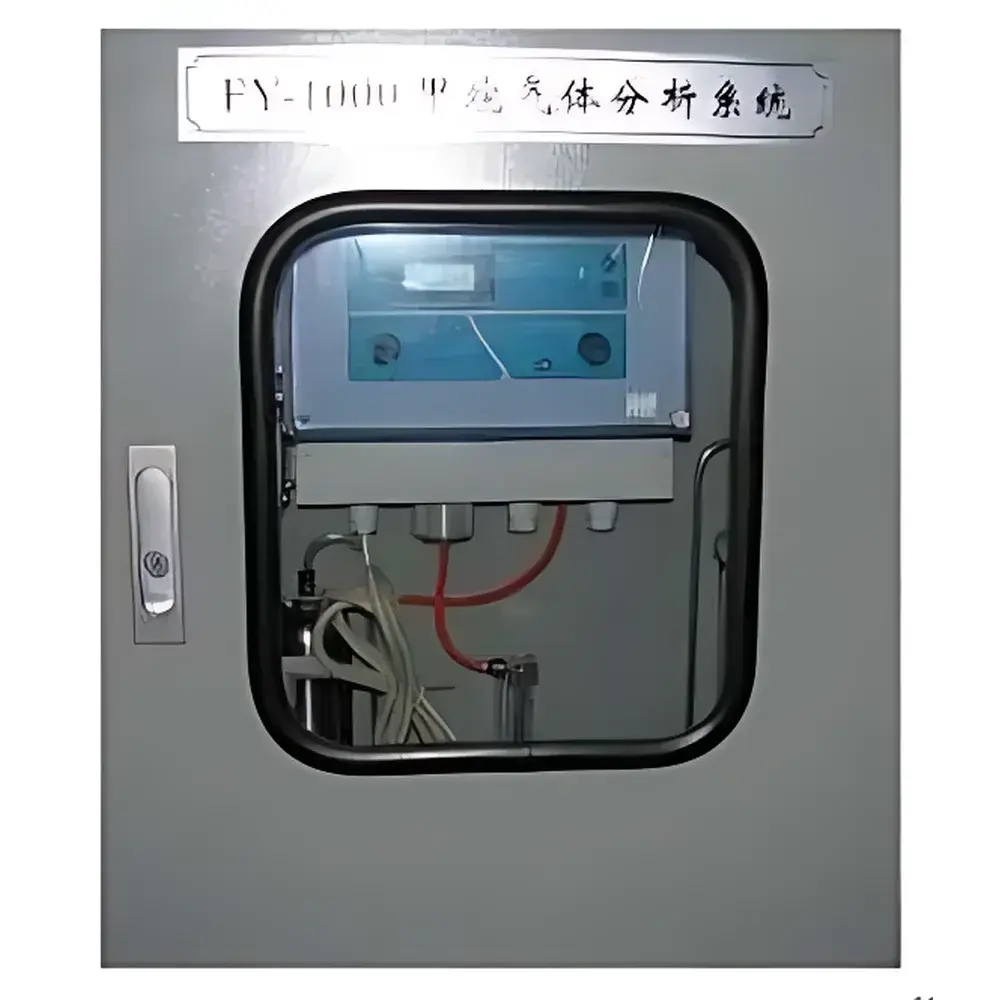
ADEV FY-1000 Multi-Gas Online Monitoring and Control System for Biogas, Landfill Gas, and Coal Mine Methane
| Brand | ADEV |
|---|---|
| Origin | Beijing, China |
| Model | FY-1000 |
| Instrument Type | Fixed-mount online analyzer |
| Detection Targets | O₂, CH₄, CO, CO₂, H₂S, H₂, SO₂, NO, NO₂, N₂, HCs, BrCH₃, SO₂F₂, Ar, He, NH₃, SF₆ |
| Measurement Range | 0.1 ppm to 100% vol (configurable per gas) |
| Repeatability | ±1% FS |
| Resolution | 0.1 ppm |
| Response Time (T₉₀) | ≤30 s (varies by sensor type) |
| Zero Drift | ±2% FS / month |
| Span Drift | ±1% FS / month |
| Linearity Error | ±2% FS |
| Output | 4–20 mA analog, digital display, relay outputs (alarm & fault), remote sampling capable |
| Power Supply | 110/220/240 V AC, 50/60 Hz |
| Power Consumption | 13 W typical |
| Enclosure Rating | IP54 |
| Operating Temperature | 0–40 °C |
| Weight | 2.7 kg |
Overview
The ADEV FY-1000 is a fixed-installation, multi-parameter gas analysis and control system engineered for continuous, real-time monitoring of complex gas matrices in demanding industrial and environmental applications. Designed specifically for biogas upgrading, landfill gas recovery, coal mine ventilation (firedamp), and anaerobic digestion process control, the system integrates multiple detection technologies—including electrochemical (EC), non-dispersive infrared (NDIR), thermal conductivity (TCD), and photoionization (PID)—within a single, compact chassis. Its architecture follows the principles of modular sensor redundancy and cross-interference compensation, enabling simultaneous quantification of up to 18 gases across concentration ranges spanning sub-ppm trace levels to 100% volume. The FY-1000 operates on a dual-wavelength NDIR platform for CH₄ and CO₂, delivering long-term baseline stability and minimizing drift from humidity or pressure fluctuations—critical for unattended operation in remote or harsh field environments.
Key Features
- Multi-sensor fusion platform supporting configurable gas combinations: O₂ (EC/paramagnetic), CH₄ (dual-wavelength NDIR), CO (EC or NDIR), CO₂ (NDIR), H₂S (EC), H₂ (TCD/EC), SO₂/NO/NO₂ (EC or NDIR), NH₃ (EC), SF₆ (TCD/NDIR), hydrocarbons (HC), BrCH₃ (PID), SO₂F₂ (NDIR), Ar/He (TCD), and N₂ (calculated or direct EC).
- Field-configurable measurement ranges: Users select span points per channel—from 0–100 ppm for toxicants like H₂S or NH₃, to 0–100% vol for CH₄ or O₂—without hardware modification.
- High-integrity signal conditioning: All analog outputs (4–20 mA) comply with IEC 61000-4 immunity standards; relay outputs support fail-safe shutdown logic per EN 61511 (SIL 2-capable when integrated into safety instrumented systems).
- Robust mechanical design: IP54-rated enclosure ensures protection against dust ingress and water splashing; operating temperature range (0–40 °C) supports deployment in outdoor shelters, gas engine rooms, and leachate pump stations.
- Integrated diagnostics: Real-time sensor health monitoring, automatic zero/span verification prompts, and event-logged fault codes facilitate predictive maintenance and reduce unscheduled downtime.
Sample Compatibility & Compliance
The FY-1000 is validated for use with humid, particulate-laden, and mildly corrosive gas streams typical of landfill gas (LFG), biogas from digesters, and coal seam gas extraction. Sample conditioning—via optional heated sample line (up to 180 °C), particulate filter (0.3 µm), and moisture trap—is recommended for high-dew-point applications. The system conforms to key international regulatory frameworks: its measurement uncertainty profiles align with ISO 14040/14044 (LCA boundary definitions for biogas projects), and its data integrity features—including time-stamped audit trails and write-protected configuration logs—support GLP-compliant reporting under EPA Method 25A and EU Directive 1999/32/EC. While not intrinsically safe certified, it may be installed in Zone 2 hazardous areas when housed in an approved purge cabinet meeting IEC 60079-2 requirements.
Software & Data Management
The embedded firmware provides local configuration via backlit LCD interface and tactile keypad. For centralized oversight, the FY-1000 supports Modbus RTU (RS-485) and optional Ethernet (Modbus TCP) communication protocols, enabling seamless integration into SCADA, DCS, or cloud-based EMS platforms (e.g., Siemens Desigo, Honeywell Experion, or custom MQTT brokers). Data logging occurs at user-defined intervals (1 s to 1 h) with internal storage capacity for ≥30 days of 1-min averaged values. All exported datasets include ISO 8601 timestamps, sensor-specific calibration IDs, and status flags (e.g., “sensor warming”, “zero drift alert”). Audit trail functionality records every parameter change, user login, and relay activation—meeting documentation requirements under FDA 21 CFR Part 11 when deployed in regulated biogas-to-grid injection facilities.
Applications
- Biogas Upgrading Plants: Real-time CH₄/CO₂ ratio monitoring for membrane or PSA system optimization; O₂ ingress detection to prevent explosion risk during compression.
- Landfill Gas Collection Systems: Continuous tracking of CH₄ oxidation efficiency in biofilters; H₂S and siloxane surrogate monitoring for downstream equipment protection.
- Coal Mine Ventilation Networks: Firedamp (CH₄) concentration surveillance in return airways; O₂ depletion alerts in sealed areas per MSHA 30 CFR Part 75.
- Wastewater Treatment Digesters: Process control of anaerobic reactors via volatile fatty acid (VFA) proxy metrics derived from CO₂/CH₄ flux ratios.
- Food & Beverage Fermentation: CO₂ accumulation monitoring in enclosed fermentation tanks; O₂ leak detection in modified-atmosphere packaging lines.
- Environmental Compliance Reporting: Automated generation of EPA GHGRP Subpart MM or EU ETS Annex IV reports through standardized CSV/Excel exports.
FAQ
What gas detection technologies are used in the FY-1000, and how are interferences mitigated?
The system combines electrochemical (EC), non-dispersive infrared (NDIR), thermal conductivity (TCD), and photoionization (PID) sensors. Cross-sensitivity is minimized through hardware-level optical filtering (for NDIR), catalytic bead compensation (for H₂ in CH₄ channels), and firmware-based interference correction algorithms trained on ASTM D6728 reference mixtures.
Can the FY-1000 be integrated into existing plant automation systems?
Yes—it supports Modbus RTU over RS-485 as standard, with optional Modbus TCP/Ethernet and 4–20 mA analog outputs compatible with most PLCs and DCS platforms. Configuration files can be imported/exported via USB for batch commissioning.
Is calibration required onsite, and what is the recommended frequency?
Initial two-point calibration (zero and span) is performed using certified gas standards before commissioning. For continuous operation in stable environments, quarterly span checks are recommended; in high-humidity or variable-pressure settings (e.g., landfill wellheads), monthly verification is advised.
Does the system meet any emissions monitoring standards (e.g., EPA or EN)?
While the FY-1000 itself is not EPA-certified as a CEMS, its measurement performance meets the accuracy and response time criteria outlined in EPA Method 25A for CH₄ and CO₂, and EN 14181 for QA/QC procedures when used with appropriate sample conditioning and validation protocols.
What maintenance is required beyond sensor replacement?
Routine tasks include quarterly inspection of inlet filters, annual verification of relay contact resistance, and biannual cleaning of optical windows (for NDIR modules). Sensor lifetimes range from 24 months (EC) to 60 months (NDIR), documented in the onboard service log.







