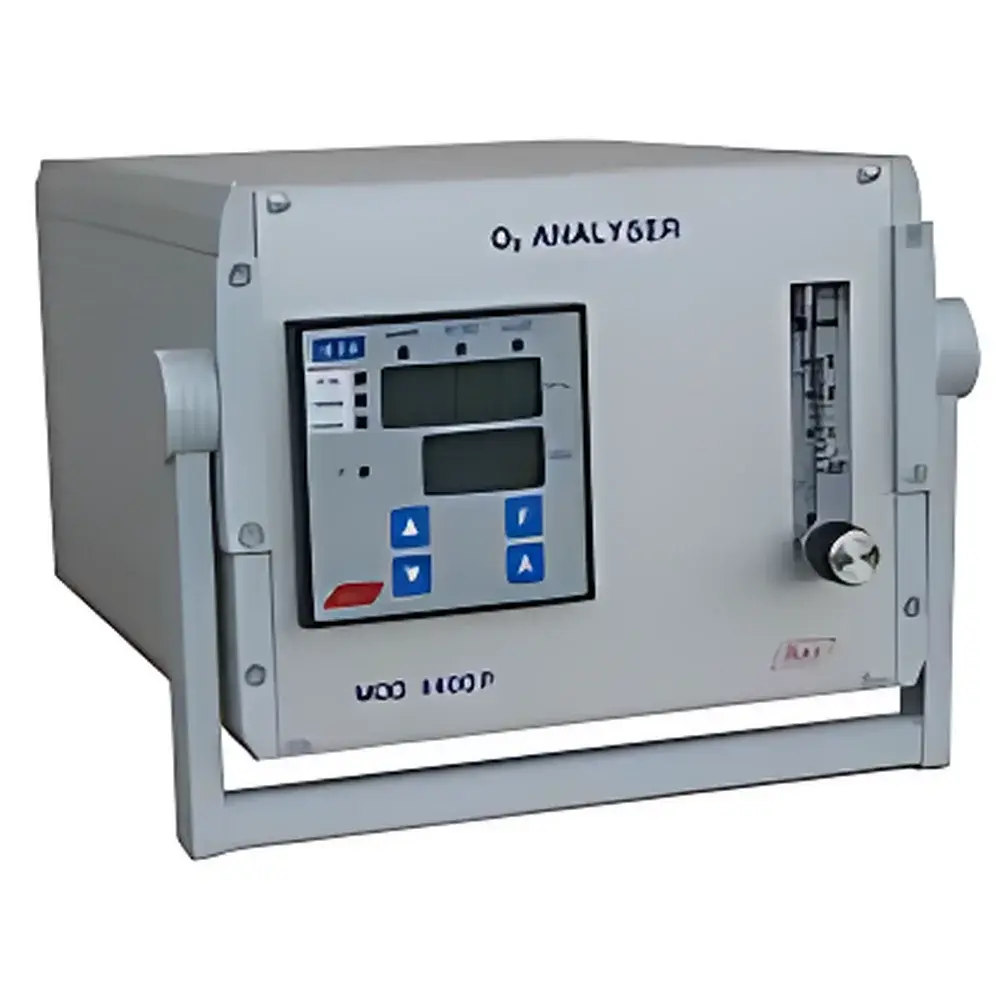
ADEV G405 Portable Zirconia Oxygen Analyzer
| Brand | ADEV |
|---|---|
| Origin | United Kingdom |
| Model | G405 |
| Display | Multi-digit LCD (character height 12.7 mm) |
| Measurement Range | 0.1 ppm – 100% O₂ (auto-ranging) |
| Resolution | 0.1% (10–100%), 0.01% (0.5–9.99%), 10 ppm (500–4999 ppm), 1 ppm (50–499 ppm), 0.1 ppm (0.00–49.9 ppm) |
| Accuracy | ±2% of reading (10–100 ppm), ±1 ppm (9.9–99 ppm), ±0.2 ppm (0.1–9.9 ppm) |
| Stability | Better than 2% of reading or 0.5 ppm/month (whichever is greater) |
| Response Time | ≤0.5 s (90% step, %-level) |
| Sample Flow Rate | 100–250 mL/min (optimal) |
| Sample Pressure (inlet) | Up to 6 bar |
| Sample Temperature (at analyzer) | ≤100 °C |
| Ambient Operating Temperature | ≤45 °C |
| Enclosure Rating | IP67 |
| Power Input | Switchable 110/120 V or 220/240 V, 50/60 Hz, max. 100 VA |
| Analog Outputs | Standard 0–5 V, optional 4–20 mA (user-programmable across 0–100% or 0–5 ppm) |
| Alarm Outputs | Two independent relay channels (programmable high/low/off with time delay and fail-safe dry contacts) |
| Sampling System Materials | Nickel, copper, aluminum, stainless steel, platinum, zirconia, alumina, PTFE, nitrile rubber |
| Sample Connection | Compression fitting for 6 mm (0.25″) OD tubing |
Overview
The ADEV G405 Portable Zirconia Oxygen Analyzer is an engineered solution for precise, field-deployable oxygen measurement in inert and non-reactive gas matrices. It employs a high-stability, heated zirconium dioxide (ZrO₂) electrochemical sensor operating on the principle of oxygen partial pressure-driven ion conduction across a stabilized ceramic electrolyte. This Nernst-based detection method delivers inherently stable, drift-resistant performance over extended periods—critical for applications where calibration intervals must be maximized and measurement integrity maintained under variable ambient conditions. Designed specifically for industrial process verification, blanking gas purity validation, glovebox monitoring, and inert atmosphere qualification, the G405 bridges laboratory-grade accuracy with true portability. Its rugged IP67-rated carry case, integrated sample flow regulation, and dual-voltage AC power selection enable reliable operation in plant floors, cleanrooms, R&D labs, and remote field sites without external infrastructure dependency.
Key Features
- Heated zirconia sensor with temperature-controlled reference air channel, ensuring consistent Nernst potential generation across wide ambient temperature ranges (up to 45 °C).
- Auto-ranging multi-digit LCD display (12.7 mm character height) with real-time concentration readout, programmable alarm thresholds, and analog output configuration.
- Dual independent relay alarm outputs—each configurable as high, low, or disabled—with user-defined time delay and mechanical dry-contact switching for integration into PLCs or safety interlocks.
- Onboard sample flow monitoring and adjustment; includes integral sampling pump for low-pressure source applications (e.g., vacuum lines or low-flow purge streams).
- Flexible analog output options: standard 0–5 V or optional 4–20 mA, both fully programmable across user-defined spans—including narrow ranges such as 0–5 ppm for ultra-trace applications.
- Robust wetted materials set compliant with high-purity gas handling requirements: 316 stainless steel, PTFE, alumina, platinum electrodes, and zirconia sensing element—minimizing catalytic interference and surface adsorption artifacts.
- Front-panel voltage selector (110/120 V or 220/240 V, 50/60 Hz) and <100 VA power draw ensure global deployment readiness without external transformers or converters.
Sample Compatibility & Compliance
The G405 is validated for use with chemically inert carrier gases including nitrogen, argon, helium, and carbon dioxide—where oxygen represents a contaminant rather than a reactive component. It is not intended for use in oxidizing, corrosive, or condensable gas streams (e.g., wet air, chlorine, or hydrocarbon-rich mixtures) without appropriate pre-treatment. The instrument complies with IEC 60529 (IP67 ingress protection), EN 61000-6-3 (EMC emission limits), and EN 61000-6-2 (immunity). While not certified for hazardous area use (ATEX/IECEx), its design supports integration into Class 1 Div 2 or Zone 2 environments when installed per local electrical codes. All internal signal conditioning and relay logic meet GLP/GMP-relevant traceability expectations, supporting audit-ready documentation of alarm events and analog output scaling parameters.
Software & Data Management
The G405 operates as a standalone, microprocessor-controlled analyzer with no embedded firmware update capability or PC connectivity. All configuration—including alarm setpoints, analog output scaling, and relay behavior—is performed via front-panel membrane keypad with immediate LCD confirmation. Critical operational parameters (e.g., zero/span history, alarm activation logs, and last calibration date) are retained in non-volatile memory. For regulatory environments requiring electronic record retention (e.g., FDA 21 CFR Part 11), external data loggers may interface with the 0–5 V or 4–20 mA outputs using timestamped acquisition systems compliant with ALCOA+ principles. No proprietary software or drivers are required.
Applications
- Verification of inert gas purity prior to semiconductor wafer processing or metal heat treatment.
- Monitoring residual oxygen in nitrogen-blanketed storage tanks, reactors, and packaging lines.
- Quality assurance of high-purity specialty gases supplied to analytical laboratories (e.g., LC-MS carrier gas lines).
- Leak detection support in sealed enclosures (gloveboxes, dry rooms) through trending of baseline O₂ drift.
- Field validation of cryogenic liquid phase oxygen content during LNG or liquid nitrogen transfer operations.
- Calibration transfer between fixed online analyzers and portable reference standards in multi-point process audits.
FAQ
Is the G405 suitable for measuring oxygen in flue gas or combustion exhaust?
No. The zirconia sensor requires inert or reducing backgrounds; exposure to CO, NOₓ, SO₂, or water vapor above dew point will cause irreversible electrode poisoning and calibration drift.
Can the instrument be used continuously in battery-powered mode?
The G405 does not include an internal battery; it requires continuous AC mains power. Portable operation relies on connection to site power or a compatible external UPS/inverter system.
What maintenance is required beyond periodic calibration?
Annual verification of sensor electromotive force (EMF) stability and zero response in certified zero gas (e.g., 99.999% N₂) is recommended. Filter replacement in the sampling train should occur based on particulate load—not on fixed intervals.
Does the analyzer support automatic temperature compensation for sample gas?
Yes. Internal thermistor feedback maintains optimal sensor heater setpoint regardless of ambient fluctuations; however, sample gas temperature must remain below 100 °C at the inlet to prevent thermal shock to the zirconia cell.
How is trace-level accuracy verified below 10 ppm?
Certified calibration gases traceable to NIST or UKAS standards—such as 5 ppm O₂ in N₂—are required. Verification must be performed in a laminar-flow test bench with controlled flow (150 ±10 mL/min) and zero-gas purging between points to eliminate memory effects.