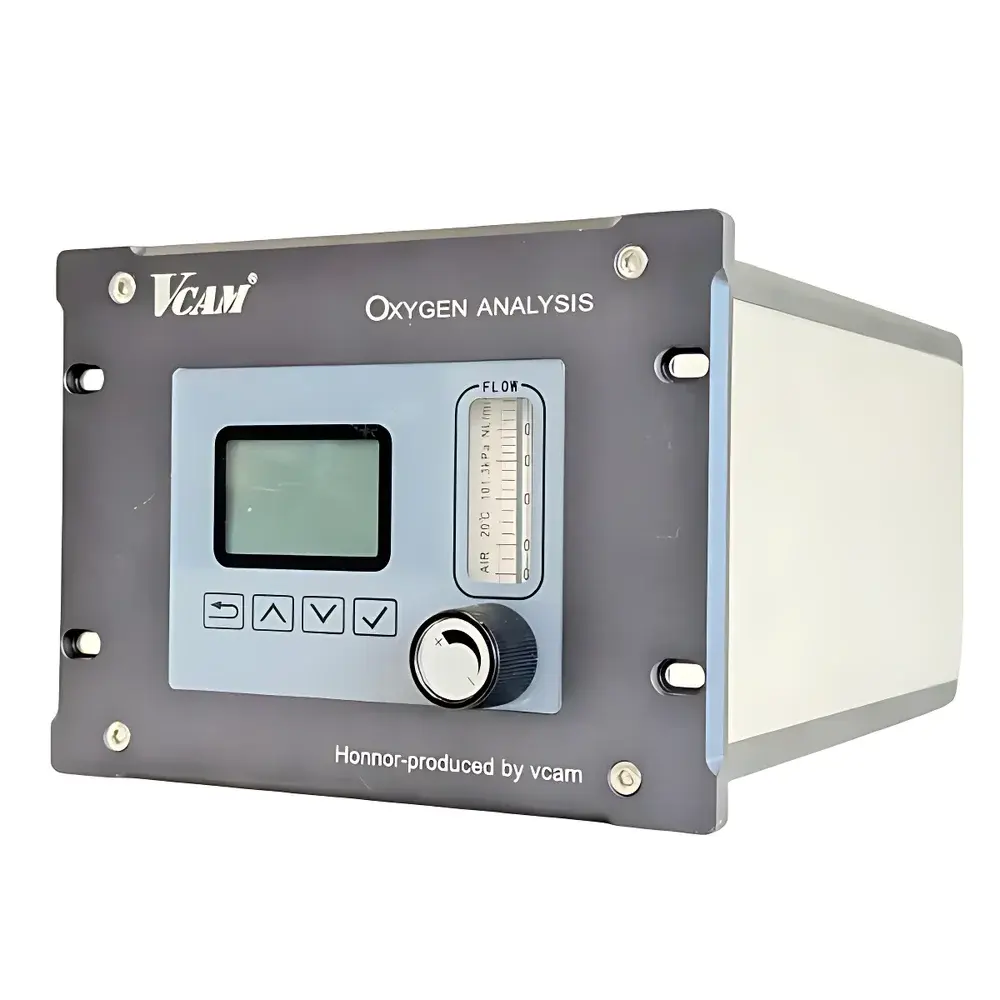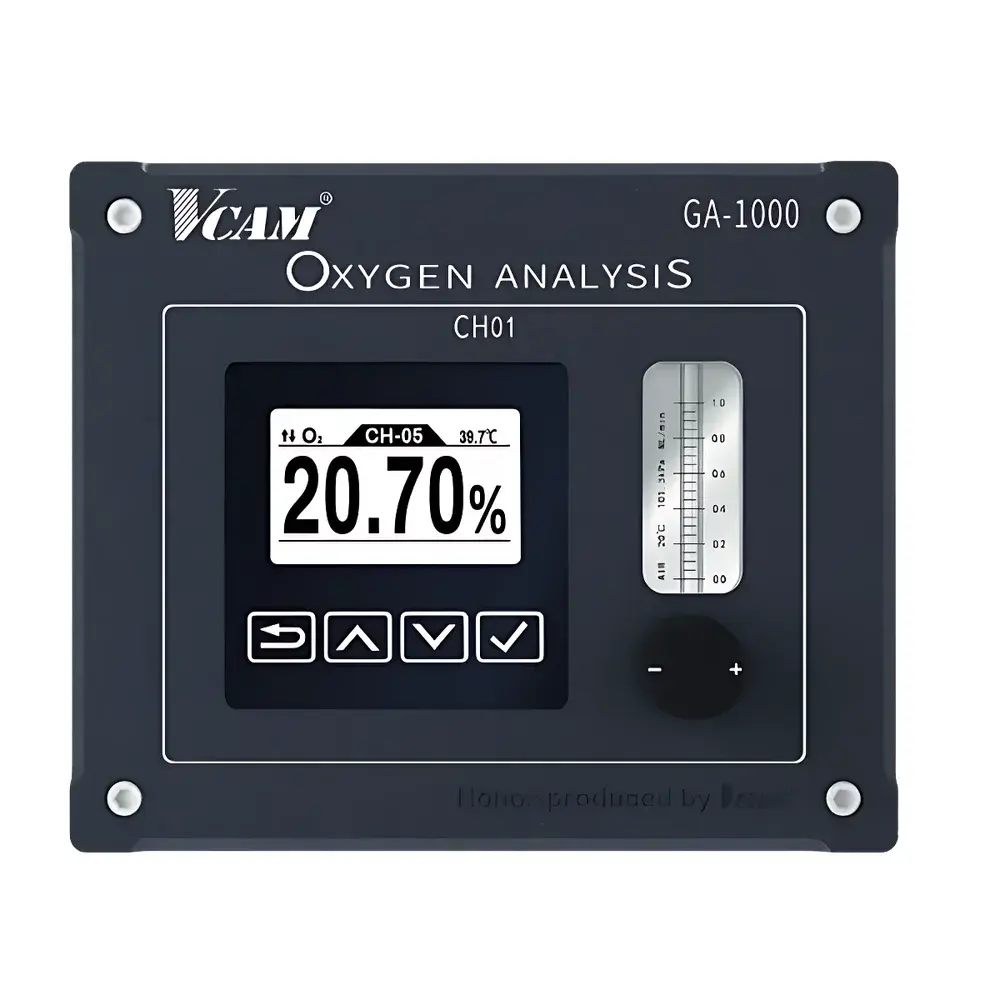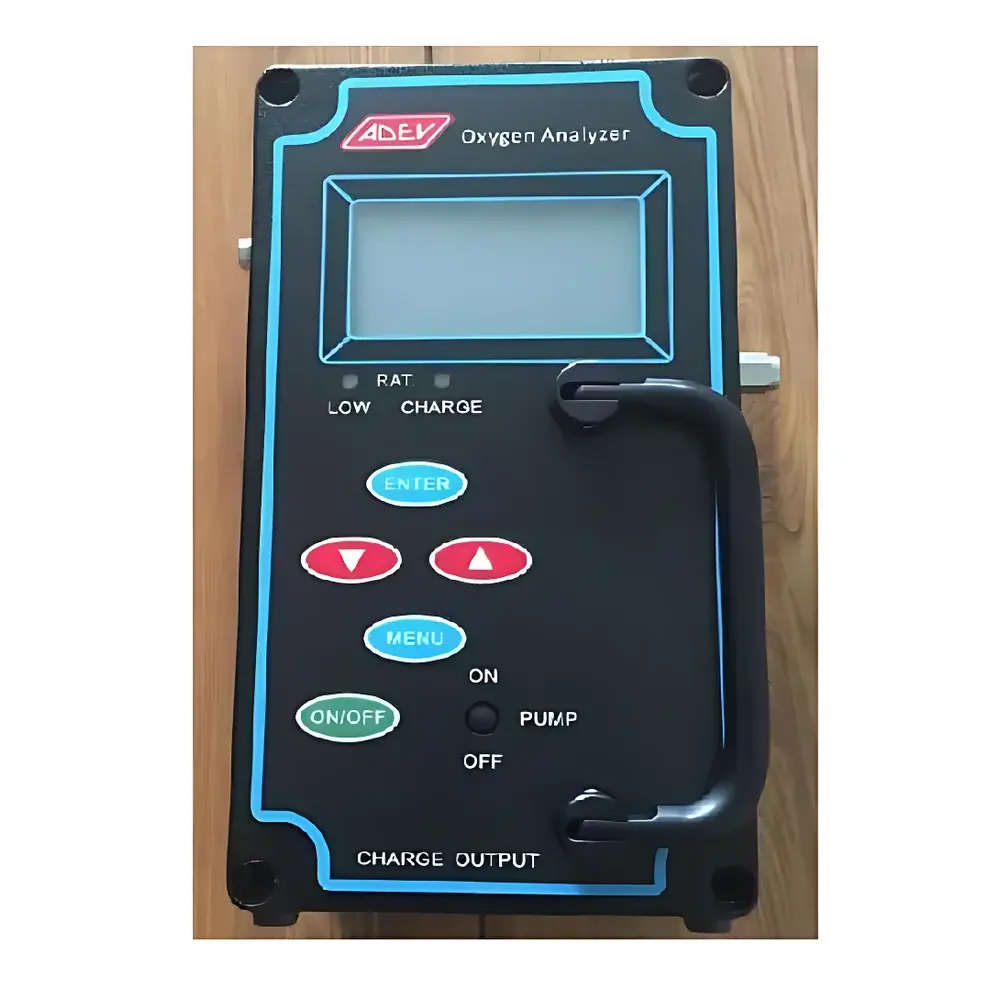
ADEV G480 Portable Trace Oxygen Analyzer
| Brand | ADEV |
|---|---|
| Origin | Italy |
| Model | G480 |
| Sensor Type | Electrochemical Fuel Cell |
| Measurement Ranges | 0–10 ppm, 0–100 ppm, 0–1,000 ppm, 0–1% O₂, 0–25% O₂ (auto/manual range switching) |
| Accuracy | ±1% of reading |
| Resolution | 0.01% O₂ (equivalent to 100 ppb at 1% range) |
| Linearity | R² > 0.995 |
| T₉₀ Response Time | ≤10 s |
| Operating Temperature | 5–45°C (GPR sensor), –20–45°C (XLT sensor) |
| Sample Pressure | 5–30 psig inlet, vent to atmosphere |
| Flow Rate | 0.5–5 SCFH (recommended: 2 SCFH / ~1 L/min) |
| Sensitivity Drift | <0.5% FS over 30 days |
| Calibration | Certified standard gas at ≥80% of selected span |
| Compensation | Automatic pressure & temperature compensation |
| Outputs | 4–20 mA (2-wire loop-powered) |
| Power Supply | 9–28 V DC (24–28 V DC with intrinsic safety barrier) |
| Enclosure | Anodized aluminum, NEMA 4X rated |
| Dimensions | 4" × 9" × 3" (102 × 229 × 76 mm) |
| Weight | 1 kg |
| Wetted Materials | Corrosion-resistant alloys (316 SS, PTFE, FKM) |
| Certifications | CE, ISO 9001, ATEX/IECEx compliant (with external safety barrier for Zone 1 / Class I, Div 1, Groups B, C, D) |
Overview
The ADEV G480 Portable Trace Oxygen Analyzer is a field-deployable electrochemical instrument engineered for high-stability, low-concentration oxygen measurement in demanding industrial process streams. Utilizing a solid-polymer electrolyte fuel cell sensor, the G480 delivers quantitative detection of molecular oxygen across five selectable ranges—from sub-ppm (0–10 ppm) to percent-level (0–25% O₂)—without requiring catalytic converters or heated zirconia elements. Its measurement principle relies on the stoichiometric oxidation of oxygen at the cathode, generating a current linearly proportional to partial pressure under controlled diffusion conditions. This architecture ensures inherent selectivity against CO₂, H₂, CH₄, and inert gases—critical for applications where cross-sensitivity compromises data integrity. Designed for integration into hydrogen purification loops, nitrogen generator off-gas monitoring, CO₂ drying validation, and natural gas conditioning systems, the G480 operates reliably in non-corrosive and mildly acidic sample matrices, including helium-, hydrogen-, and hydrocarbon-based carrier streams.
Key Features
- Five user-selectable measurement ranges with seamless auto-ranging capability, enabling single-instrument coverage from trace (10 ppm) to bulk-phase (25%) oxygen analysis
- Electrochemical fuel cell sensor with proven long-term stability (>2 years typical service life), minimal zero drift (<0.1% O₂/month), and no internal consumables or purge gases required
- Real-time simultaneous display of O₂ concentration, sample pressure (psig), and temperature (°C) on a backlit LCD with 0.1% resolution and intuitive navigation via sealed membrane keypad
- Integrated automatic pressure and temperature compensation algorithms compliant with ISO 8573-1 Annex B methodology, correcting for density-dependent diffusion rate variations
- Intrinsically safe operation certified for hazardous locations when used with an approved galvanic isolation barrier (Class I, Division 1, Groups B, C, D; ATEX II 2G Ex ib IIB T4 Ga)
- NEMA 4X-rated anodized aluminum enclosure providing ingress protection against dust, water jets, and corrosive atmospheres—suitable for outdoor panel mounting or mobile field use
- 2-wire 4–20 mA analog output with HART-compatible signal conditioning, supporting direct connection to DCS/PLC systems without additional signal isolators
Sample Compatibility & Compliance
The G480 is validated for continuous sampling of dry or saturated process gases containing H₂, He, N₂, Ar, CO₂, CH₄, C₂H₆, and mixed refinery streams—including those with low-level H₂S or CO. Wetted components consist exclusively of 316 stainless steel, PTFE-sealed fittings, and FKM elastomers, ensuring resistance to oxidation and acid gas exposure up to 100 ppm H₂S. It complies with ISO 9001:2015 quality management requirements and bears CE marking per EU Directive 2014/30/EU (EMC) and 2014/35/EU (LVD). When deployed with an I.S. barrier meeting EN 60079-11, it satisfies functional safety requirements for SIL 2 applications per IEC 61508 and supports audit-ready documentation for FDA 21 CFR Part 11–aligned environments through optional digital logging interfaces.
Software & Data Management
While the G480 operates as a standalone analyzer with embedded firmware, its 4–20 mA output is fully compatible with industry-standard SCADA, DCS, and historian platforms (e.g., Emerson DeltaV, Honeywell Experion, Siemens PCS7). Optional RS-485 Modbus RTU interface enables remote configuration of range selection, alarm thresholds, and calibration timestamps. All calibration events—including date, standard gas concentration, and post-calibration deviation—are stored in non-volatile memory with tamper-evident logging. The device supports GLP/GMP-compliant workflows via external data acquisition systems that enforce electronic signatures, audit trails, and change control protocols aligned with Annex 11 and USP .
Applications
- Monitoring residual O₂ in PEM electrolyzer hydrogen output (target: <1 ppm) prior to compression and storage
- Verifying oxygen removal efficiency in pressure swing adsorption (PSA) nitrogen generators (specification: <10 ppm O₂ in 99.999% N₂)
- Leak detection and blanketing verification in pharmaceutical inert gas manifolds (N₂/Ar) supplying lyophilizers and reactors
- Quality assurance testing of CO₂ used in food-grade carbonation and modified atmosphere packaging (MAP)
- Process safety interlock for oxygen-rich vent streams in amine-based natural gas sweetening units
- Field verification of cryogenic distillation column purity during commissioning and turnaround support
FAQ
What is the recommended calibration frequency for the G480 in continuous process monitoring?
For critical applications (e.g., hydrogen purity certification), quarterly calibration using NIST-traceable standard gas is advised. For less demanding environments, semi-annual verification suffices—provided zero stability remains within ±0.05% O₂ over 72 hours.
Can the G480 measure oxygen in wet or condensing sample streams?
No. The fuel cell sensor requires dew point-controlled gas—preferably ≤ –40°C (–40°F) —to prevent electrolyte dilution and electrode flooding. A coalescing filter and refrigerated dryer are mandatory upstream of the analyzer inlet.
Is sensor replacement a field-serviceable procedure?
Yes. The electrochemical cartridge is user-replaceable using standard Torx tools. Full sensor swap—including electrical and mechanical alignment—takes <8 minutes and requires no recalibration if performed with original ADEV-certified parts.
Does the G480 support digital communication protocols beyond 4–20 mA?
Standard configuration includes only analog output. Optional factory-installed RS-485 Modbus RTU module enables serial command-and-control, but Ethernet/IP or Profibus DP are not supported.
How does temperature compensation function across the extended XLT sensor range (–20°C to 45°C)?
The XLT variant employs dual thermistor networks—one measuring ambient housing temperature, the other embedded in the sensor head—to dynamically adjust diffusion coefficient coefficients in real time, maintaining ±1% accuracy across the full operational envelope without manual offsetting.