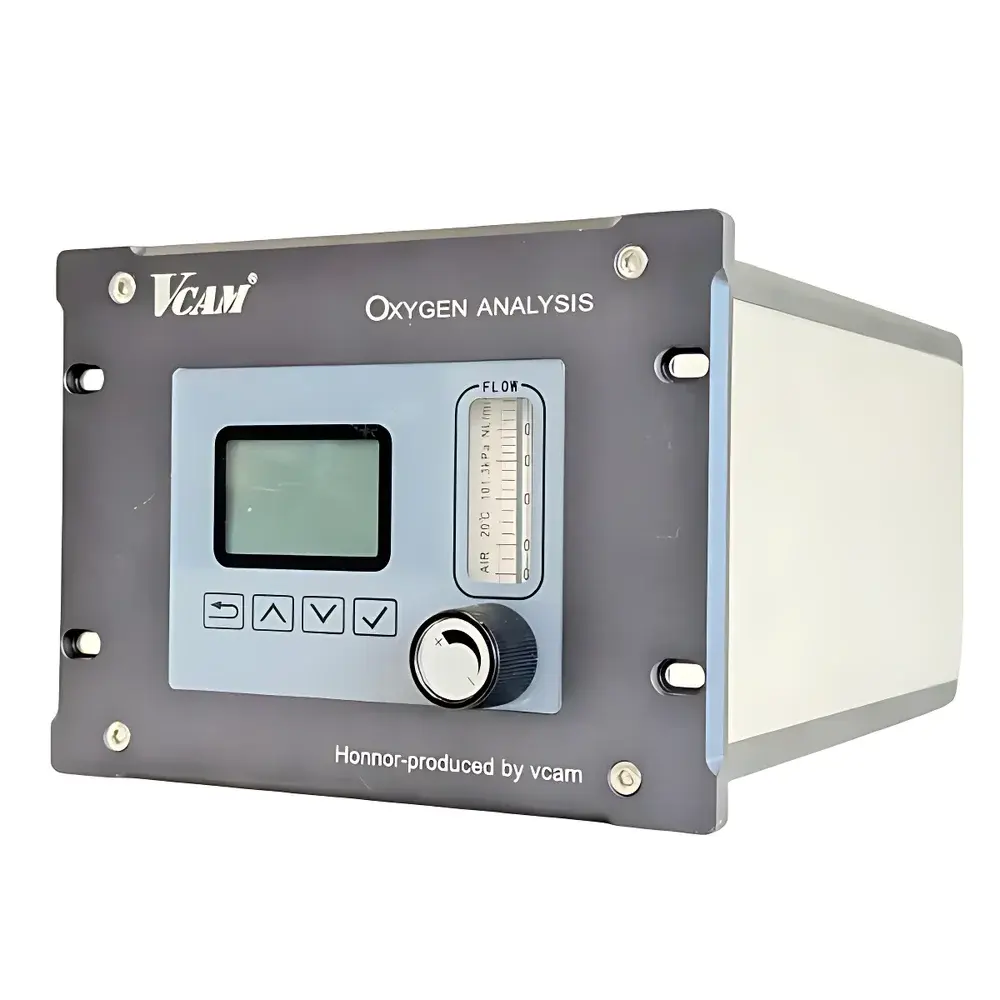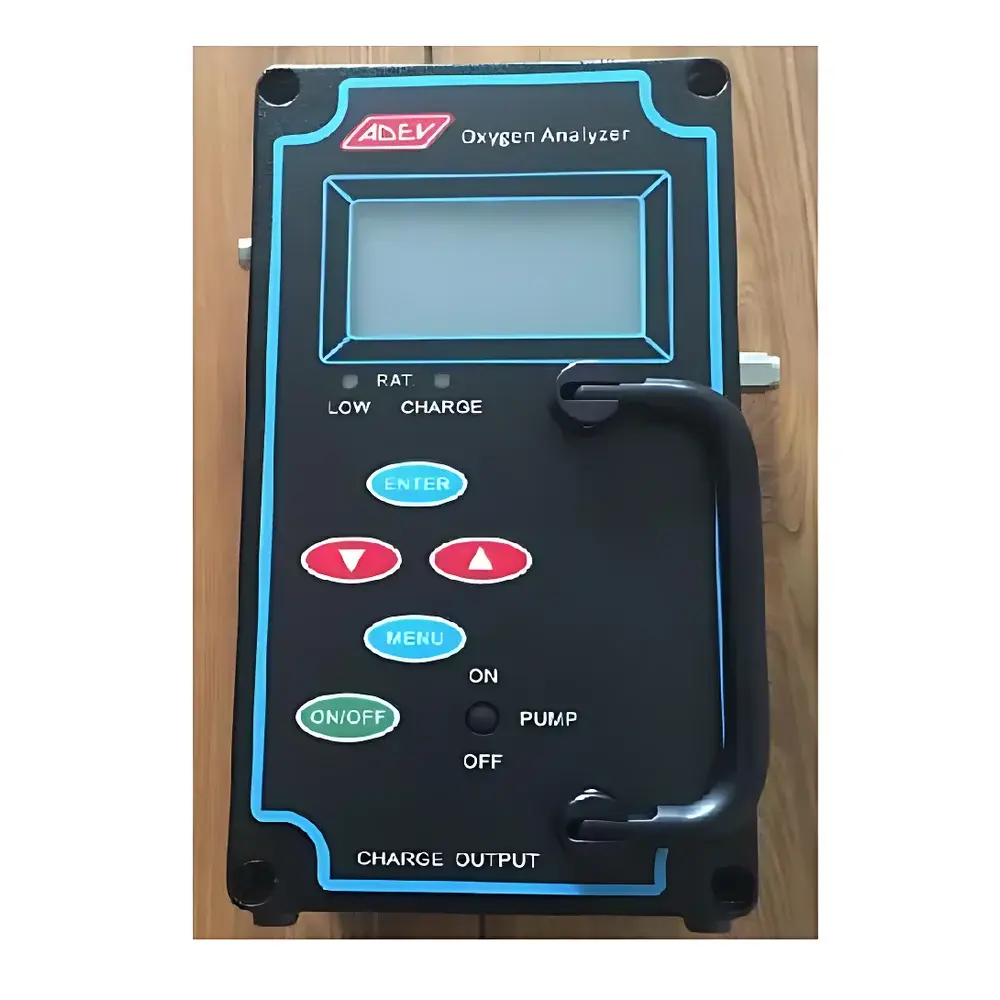
ADEV G480EC Portable Trace Oxygen Analyzer
| Brand | ADEV |
|---|---|
| Origin | Italy |
| Model | G480EC |
| Sensor Type | Electrochemical Fuel Cell |
| Measurement Range | 0–10 ppm, 0–100 ppm, 0–1,000 ppm, 0–1% O₂, 0–25% O₂ (auto/manual range selection) |
| Accuracy | ±1% of reading |
| Resolution | 0.01% O₂ |
| Linearity | R² > 0.995 |
| T₉₀ Response Time | ≤10 s |
| Operating Temperature | 5–45°C (GPR sensor), –20–45°C (XLT sensor) |
| Sample Pressure | 5–30 psig inlet, vent to atmosphere |
| Flow Rate | 0.5–5 SCFH (recommended: 2 SCFH / ~1 L/min) |
| Sensitivity Drift | <0.5% FS per month |
| Calibration | Certified standard gas at ~80% of selected span |
| Compensation | Automatic pressure & temperature compensation |
| Output | 4–20 mA (2-wire), optional alarm relay |
| Power Supply | 9–28 V DC (24–28 V DC with intrinsic safety barrier) |
| Enclosure | Anodized aluminum, NEMA 4X rated |
| Dimensions | 102 × 229 × 76 mm (4" × 9" × 3") |
| Weight | ~1 kg |
| Wetted Materials | Corrosion-resistant alloys and fluoropolymers |
| Certifications | CE, ISO 9001, ATEX/IECEx compliant (with external intrinsically safe barrier for Zone 1 / Class I, Div 1, Groups B, C, D) |
Overview
The ADEV G480EC Portable Trace Oxygen Analyzer is a field-deployable electrochemical instrument engineered for high-stability, low-concentration oxygen measurement in inert, reducing, and reactive process gas streams. It employs a galvanic fuel cell sensor—free of consumable electrolytes or external power requirements at the sensing element—to deliver drift-free, maintenance-light performance across trace (ppm) to percent-level O₂ ranges. Unlike paramagnetic or zirconia-based analyzers, the G480EC leverages diffusion-limited current generation proportional to partial pressure of O₂, enabling robust operation in H₂, He, N₂, CO₂, natural gas, and acid gas matrices without cross-sensitivity to CO, CH₄, or H₂S. Its design targets applications where rapid deployment, intrinsic safety compliance, and real-time environmental compensation are critical—particularly in on-site commissioning, periodic validation, and troubleshooting of nitrogen generators, hydrogen purification units, and bulk gas drying systems.
Key Features
- Five selectable measurement spans (0–10 ppm to 0–25% O₂) with automatic range switching and manual override
- True electrochemical fuel cell sensor with no internal battery or heater—zero power draw at sensor head
- Integrated pressure and temperature transducers enabling real-time compensation per ideal gas law (PVT correction)
- NEMA 4X anodized aluminum enclosure rated for outdoor, washdown, and corrosive industrial environments
- Intrinsically safe operation when paired with certified Zener barrier or isolator (Class I, Div 1, Groups B, C, D; ATEX II 1G Ex ia IIC T4 Ga)
- Backlit LCD display showing O₂ concentration, sample pressure (psig), and temperature (°C) simultaneously at 0.1% resolution
- Two-wire 4–20 mA output with HART-compatible signal conditioning and configurable alarm thresholds
- Minimal wetted path constructed from 316 stainless steel, Kalrez® seals, and PTFE-lined fittings to resist halogenated, acidic, and sulfur-bearing gases
Sample Compatibility & Compliance
The G480EC is validated for continuous analysis of non-condensing, non-particulate gas streams including hydrogen, helium, argon, nitrogen, carbon dioxide, natural gas, syngas, and mixed industrial gases containing up to 10% CO₂ or 50 ppm H₂S. It excludes use with oxidizing halogens (Cl₂, F₂), strong oxidizers (NO₂, O₃), or vapors that polymerize on electrode surfaces (e.g., unsaturated hydrocarbons above C₄). The analyzer conforms to ISO 9001:2015 quality management standards and carries CE marking under the EU Measuring Instruments Directive (MID) and Electromagnetic Compatibility (EMC) Directive. When installed with an approved intrinsic safety barrier, it satisfies IEC 60079-11 and UL 913 requirements for hazardous locations. Its calibration protocol aligns with ASTM D6299 and ISO 17025 principles—traceable to NIST-certified reference gases with documented uncertainty budgets.
Software & Data Management
While the G480EC operates as a standalone analog transmitter, its 4–20 mA output integrates seamlessly into DCS, PLC, and SCADA architectures supporting HART 7 communication (via optional HART modem). No proprietary software is required for basic operation; however, ADEV provides a Windows-based configuration utility for advanced setup—including zero/span offset adjustment, damping time (0.1–10 s), alarm hysteresis, and unit scaling. All calibration events are timestamped and stored in non-volatile memory with audit trail capability, supporting GLP/GMP documentation requirements. The device logs operational hours, sensor voltage decay trends, and temperature-compensated deviation history—enabling predictive maintenance scheduling without external data loggers.
Applications
- Verification of oxygen removal efficiency in pressure swing adsorption (PSA) and membrane-based nitrogen generators
- In-line monitoring of dissolved O₂ breakthrough during cryogenic air separation plant start-up and regeneration cycles
- Leak detection and purge verification in hydrogen refueling stations and fuel cell manufacturing cleanrooms
- Residual oxygen quantification in CO₂ recovery units prior to food-grade or EOR injection
- Quality assurance testing of inert gas blankets in pharmaceutical lyophilization and semiconductor wafer packaging
- Field validation of online analyzers during ISO 50001 energy management audits
FAQ
What is the expected service life of the fuel cell sensor under typical operating conditions?
Fuel cell sensors in the G480EC typically operate for 24–36 months in clean, dry, non-acidic gas streams; lifespan decreases proportionally with exposure to condensable vapors, high humidity (>80% RH), or H₂S >1 ppm.
Can the G480EC be used for oxygen-in-argon measurements in semiconductor process tool validation?
Yes—its low ppm detection limit, absence of thermal drift, and immunity to argon matrix effects make it suitable for verifying <1 ppm O₂ in Ar carrier gases per SEMI F21 and ASTM E2914 specifications.
Is temperature compensation applied to both the sensor signal and pressure transducer readings?
Yes—dual compensation algorithms correct for thermal expansion of the sensor’s diffusion barrier and piezoresistive pressure element, ensuring accuracy across the full –20°C to +45°C ambient range.
Does the 4–20 mA output support fault signaling (e.g., sensor failure or out-of-range)?
Yes—the transmitter outputs 3.6 mA for below-range and 22.0 mA for above-range conditions, per NAMUR NE43 recommendation, enabling immediate fault identification in control systems.
How frequently must the unit be calibrated to maintain ±1% accuracy?
Annual calibration is recommended for routine QC use; semi-annual calibration is advised for critical GMP applications or after exposure to extreme thermal cycling or gas composition shifts.