
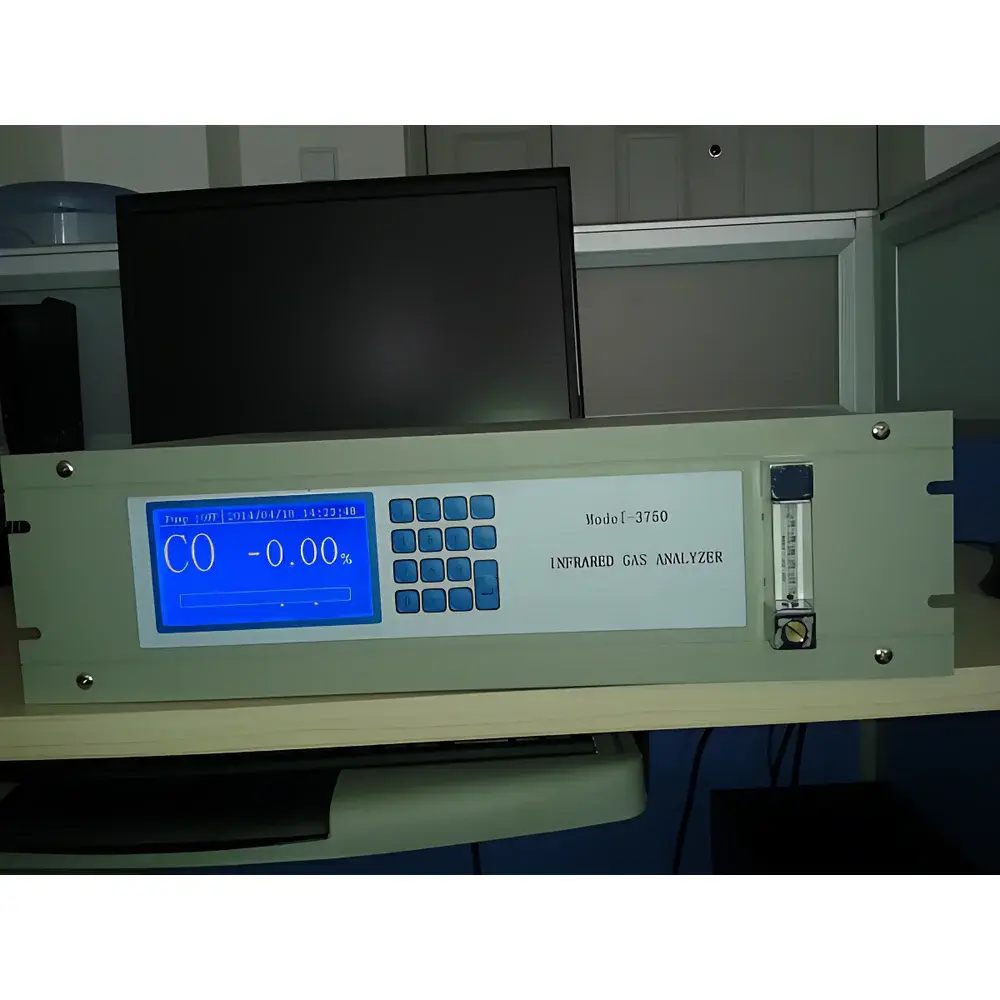
ADEV MODEL3750 Multi-Gas Infrared Analyzer
| Brand | ADEV |
|---|---|
| Origin | Beijing, China |
| Model | MODEL3750 |
| Instrument Type | Online Continuous Emission Monitor |
| Detection Principle | Dual-Beam NDIR (Non-Dispersive Infrared) + Electrochemical (EC) + Thermal Conductivity (TCD) + Photoionization (PID) Sensor Modules |
| Measurable Gases | CO, CO₂, CH₄, C₂H₄, C₃H₈, C₄H₁₀, H₂, O₂, NO, NO₂, N₂O, NH₃, SO₂, H₂S, SF₆, Ar, He, BrCH₃, SO₂F₂, HC (hydrocarbons) |
| Range Options | 0–100 ppm to 0–100% vol (user-selectable per channel) |
| Minimum Detectable Range | 0–20 ppm |
| Resolution | 0.1 ppm |
| Repeatability | ±1% FS |
| Zero Drift | ±2% FS / 7 days |
| Span Drift | ±1% FS / 7 days |
| Linearity Error | ±2% FS |
| Response Time (T₉₀) | ≤10 s (for most NDIR channels), ≤30 s (for EC/TCD/PID) |
| Compliance | CE-marked |
| Output Interfaces | 4–20 mA analog (isolated), RS232, RS485, CAN bus |
| Data Logging | Internal non-volatile memory (≥100,000 records), timestamped with real-time clock |
| Display & UI | 320×240 monochrome LCD, full Chinese menu, five-key navigation |
| Enclosure | 19-inch rack-mount chassis (4U height), IP20 rated |
| Power Supply | 220 VAC ±10%, 50/60 Hz |
| Operating Temperature | 5–40 °C |
| Humidity Range | 20–80% RH (non-condensing) |
Overview
The ADEV MODEL3750 Multi-Gas Infrared Analyzer is an online, multi-channel continuous emission monitoring system engineered for high-stability, simultaneous quantification of up to 20 gas species in industrial process streams, ambient air, combustion exhaust, and laboratory sample loops. Its core architecture integrates multiple detection technologies—primarily dual-beam non-dispersive infrared (NDIR) spectroscopy for CO, CO₂, CH₄, SO₂, NO, NO₂, NH₃, SF₆, and hydrocarbons; electrochemical (EC) cells for O₂, H₂S, NO, NO₂, and BrCH₃; thermal conductivity detectors (TCD) for H₂, He, Ar, and N₂; and photoionization detection (PID) for low-concentration volatile organics such as sulfuryl fluoride. This hybrid sensor strategy ensures cross-interference minimization, broad dynamic range coverage (ppm to 100% vol), and long-term baseline stability without optical alignment drift. Designed for unattended operation in fixed-site installations, the MODEL3750 complies with fundamental electromagnetic compatibility (IEC 61000-6-2/6-4) and supports integration into ISO 14001-certified environmental management systems. It is not intended for personal safety or confined-space entry applications, but rather for regulatory-grade process control, stack emissions verification, and research-grade gas composition profiling.
Key Features
- Rack-mounted 19-inch 4U chassis with front-accessible modular sensor bays—enabling field-replaceable detection units without system shutdown
- Real-time dual-beam NDIR optics with temperature- and pressure-compensated signal processing, delivering <10 s T₉₀ response for key IR-active gases
- Configurable channel assignment: users select up to eight active gas channels from a library of 20 pre-characterized analytes, each with independently programmable range, alarm thresholds, and calibration intervals
- Embedded microcontroller platform with deterministic real-time OS—guaranteeing consistent sampling cycle timing, data timestamping, and watchdog-driven fault recovery
- Full Chinese-language UI on 320×240 monochrome LCD with intuitive five-key navigation; no external PC required for routine operation or calibration
- Automated zero/span validation using internal solenoid-valve manifold and optional built-in calibration gas reservoirs (external cylinder interface also supported)
- Dual redundant data output: isolated 4–20 mA analog outputs (per channel, HART-compatible) plus digital interfaces (RS232 for local PC connection, RS485/CAN for SCADA integration)
- Onboard data logging with 100,000+ record capacity, UTC-synchronized timestamps, and configurable storage intervals (1 s to 1 h)
Sample Compatibility & Compliance
The MODEL3750 accepts conditioned sample gas at flow rates of 0.5–2.0 L/min, requiring standard particulate filtration (≤1 µm), moisture removal (dew point ≤−10 °C), and optional catalytic scrubbing for interfering VOCs when measuring NO/NO₂. It is validated for use with dry, non-corrosive, non-explosive sample matrices typical of flue gas, biogas upgrading streams, fermentation off-gas, and cleanroom ambient monitoring. While not certified to ATEX or IECEx for hazardous areas, its enclosure meets IP20 ingress protection for indoor industrial environments. The analyzer satisfies technical prerequisites for ASTM D6216-20 (standard test method for measurement of gaseous pollutants from stationary sources using extractive Fourier transform infrared spectroscopy—where applicable to NDIR-based subcomponents) and aligns with QA/QC expectations under EPA Method 10 and EN 15267 for continuous emission monitoring systems. Firmware supports audit-trail logging of all configuration changes and calibration events, facilitating GLP-compliant documentation.
Software & Data Management
No proprietary PC software is required for basic operation; however, the included ADEV DataLink utility (Windows-compatible, USB/RS232) enables advanced configuration, historical data export (CSV), trend visualization, report generation (PDF/Excel), and firmware updates. All communication protocols are openly documented—enabling direct integration with third-party SCADA platforms (e.g., Ignition, Siemens Desigo, Schneider EcoStruxure) via Modbus RTU over RS485 or CANopen. Logged data includes raw sensor voltages, temperature/pressure compensation values, diagnostic flags (e.g., lamp intensity, detector saturation), and user-defined metadata tags. Internal memory retains data during power loss and supports cyclic overwrite policies. Remote access is possible via optional Ethernet gateway module (sold separately), supporting HTTP-based status polling and secure TLS-encrypted data upload to cloud-based environmental dashboards.
Applications
- Continuous monitoring of CO, CO₂, and CH₄ in municipal solid waste landfill gas collection systems per EPA SW-846 Method 0030
- Real-time combustion efficiency optimization in boiler and kiln stacks via O₂/CO/CO₂ ratio analysis
- Biogas quality assurance in anaerobic digestion facilities (CH₄, CO₂, H₂S, NH₃, H₂)
- Process gas purity verification in semiconductor fabrication (N₂, Ar, He, O₂, SF₆)
- Lab-scale reaction monitoring for catalytic studies involving CO oxidation, methane reforming, or ammonia synthesis
- Ambient air quality stations measuring urban NOₓ, SO₂, and CO concentrations in compliance with national ambient air quality standards
- Pharmaceutical cleanroom environmental monitoring (O₂ depletion, CO₂ buildup, trace solvent vapors)
FAQ
Does the MODEL3750 support automatic calibration with external gas cylinders?
Yes—via its integrated 6-port solenoid valve manifold, the analyzer supports scheduled or manual zero/span calibration using certified reference gases. Optional internal gas reservoirs (100 mL, 200 bar) are available for fully autonomous calibration cycles.
Can I configure different measurement ranges for individual gas channels?
Absolutely. Each active channel is independently configurable for range (e.g., CO: 0–50 ppm or 0–1000 ppm), alarm setpoints, averaging time (1–60 s), and output scaling.
Is the firmware upgradeable in the field?
Yes—firmware updates are delivered as signed binary files and installed via RS232 or USB-to-serial adapter using the ADEV DataLink utility. All update logs are retained in internal audit memory.
What maintenance is required beyond periodic calibration?
Annual inspection of optical windows (for NDIR modules), replacement of particulate filters (every 3–6 months depending on sample cleanliness), and verification of pump performance and flow sensor accuracy are recommended. No optical alignment or detector replacement is required under normal operating conditions.
Does the unit meet FDA 21 CFR Part 11 requirements for electronic records?
While the MODEL3750 does not provide full Part 11 compliance out-of-the-box (e.g., electronic signatures, role-based access control), its audit-trail functionality—including immutable timestamps, user ID logging, and change history—forms a foundational layer for validation in regulated GxP environments when deployed with appropriate procedural controls and supplementary IT infrastructure.
Related Products







