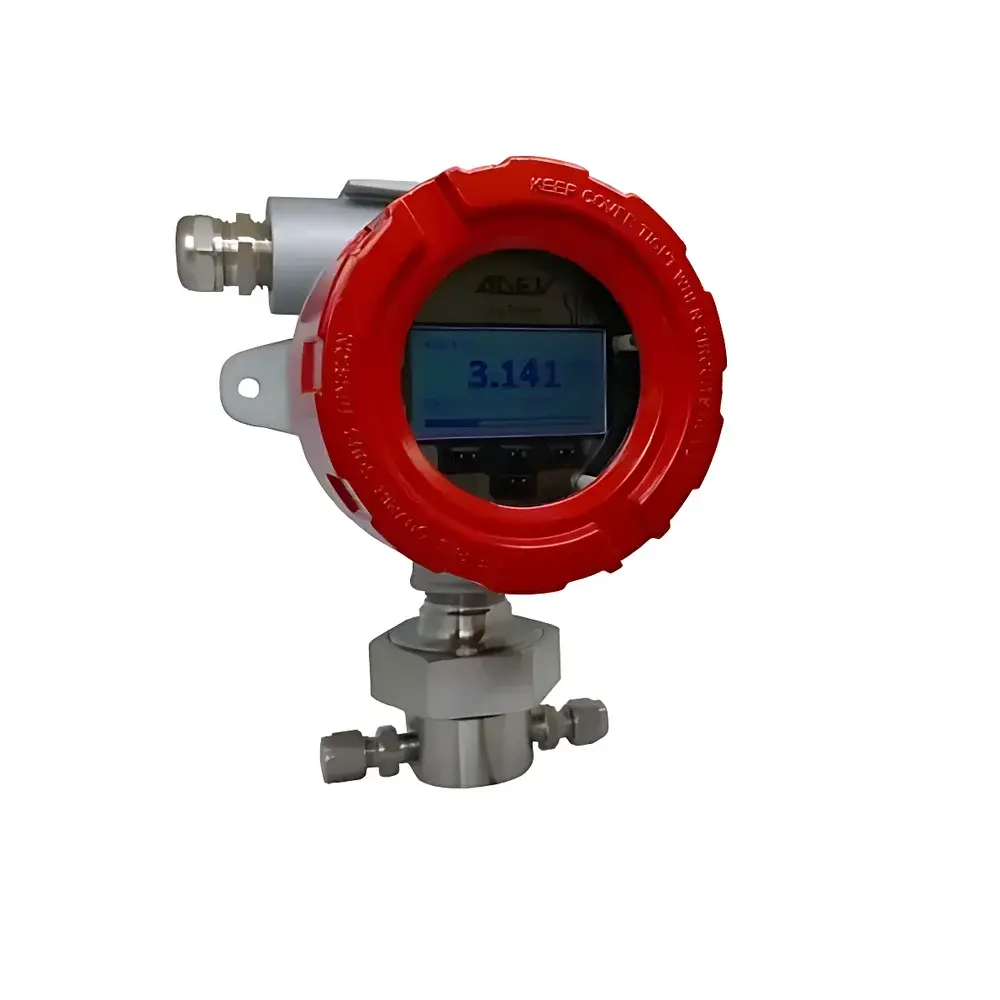
ADEV OxyTrend Online Trace Oxygen Analyzer
| Brand | ADEV |
|---|---|
| Origin | Italy |
| Model | OxyTrend |
| Measurement Principle | Electrochemical (Galvanic or Zirconia-based, configurable) |
| Range Options | 0–10 ppm, 0–100 ppm, 0–1,000 ppm, 0–10,000 ppm, 0–25% O₂ |
| Accuracy | ±1% of full scale |
| Linearity | >0.995 across all ranges |
| Response Time (t₉₀) | 15 s |
| Detection Limit | 100 ppb |
| Temperature Compensation | Yes |
| Pressure Compensation | Yes |
| Operating Temp. | 5–45°C (TO2 series), –20–45°C (PO2 series) |
| Sample Flow Rate | 0.25–2.5 L/min (recommended: 1 L/min) |
| Inlet Pressure | 0–3 MPa |
| Output | 4–20 mA analog |
| Alarm Outputs | 2 relay outputs |
| Display | Backlit LCD, resolution 0.01 ppm |
| Enclosure Rating | IP65 |
| ATEX Certification | II 2 G D Ex db IIC T6 Gb / Ex tb IIIC T85°C Db (Zone 1 / Zone 21) |
| Sensor Lifetime | 24 months at 25°C |
| Warranty | 12 months (instrument & sensor) |
| Wetted Materials | 316L stainless steel |
| Calibration | Certified standard gas at ~80% FS |
| Sensor Options | TO2-1x (ppm-level, H₂S/CO₂ tolerant), TO2-2x (enhanced ppm-level), PO2-160 (percent-level), PO2-24 (percent-level, H₂S/CO₂ tolerant) |
| Power Supply | 9–28 VDC |
Overview
The ADEV OxyTrend Online Trace Oxygen Analyzer is an industrial-grade electrochemical analyzer engineered for continuous, real-time monitoring of trace and percent-level oxygen concentrations in inert, reducing, and reactive process gas streams. Designed for integration into critical safety and purity assurance loops, it employs either galvanic or zirconia-based sensing technology—selected per application requirements—to deliver stable, drift-resistant measurements in demanding environments such as high-purity nitrogen blanketing, hydrogen purification, semiconductor purge gas lines, and aerospace-grade inerting systems. Its measurement principle relies on selective electrochemical reduction of O₂ at a catalytic electrode, generating a current linearly proportional to partial pressure—compensated in real time for sample temperature and pressure variations. Unlike optical or paramagnetic analyzers, the OxyTrend offers inherent immunity to background gas interference (e.g., CO₂, H₂S up to 0.5%) when configured with TO2-2x or PO2-24 sensors, eliminating the need for frequent recalibration or external scrubbers under typical operating conditions.
Key Features
- Multi-range flexibility: Selectable spans from 0–10 ppb (effective lower detection limit) to 0–100% O₂, covering applications from ultra-high-purity gas certification (e.g., ASTM D7422 for electronic-grade N₂) to combustion air monitoring.
- ATEX-certified hazardous area operation: Approved for Zone 1 (gas) and Zone 21 (dust) per Directive 2014/34/EU, with explosion protection modes Ex db IIC T6 Gb and Ex tb IIIC T85°C Db—enabling direct installation in refineries, hydrogen production skids, and solvent recovery units.
- True process-compensated accuracy: Onboard temperature and pressure sensors enable dynamic correction of O₂ partial pressure, ensuring metrological validity across variable line pressures (0–3 MPa) and ambient shifts (5–45°C).
- Robust sensor architecture: TO2-series sensors feature solid-electrolyte construction with integrated H₂S/CO₂ tolerance; PO2-series variants maintain stability in high-CO₂ biogas or syngas streams without consumable scrubbers.
- Industrial HMI: Backlit LCD with 0.01 ppm resolution, sealed membrane keypad, and intuitive menu navigation—designed for glove-compatible operation in control rooms or field enclosures.
- Process interface readiness: Standard 4–20 mA output with HART option (upon request), dual programmable relays for high/low alarms, and 1/4″ Swagelok®-compatible stainless-steel sample fittings (316L).
Sample Compatibility & Compliance
The OxyTrend is validated for use with non-corrosive, non-condensing process gases including N₂, Ar, He, H₂, CO₂, CH₄, and hydrocarbon mixtures—provided total H₂S and CO₂ remain ≤0.5% v/v when using TO2-1x/TO2-2x sensors. It meets EN 61000-6-2 (immunity) and EN 61000-6-4 (emissions) for industrial electromagnetic compatibility. The analyzer supports compliance workflows for ISO 8573-1 (compressed air purity), USP (pharmaceutical inerting), and IEC 61511 (functional safety—SIL 2 capable with external logic solver). All factory calibrations are traceable to NIST-certified reference standards; documentation includes calibration certificates per ISO/IEC 17025 requirements.
Software & Data Management
While the OxyTrend operates as a standalone, self-contained analyzer, its 4–20 mA output integrates natively with DCS, PLC, and SCADA platforms (e.g., Siemens PCS7, Emerson DeltaV, Honeywell Experion). Optional HART-enabled firmware (model-specific) allows remote configuration of range, alarm thresholds, damping, and zero/span verification via handheld communicators or asset management software. Audit trails—including calibration events, alarm activations, and sensor health status—are retained in non-volatile memory for GLP/GMP-aligned review. The device complies with FDA 21 CFR Part 11 requirements when deployed with validated data acquisition systems supporting electronic signatures and change control.
Applications
- Petrochemical refining: Monitoring O₂ ingress in amine regeneration units, catalyst protection blankets, and flare gas recovery systems.
- Semiconductor manufacturing: Real-time verification of <100 ppb O₂ in bulk N₂/H₂ delivery lines for CVD/PVD tool purging.
- Hydrogen production & distribution: Ensuring <1 ppm O₂ in PEM electrolyzer outlet gas and pipeline-grade H₂ per ISO 8583-2.
- Aerospace & defense: Qualifying inerting gas purity for fuel tank vapor suppression (MIL-STD-810G, Section 514.7).
- Pharmaceutical manufacturing: Validating nitrogen sparge gas integrity during lyophilization and API synthesis under cGMP Annex 1.
- Food packaging & modified atmosphere processing: Controlling residual O₂ in vacuum-sealed trays (<0.5% v/v) to extend shelf life.
FAQ
What sensor technology does the OxyTrend use?
It utilizes electrochemical sensing—either galvanic (for ppm-level) or zirconia-based (for %-level)—with model-specific selection based on required range, background gas composition, and maintenance expectations.
Can it measure oxygen in hydrogen-rich streams?
Yes. The TO2-2x and PO2-24 sensors are explicitly rated for operation in H₂ matrices with no cross-sensitivity or accelerated degradation, provided moisture and particulates are removed upstream.
Is field calibration possible without certified gas?
No. Calibration requires traceable standard gas at ~80% of selected span. Zero calibration may be performed with certified nitrogen (99.999% purity), but span validation mandates certified O₂-in-N₂ or O₂-in-Ar standards.
What is the recommended maintenance interval?
Sensor replacement is scheduled at 24 months under continuous operation at 25°C. Routine verification (zero/span check) is advised quarterly; full calibration annually or per process risk assessment.
Does it support Modbus RTU or Ethernet/IP?
Standard configuration provides 4–20 mA and relay outputs only. Digital protocols require optional communication modules—contact ADEV Technical Support for compatible fieldbus interface kits.