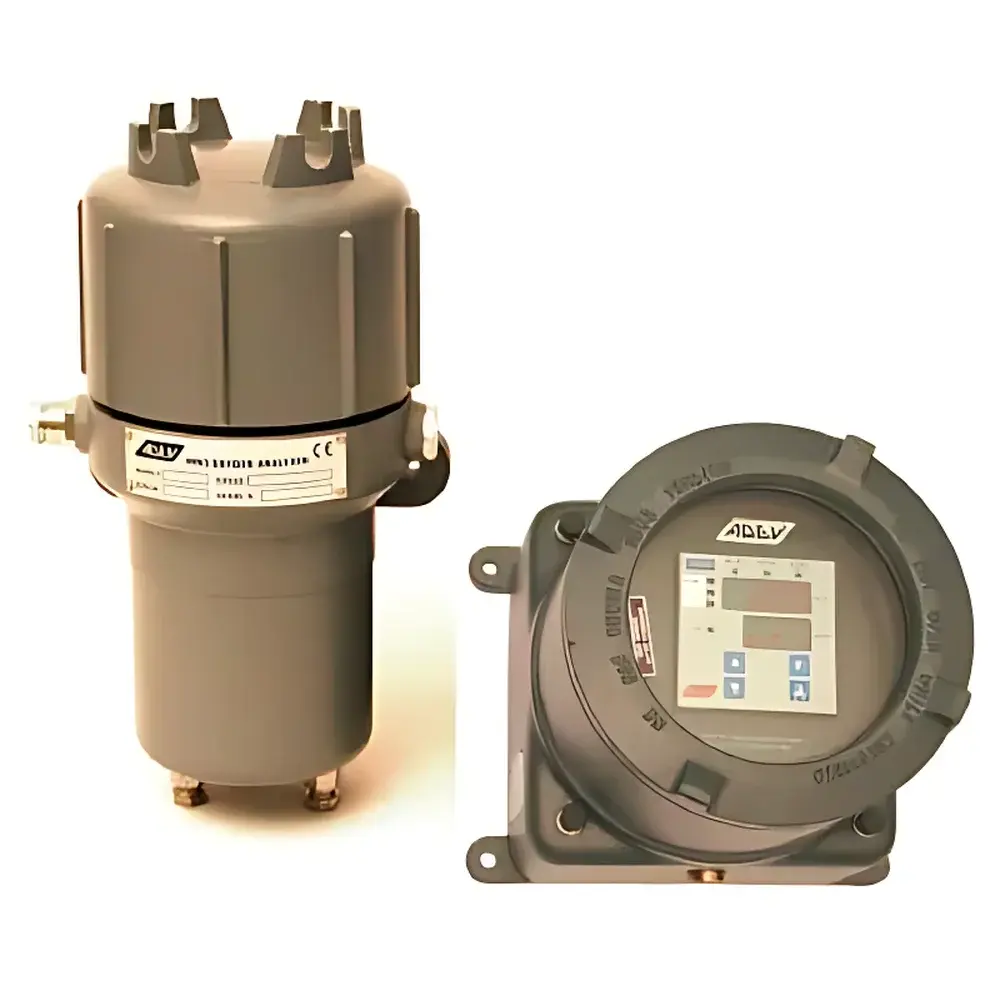
ADEV P8863 Mechanical Paramagnetic Oxygen Analyzer
| Brand | ADEV |
|---|---|
| Origin | USA |
| Model | P8863 |
| Measurement Principle | Mechanical Paramagnetism |
| Accuracy | ±1% FS |
| Repeatability | ±0.3% (short-term) |
| Linearity | ±1% FS |
| Response Time (T90) | <3 s |
| Zero Drift | ±0.1% FS/week |
| Span Drift | ±0.1% FS/week |
| Flow Rate | 250–1000 mL/min |
| Inlet Pressure | ≥0.003 MPa (flow-switch controlled) |
| Range Options | 0–2%, 0–5%, 0–7.5%, 0–10%, 0–15%, 0–20%, 0–25%, 0–100%, 15–25%, 20–30%, 90–100%, 95–100%, 98–100% |
| Sample Interface | 1/4″ or 6 mm compression fitting |
| Operating Temp. | –10 to +45 °C |
| Max. Ambient Temp. | 70 °C |
| Relative Humidity | ≤90% RH (non-condensing) |
| Output Signal | 4–20 mA analog |
| Power Supply | 24 VDC / 50 VA or 115–220 VAC, 50/60 Hz, 40 VA |
| Enclosure Rating | IP65 |
| Explosion Protection | ATEX II 2G Ex d IIC T6 Gb / II 2D Ex tb IIIC T85°C Db |
| Sensor Weight | 8.5 kg |
| Dimensions (H×W×D) | 325 × 180 × 155 mm |
| Wetted Materials | 316SS, 303SS, Pt-Ir alloy, borosilicate glass, PTFE, FKM |
| Compliance | ATEX Directive 2014/34/EU, IEC 60079-0, -1, -11, -31 |
Overview
The ADEV P8863 Mechanical Paramagnetic Oxygen Analyzer is a high-stability, high-response industrial-grade analyzer engineered for continuous, real-time oxygen concentration measurement in process gas streams. It operates on the fundamental physical property of paramagnetism—oxygen exhibits the highest volume magnetic susceptibility among common gases, typically 50–100 times greater than nitrogen or argon. This principle enables selective, interference-free quantification of O₂ in complex gas matrices without chemical consumption or catalytic degradation. The analyzer employs a precision mechanical “dumbbell” sensor: two identical quartz spheres filled with inert nitrogen or argon are suspended on a taut platinum-iridium torsion ribbon within opposing non-uniform magnetic fields. Differential magnetic forces acting on the spheres generate a torque proportional to the sample’s oxygen content; this torque rotates the dumbbell until balanced by the restoring torque of the ribbon. Angular displacement (Ψ) is detected optically via a mirror-mounted reflective system and dual photodiodes operating in differential mode—ensuring zero output at 0% O₂ and linear signal response across the selected range. Unlike electrochemical or zirconia-based sensors, the P8863 requires no consumables, exhibits no cross-sensitivity to CO₂, H₂O, or hydrocarbons, and delivers long-term baseline stability under demanding process conditions.
Key Features
- True mechanical paramagnetic sensing with no drift-inducing electrodes or electrolytes
- Response time T90 < 3 seconds—optimized for fast-loop process control and safety interlock applications
- Modular architecture enabling field-replaceable sensor cartridges and electronics units without system shutdown
- Dual-certified explosion protection: ATEX II 2G Ex d IIC T6 Gb for gas atmospheres (Zone 1) and II 2D Ex tb IIIC T85°C Db for combustible dust environments (Zone 21)
- Robust aluminum die-cast housing with stainless steel sensor enclosure—rated IP65 for outdoor or washdown installations
- Microprocessor-based front panel with membrane keypad and LED status indicators for local configuration, calibration, and diagnostics
- Optional RS-232 digital interface for remote parameter access and firmware updates
- Automatic zero calibration function (with optional zero gas valve assembly) compliant with periodic verification requirements per ISO 8573-1 and ASTM D6245
Sample Compatibility & Compliance
The P8863 is validated for use with dry or moderately humid gas streams (≤90% RH, non-condensing), including air, flue gas, inert blanketing gases (N₂, Ar), syngas, fermentation off-gas, and pharmaceutical purge streams. Wetted materials—including 316 stainless steel, 303 stainless steel, platinum-iridium torsion ribbon, borosilicate glass, PTFE, and FKM elastomers—are chemically resistant to common process contaminants such as CO₂, SO₂, NOₓ, and trace organics. The analyzer complies with ATEX Directive 2014/34/EU and associated harmonized standards IEC 60079-0, -1, -11, and -31. Its design supports integration into safety instrumented systems (SIS) meeting IEC 61511 SIL-2 requirements when deployed with certified logic solvers. Calibration traceability aligns with NIST-traceable standards, and operational documentation satisfies GLP and GMP record-keeping expectations for regulated industries.
Software & Data Management
While the P8863 operates autonomously via its embedded microcontroller, its 4–20 mA analog output is compatible with all major DCS, PLC, and SCADA platforms. Optional RS-232 connectivity allows integration with ADEV’s proprietary configuration utility for advanced setup—including range selection, damping adjustment, alarm thresholds, and diagnostic logging. All configuration changes are timestamped and stored in non-volatile memory. The unit supports audit trail functionality per FDA 21 CFR Part 11 when interfaced with validated host systems—enabling electronic signature capture, user access control, and change history review. Firmware updates are performed via secure serial upload with checksum validation to ensure integrity.
Applications
- Combustion optimization and excess oxygen monitoring in boiler and furnace control loops
- Inert gas blanketing verification in petrochemical storage tanks and reactors
- O₂ purity assurance in medical and industrial gas production (ISO 8573-1 Class 2–4)
- Fermentation process control in biopharmaceutical manufacturing
- Atmosphere monitoring in gloveboxes, anaerobic chambers, and semiconductor cleanrooms
- Safety-critical oxygen deficiency/enrichment detection in confined space entry systems
- Quality assurance in heat treatment furnaces (e.g., sintering, annealing, brazing)
FAQ
What makes mechanical paramagnetic detection superior to electrochemical or zirconia-based O₂ analyzers?
Mechanical paramagnetism provides inherently stable, non-consumptive measurement—no electrode aging, electrolyte depletion, or high-temperature ceramic degradation. It delivers superior long-term repeatability (<±0.3% short-term), minimal zero/span drift (±0.1% FS/week), and immunity to common interferents like CO₂, H₂O vapor, and hydrocarbons.
Can the P8863 be installed in hazardous areas?
Yes—the standard sensor variants are certified for Zone 1 (gas) and Zone 21 (dust) per ATEX, with temperature class T6 (surface temp ≤85°C) and ingress protection IP65. Mounting must comply with EN 60079-14 for cable routing and grounding.
Is field calibration possible without external gas standards?
Manual zero calibration using ambient air (20.9% O₂) is supported; however, full span verification and automated zero calibration require certified zero gas (e.g., N₂) and span gas (e.g., 100% O₂ or certified mix), traceable to NIST or equivalent national metrology institutes.
What maintenance intervals are recommended?
No routine sensor replacement is required. Annual verification of zero/span accuracy, optical alignment, and flow path integrity is advised. The modular design permits replacement of the dumbbell assembly or electronics board independently—minimizing downtime and lifecycle cost.
Does the analyzer support digital communication protocols beyond RS-232?
The base model includes only 4–20 mA and RS-232. HART or Modbus RTU options are available upon request as factory-configured variants—not field-upgradable.