
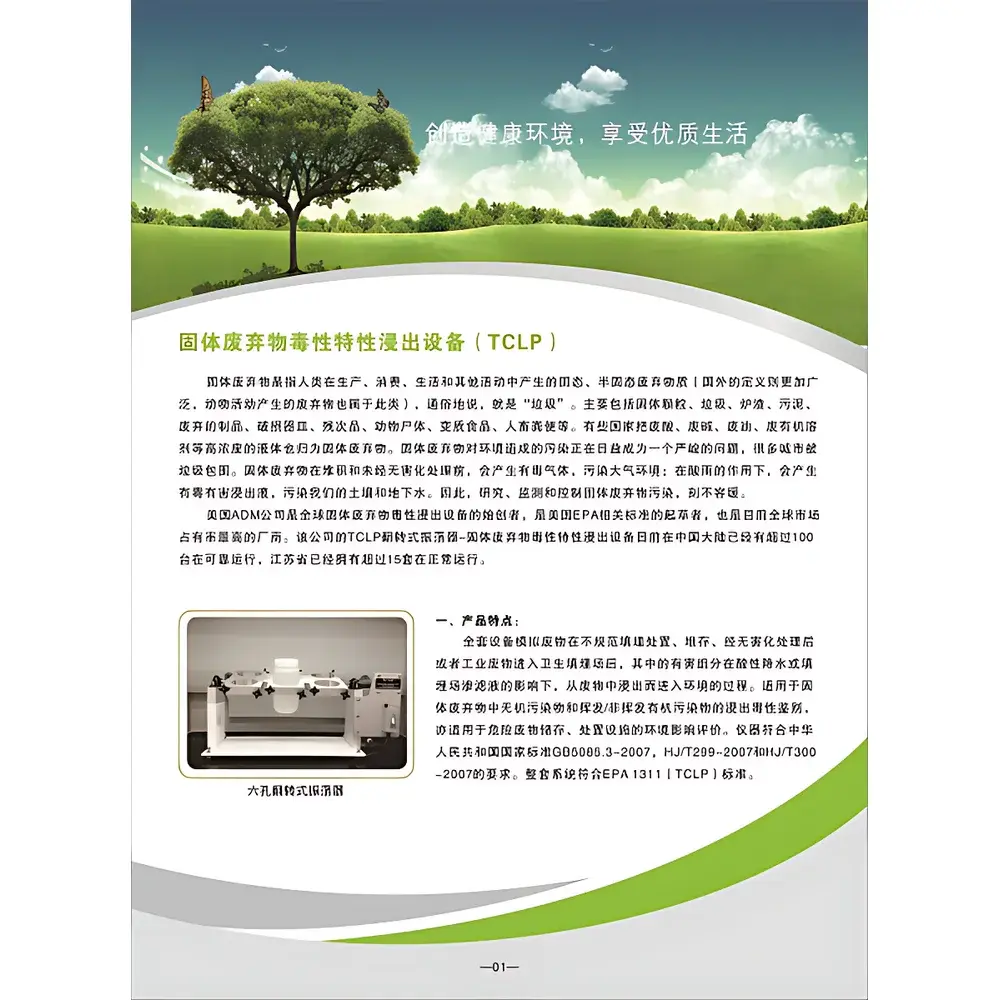
ADM TCLP Rotary Tumbler System for Solid Waste Toxicity Leaching
| Origin | USA |
|---|---|
| Manufacturer Type | Authorized Distributor |
| Origin Category | Imported |
| Model | TCLP |
| Price | USD 35,000 (FOB) |
Overview
The ADM TCLP Rotary Tumbler System is a rigorously engineered laboratory platform designed to simulate the leaching behavior of hazardous constituents from solid waste under acidic, landfill-relevant conditions. It implements the U.S. Environmental Protection Agency (EPA) Method 1311 — Toxicity Characteristic Leaching Procedure — as a standardized protocol for regulatory toxicity characterization. The system operates on the principle of controlled rotational tumbling in sealed containers, subjecting solid waste samples to pH-adjusted acetic acid or buffered nitric/sulfuric acid extraction solutions for 18 ± 2 hours at 30 ± 2 rpm. This mimics long-term geochemical interactions between waste matrices and infiltrating leachate in unlined or inadequately managed disposal sites. As the original equipment developer for EPA 1311 and a primary contributor to ASTM D5233 and ISO 17241-3, ADM’s design forms the technical foundation for regulatory compliance testing across North America, the EU, and APAC jurisdictions requiring TCLP-equivalent data for RCRA, WEEE, ELV, and national hazardous waste classification frameworks.
Key Features
- Rotary tumbler with precision-engineered aluminum frame, overload protection circuitry, and vibration-damped bearing assembly for continuous 18-hour operation at 30 ± 2 rpm
- Configurable chamber capacity: 2-, 6-, 12-, or 24-position models accommodating 2-L glass, HDPE, PTFE-lined, or ZHE-compatible vessels
- Integrated pH adjustment port enabling rapid, in-situ acidification without vessel removal — compliant with HJ/T 299–2007 and GB 5085.3–2007 procedural requirements
- High-pressure stainless steel hardware: HWF filter (316 SS, 2.2 L volume, 142 mm diameter, mirror-finished & passivated interior, rated >50 psi)
- Zero-Headspace Extractor (ZHE): 316 SS construction with SLO/FLO-coated piston, 550 mL capacity, 90 mm diameter, calibrated oil-filled pressure gauge (0–60 psi), and 4 °C operational stability
- PTFE-lined 600 mL stainless steel gas-tight syringe with integrated safety pressure relief valve
- Chemically inert fluid metering pump: PTFE-wetted tubing and pump head, 100 psi maximum pressure, adjustable flow rate (0–100 mL/min), bidirectional flow control, and fine-resolution flow calibration
Sample Compatibility & Compliance
The system supports representative sampling and extraction of heterogeneous solid waste matrices including municipal solid waste incinerator ash, industrial sludge, spent catalysts, contaminated soils, foundry sands, electronic waste fractions, and stabilized remediation residuals. It accommodates both volatile organic compounds (VOCs) and semi-volatile/non-volatile analytes (SVOCs, metals, cyanide, anions) per EPA 1311, 1312 (SPLP), and 1330B (WET) protocols. Hardware surfaces are electropolished and passivated to minimize analyte adsorption and metal leaching during extraction. All components meet FDA 21 CFR Part 11 requirements for audit-trail-capable instrumentation when paired with validated ADM LIMS-integrated software. The system is certified for use in GLP-compliant laboratories conducting Tier 1 environmental impact assessments for landfill permitting, waste classification under EU Waste Framework Directive Annex III, and RCRA Subtitle C hazardous waste determination.
Software & Data Management
The ADM TCLP Control Suite (v4.2+) provides instrument parameter logging, real-time RPM and temperature monitoring, automated run-time validation alerts, and digital signature-enabled report generation. Data export conforms to ASTM E2500-13 for analytical instrument qualification, supporting IQ/OQ/PQ documentation packages. Audit trails record operator ID, method version, calibration history, and all parameter modifications — fully traceable for FDA 21 CFR Part 11, ISO/IEC 17025:2017, and China CNAS-CL01:2018 compliance. Raw datasets are structured in .CSV and .XML formats compatible with Thermo Fisher Chromeleon, Agilent OpenLab, and Waters Empower chromatography data systems.
Applications
- Determination of TCLP-extractable concentrations of arsenic, barium, cadmium, chromium, lead, mercury, selenium, silver, and antimony per 40 CFR Part 261.24
- VOC leaching assessment using ZHE-coupled GC-MS analysis per EPA 8260D
- Leachate quality modeling input generation for landfill post-closure monitoring programs
- Pre-disposal screening of industrial byproducts prior to landfill acceptance (e.g., coal combustion residuals, mining tailings)
- Validation of stabilization/solidification treatment efficacy for contaminated soils
- Supporting environmental site assessments (ESAs) under ASTM E1527-21 and Phase II investigations
FAQ
Does this system comply with Chinese national standards for hazardous waste identification?
Yes — fully compliant with GB 5085.3–2007, HJ/T 299–2007 (TCLP), and HJ/T 300–2007 (SPLP), including hardware specifications, rotation parameters, and container compatibility requirements.
Can the rotary tumbler accommodate non-standard container geometries?
Standard configurations support 2-L cylindrical vessels; custom clamping fixtures are available for irregular shapes upon engineering review and mechanical validation.
Is the ZHE suitable for benzene, chloroform, and other highly volatile organics?
Yes — the zero-headspace design, PTFE-sealed piston, and pressure-rated construction ensure quantitative recovery of VOCs with boiling points below 100 °C per EPA Method 5021A.
What maintenance intervals are recommended for the fluid metering pump?
PTFE pump heads require replacement every 1,500 operational hours; tubing inspection and calibration verification are required quarterly per ADM PM-1311-02 maintenance protocol.
How is system performance verified prior to regulatory submission?
Each unit ships with NIST-traceable RPM and pressure calibration certificates; users perform daily system suitability checks using certified reference materials (CRM 401, CRM 402) per EPA SW-846 Chapter One guidelines.







