
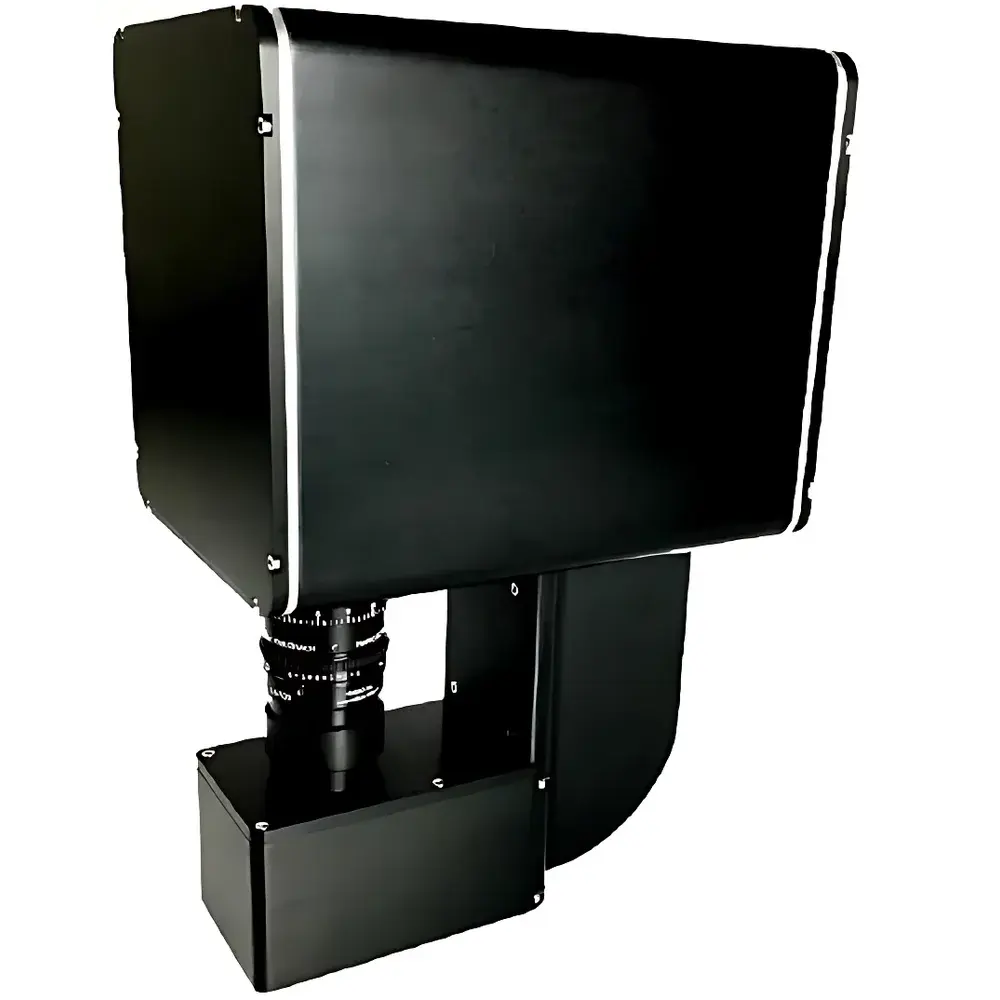
Admesy Atlas Imaging Colorimeter for Display Metrology
| Brand | Admesy |
|---|---|
| Origin | Netherlands |
| Model | Atlas-Colorimeters |
| Spectral Range | 380–780 nm |
| Wavelength Resolution (FWHM) | 2.3 nm |
| Camera Options | 8 MP (3312 × 2488) or 16 MP (4872 × 3248), 12-bit output |
| Nonlinearity | < 1% |
| SNR | 60 dB |
| Exposure Time | 1 ms – 16 s |
| Integral Time (Spectrometer) | 1.4 ms – 20 s |
| Stray Light | < 0.03% |
| Lens Options | Componon-S f/4.0–f/5.6, focal lengths 80–102 mm |
| Field of View (Diagonal) | 12.6°–19.2° (depending on model & working distance) |
| Compliance | ISO/CIE photopic and colorimetric standards, NIST-traceable calibration protocols |
Overview
The Admesy Atlas Imaging Colorimeter is a high-precision, two-dimensional spectral imaging system engineered for objective photometric and colorimetric characterization of flat-panel displays, LED modules, OLED panels, and other emissive or reflective optical surfaces. Unlike conventional single-point colorimeters or tristimulus meters, the Atlas integrates a calibrated scientific-grade CCD sensor with a built-in Czerny-Turner spectrometer—enabling simultaneous spatial and spectral measurement across the full visible spectrum (380–780 nm). This hybrid architecture delivers true CIE-compliant XYZ tristimulus values at every pixel, supporting rigorous luminance (cd/m²), chromaticity (x, y or u’, v’), and correlated color temperature (CCT) mapping. The system operates on the principle of spectral radiance imaging: each pixel records a full spectrum, from which photometric and colorimetric quantities are derived via CIE 1931 2° standard observer functions and CIE 1964 10° supplemental functions—ensuring metrological traceability to international lighting and display standards.
Key Features
- Full-spectrum imaging: Captures spatially resolved spectra (380–780 nm) with 2.3 nm FWHM resolution, enabling accurate derivation of CIE XYZ, Yxy, Lu*v*, and CCT without interpolation artifacts.
- Two camera configurations: 8 MP (3312 × 2488) and 16 MP (4872 × 3248) TrueSense CCD sensors, both delivering 12-bit linear output, <1% nonlinearity, and 60 dB SNR for high dynamic range performance.
- Automated 2D uniformity analysis: Implements Admesy’s proprietary DFF (Dynamic Flat Field) and MURA algorithms for quantitative assessment of luminance and chromaticity uniformity, including black MURA, cloud MURA, blob, line, and edge leakage defects.
- Pixel-level defect detection: Identifies dead pixels, stuck subpixels, line defects, and foreign particles (e.g., dust, residue) using spectral contrast thresholds and spatial gradient analysis.
- No-user-calibration operation: Factory-calibrated with NIST-traceable reference sources; includes embedded photopic V(λ) and color-matching function weighting—eliminating field recalibration requirements.
- Scriptable test automation: Extensive Python-based API with pre-integrated function library enables users to define custom workflows—including region-of-interest (ROI) masking, pass/fail logic, multi-step sequences, and conditional branching—without programming expertise.
- Real-time flicker analysis: Optional time-resolved mode supports temporal luminance modulation measurement per pixel (flicker %, frequency, waveform shape) in compliance with IEC TR 61000-3-3 and ENERGY STAR V2.1 requirements.
Sample Compatibility & Compliance
The Atlas system is optimized for flat, planar, and mildly curved emissive surfaces including LCD, OLED, microLED, Mini-LED, and AMOLED displays—supporting measurements at standard working distances (152–1041 mm) with interchangeable Componon-S lenses. It meets essential metrological requirements for display qualification in R&D, production QA, and regulatory validation environments. All photometric outputs conform to CIE S 014-1/E:2006 (photopic luminous efficiency), CIE 15:2018 (colorimetry), and ISO 13406-2 (display ergonomics). For regulated industries, the software architecture supports audit-ready data logging with timestamped metadata, user authentication, and configurable electronic signatures—facilitating alignment with GLP, GMP, and FDA 21 CFR Part 11 documentation integrity requirements.
Software & Data Management
The Atlas Control Suite provides a modular, Windows-based interface with real-time visualization, batch processing, and report generation. Raw spectral cubes (x, y, λ) are stored in HDF5 format with embedded calibration metadata, ensuring long-term reproducibility. Export options include CSV (per-pixel XY coordinates + CIE values), TIFF (luminance/chromaticity maps), PDF reports with statistical summaries (min/max/mean/std dev per ROI), and XML for integration into MES or LIMS platforms. The scripting engine logs all executed commands with timestamps and parameter states—enabling full procedural traceability for internal audits or external certification bodies.
Applications
- Display manufacturing: MURA grading, white point tuning, gamma verification, and panel binning based on Δu’v’ or ΔE₀₀ tolerances.
- R&D labs: Spatial chromaticity drift analysis under thermal stress, viewing angle characterization, and backlight uniformity optimization.
- Quality assurance: Automated pass/fail inspection for brightness uniformity (ΔL*), color shift (ΔE₂₀₀₀), pixel defects, and edge glow in consumer electronics.
- AR/VR optics: Microdisplay evaluation, waveguide exit pupil uniformity mapping, and chromatic aberration quantification.
- Automotive HMI: Instrument cluster and infotainment screen validation per UNECE R118 and ISO 15008 ambient light adaptation criteria.
FAQ
Does the Atlas require periodic recalibration by the user?
No. The system is factory calibrated using NIST-traceable standards and maintains stability through temperature-compensated optics and spectral referencing. Recalibration is only recommended after physical impact or extended storage (>12 months).
Can the Atlas measure reflective samples such as printed color charts or automotive trim?
Yes—when used with an optional integrated diffuse illumination unit (sold separately), the system supports reflectance mode with controlled 45°/0° or 0°/45° geometry per ISO 5-4 and ASTM E308.
Is the software compatible with third-party automation platforms like LabVIEW or PLC-controlled conveyors?
Yes. The SDK provides TCP/IP and DLL interfaces with full command documentation, enabling seamless integration into automated inline inspection stations or custom test benches.
What spectral data formats are supported for export?
Raw spectral data is saved in HDF5 with embedded CIE function weights; processed results support CSV, TIFF, PNG, PDF, and XML—ensuring compatibility with MATLAB, Python (NumPy/Pandas), and enterprise analytics tools.
How is measurement uncertainty quantified for luminance and chromaticity?
Uncertainty budgets follow JCGM 100:2008 (GUM) methodology and are documented per ISO/IEC 17025. Typical expanded uncertainties (k=2) are ±1.2% for luminance and ±0.0015 in CIE 1976 u’v’ space under controlled lab conditions.



