
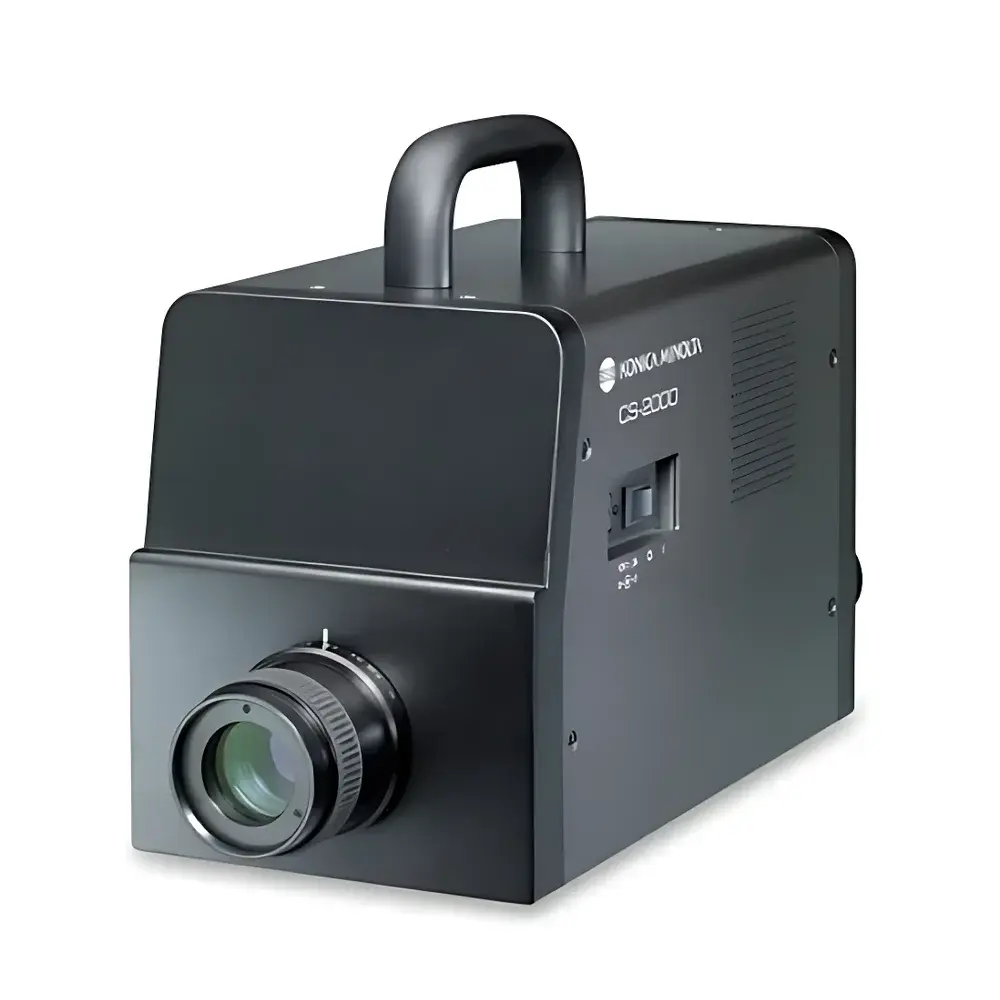
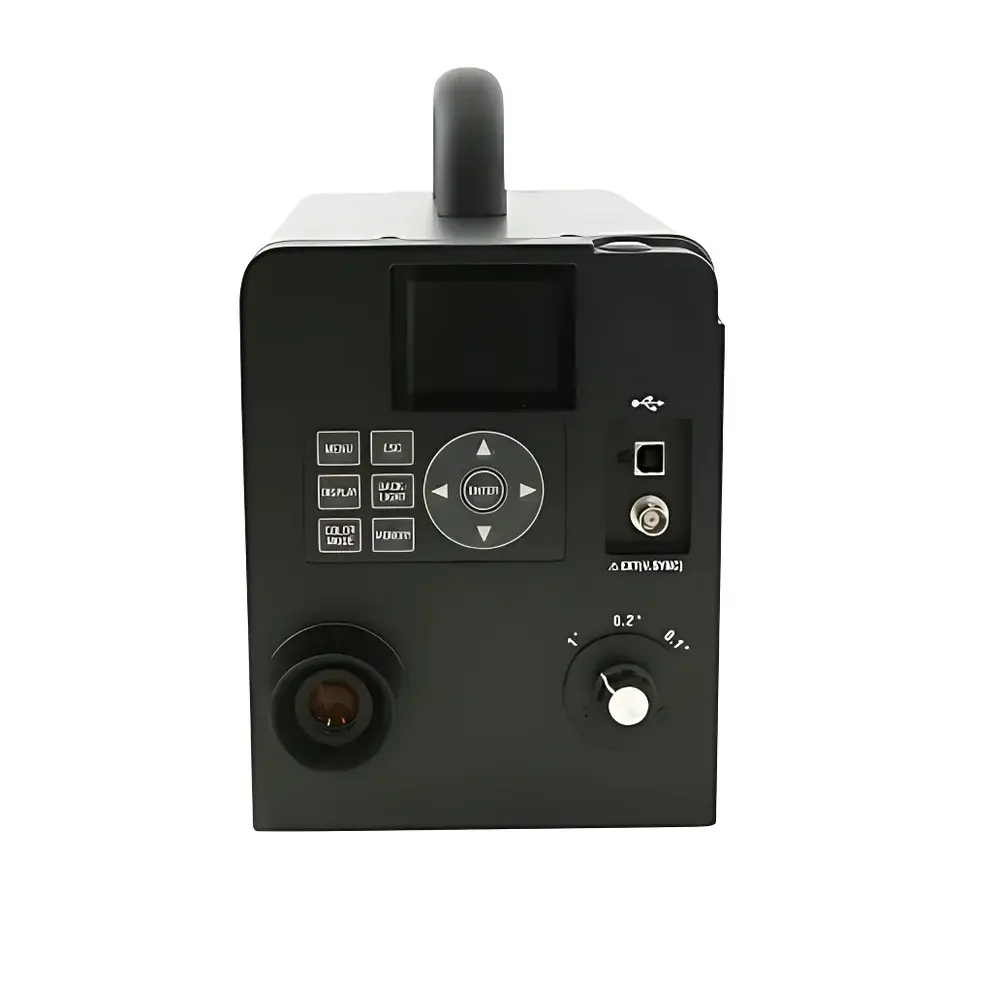
Admesy CS2000 Spectroradiometer
| Brand | Admesy |
|---|---|
| Origin | Netherlands |
| Model | CS2000 |
| Luminance Range | 0.003–300 cd/m² |
| Contrast Ratio Measurement Capability | Up to 100,000:1 |
| Spectral Bandwidth (FWHM) | 5 nm |
| Polarization Error | ≤2% (at 1° field of view) |
| Measurement Angles | 1°, 0.2°, 0.1° |
| Minimum Measurable Spot Size | Ø0.1 mm (with close-up lens) |
| Measurement Time at 1 cd/m² (Fast Mode) | ~5 s |
| Warm-up Time | 30 s |
| Operating Temperature | 5–35 °C |
| Compliance | JIS Z 8724-1997, CIE 122-1996 |
Overview
The Admesy CS2000 Spectroradiometer is a high-precision, benchtop-grade instrument engineered for absolute spectral radiance and luminance measurement across ultra-low-light display technologies. Unlike broadband photometers or simplified colorimeters, the CS2000 employs a double-pass Czerny–Turner optical architecture with a reflective holographic diffraction grating to deliver true spectroradiometric data — enabling traceable, wavelength-resolved radiance (W·sr⁻¹·m⁻²·nm⁻¹) and photopic luminance (cd/m²) in a single acquisition. Its core application domain centers on the metrology of next-generation emissive displays — including OLED, MicroLED, QD-OLED, and high-dynamic-range (HDR) LCDs — where accurate quantification of near-black luminance levels (down to 0.003 cd/m²), narrow spectral features, and angularly resolved emission profiles is essential for conformance with ITU-R BT.2100, VESA DisplayHDR, and ISO 13406-2 standards.
Key Features
- Ultra-low-luminance capability: calibrated measurement range from 0.003 cd/m² to 300 cd/m² with ±2% luminance accuracy (at 5 cd/m² and above), validated per CIE TN 006:2021 protocols.
- Narrow spectral resolution: 5 nm full width at half maximum (FWHM) across 380–780 nm, satisfying the spectral bandwidth requirements defined in JIS Z 8724-1997 and CIE Publication 122-1996 for chromaticity accuracy.
- Low polarization sensitivity: ≤2% polarization error at 1° field of view — critical for stable, repeatable measurements of polarized emissive surfaces such as twisted-nematic (TN) and in-plane switching (IPS) LCDs.
- Configurable field-of-view optics: interchangeable apertures support 1°, 0.2°, and 0.1° measurement angles; optional close-up lens enables spot measurements as small as Ø0.1 mm for pixel-level analysis.
- Multi-synchronization architecture: supports internal sync (via user-defined frame rate), external vertical sync (TTL/CMOS input), and multi-integration averaging — ensuring stable capture of pulsed, PWM-driven, or temporally unstable emitters (e.g., OLEDs under variable refresh rates).
- Rapid thermal stabilization: functional readiness within 30 seconds post-power-on under ambient conditions (23°C), minimizing downtime in production QA environments.
Sample Compatibility & Compliance
The CS2000 is optimized for non-contact, collimated measurement of planar and curved emissive surfaces under controlled ambient lighting. It accommodates flat-panel displays (FPDs), automotive HUDs, AR/VR microdisplays, and signage modules mounted on standard optical tables or integrated into automated test fixtures. All radiometric calibrations are NIST-traceable and performed in accordance with ISO/IEC 17025-accredited procedures. The instrument supports audit-ready data export compliant with FDA 21 CFR Part 11 requirements when used with Admesy’s certified software suite. Its spectral response and angular acceptance meet the validation criteria for ISO 11664-1 (CIE S 014-1/E:2006) and are routinely referenced in GLP-compliant display qualification reports submitted to regulatory bodies in EU (CE marking), USA (FCC ID), and Japan (JIS compliance).
Software & Data Management
Controlled via Admesy’s SpectraWin Pro v4.x platform, the CS2000 integrates real-time spectral visualization, CIE 1931/1976 chromaticity mapping, gamma curve derivation, and Delta E₀₀ deviation reporting. Raw spectral data is stored in vendor-neutral, self-documenting HDF5 format — preserving metadata such as integration time, FOV, calibration timestamp, and environmental sensor readings (temperature/humidity). Batch processing scripts support automated pass/fail evaluation against user-defined limits (e.g., Δu’v’ < 0.003, Y < 0.005 cd/m² for black level). Audit trails record all parameter changes, user logins, and calibration events — fulfilling ALCOA+ principles for data integrity in regulated manufacturing environments.
Applications
- Display R&D: characterization of black-level performance, viewing angle dependency, and temporal emission stability in OLED and MicroLED prototypes.
- Production QA: inline verification of luminance uniformity, white-point drift, and contrast ratio (up to 100,000:1) across AEC-Q200-qualified automotive displays.
- Standards lab metrology: reference-grade validation of HDR tone-mapping curves per SMPTE ST 2084 and perceptual quantizer (PQ) transfer functions.
- AR/VR development: angularly resolved spectral radiance mapping of waveguide exit pupils and eyebox illumination profiles.
- Lighting design: spectral power distribution (SPD) analysis of tunable-white and circadian-friendly LED modules.
FAQ
What is the minimum measurable luminance, and under what conditions is the ±2% accuracy guaranteed?
The CS2000 achieves 0.003 cd/m² minimum luminance with ±2% uncertainty at luminance levels ≥5 cd/m² (1° FOV, 23°C ambient, post-30s warm-up). At sub-1 cd/m², uncertainty increases incrementally per CIE TR 215:2022 guidance.
Can the CS2000 measure flicker or temporal modulation index (TMI)?
No — it is not a high-speed photometer. For flicker analysis (IEEE 1789, IEC TR 61000-3-3), pairing with Admesy’s Hyperion high-speed spectrometer is recommended.
Is factory recalibration required annually?
Yes. Admesy recommends annual NIST-traceable recalibration, including spectral responsivity verification and FOV alignment check, to maintain compliance with ISO/IEC 17025 and internal quality management systems.
Does the instrument support remote operation via Ethernet or USB?
Yes — full SCPI command set over TCP/IP (Ethernet) and USB 2.0 (CDC class), enabling integration into LabVIEW, Python (PyVISA), or custom CI/CD test automation pipelines.
How does the CS2000 handle stray light in low-luminance measurements?
Its optical path includes dual-stage baffling, cold-stop design, and order-sorting filters — reducing stray light contribution to <0.01% of signal at 0.01 cd/m², as verified per CIE 127:2007 Annex B.
Related Products





