
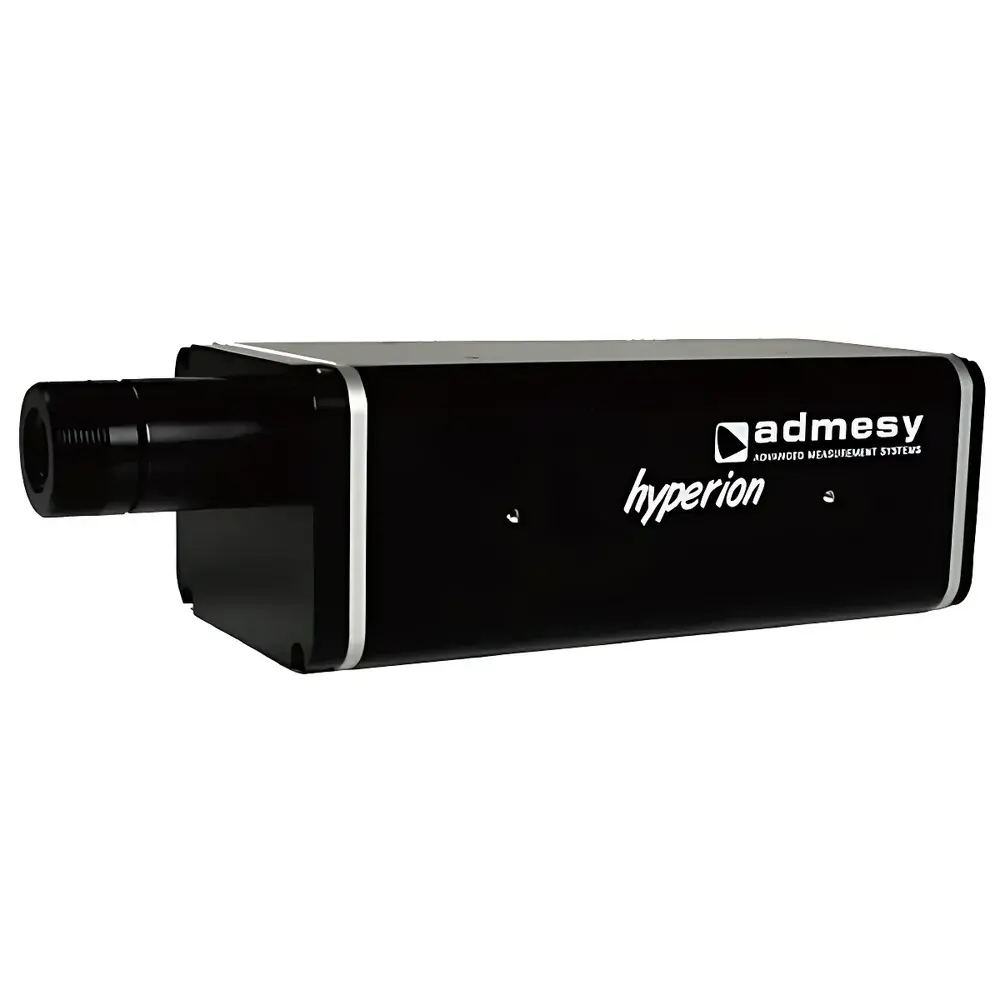
Admesy Hyperion Colorimeter
| Brand | Admesy |
|---|---|
| Origin | Netherlands |
| Model | Hyperion_colorimeters |
| Detector | Triple silicon photodiodes with XYZ interference filters |
| Spectral Response | CIE 1931 standard observer (close match) |
| Luminance Range | 0.005–20,000 cd/m² |
| Chromaticity Accuracy (x,y) | ±0.001 (calibrated) |
| Luminance Accuracy | ±4% of reading |
| Flicker Measurement | JEITA & Contrast methods |
| Sampling Rate | Up to 40 Hz (at ≥5 cd/m²) |
| Dynamic Range | >80 dB |
| Resolution | 16-bit for X, Y, Z |
| Integration Time | 0.5 ms – 1 s |
| Optical Field of View | 5° (±2.5°) |
| Spot Size | 13.5 mm @ 50 mm WD |
| Interface | USB 2.0, RS-232 |
| Power | USB bus-powered + optional 9 V DC |
| Dimensions (w/o lens) | 53 × 70 × 147 mm |
| Weight | 670 g |
| Operating Temperature | 10–35 °C |
| Shutter Lifetime | >1 million cycles |
| Shutter Speed | 250–300 ms |
| Color Spaces | CIE XYZ, Yxy, Yu’v’, CCT, Duv, Dominant Wavelength (DWL), Flicker (%, dB) |
Overview
The Admesy Hyperion Colorimeter is a high-speed, high-fidelity tristimulus color measurement instrument engineered for precision photometric and chromatic evaluation in demanding industrial and R&D environments. Based on the CIE 1931 standard observer spectral response, the Hyperion employs three matched silicon photodiodes with proprietary XYZ interference filters—ensuring accurate spectral weighting without reliance on post-acquisition correction algorithms. Its optical architecture is optimized for low-noise, high-dynamic-range operation, delivering stable performance even at luminance levels as low as 0.005 cd/m²—a critical capability for evaluating OLEDs, microLEDs, and low-power display backlights. Unlike conventional colorimeters requiring frequent recalibration, the Hyperion’s factory-traceable calibration remains valid across its full operational range, enabling rapid deployment and consistent inter-instrument reproducibility. The device operates on a dual-mode acquisition principle: continuous real-time sampling for flicker analysis and gated integration for high-SNR static measurements—making it uniquely suited for both transient display characterization and steady-state quality assurance.
Key Features
- True CIE 1931-compliant XYZ spectral response, validated per ISO/CIE 11664-3 and CIE Publication 15:2018
- Ultra-low electronic noise floor (80 dB dynamic range for reliable sub-0.01 cd/m² measurements
- Integrated flicker analysis engine supporting both JEITA TR-001 (dB-based) and contrast-ratio methodologies, sampled at up to 2000 Hz
- Modular optical interface: standard 10 mm fixed-focus lens (5° FOV); optional fiber-optic coupling for remote or confined-space applications
- 16-bit analog-to-digital conversion with programmable gain stages (Gain 1–3), each maintaining flat frequency response from DC to 500 Hz
- USB 2.0 and RS-232 dual-interface architecture for seamless integration into automated test stations, including compatibility with JEITA-standard communication protocols
- Self-contained power design: fully USB bus-powered (5 V) with optional 9 V DC auxiliary input for extended thermal stability
Sample Compatibility & Compliance
The Hyperion is designed for non-contact reflectance and emissive measurements of flat, curved, or textured surfaces—including LCD, OLED, QD-LCD, and microLED displays; automotive HUDs; signage panels; and coated optical components. Its 5° field-of-view optics enable precise spot metrology at working distances from 50 mm to 100 mm, supporting MURA assessment, white-point uniformity mapping, dead-pixel detection, and chromaticity drift monitoring over time. All factory calibrations are traceable to NIST-certified standards and documented per ISO/IEC 17025 requirements. The instrument complies with IEC 62341-6-3 (OLED measurement), ISO 9241-307 (display ergonomics), and supports audit-ready data export for GLP/GMP environments. Firmware includes configurable pass/fail thresholds, statistical process control (SPC) triggers, and timestamped metadata for full traceability under FDA 21 CFR Part 11 guidelines.
Software & Data Management
Admesy provides the open-architecture Hyperion Control Suite—a cross-platform application (Windows/macOS/Linux) supporting real-time visualization, batch scripting, and API-driven automation via .NET, Python, and LabVIEW drivers. Raw XYZ, Yxy, Yu’v’, CCT, Duv, DWL, and flicker metrics are logged in HDF5 or CSV formats with embedded calibration metadata and instrument ID. The software implements automatic dark-current compensation, temperature drift correction (using internal thermal sensors), and adaptive integration time selection based on incoming signal level. For enterprise integration, the Hyperion supports SCPI command syntax and OPC UA server mode—enabling direct linkage to MES, SPC dashboards, and centralized QA databases. All measurement sessions include immutable audit trails: user login, calibration status, environmental conditions (temperature/humidity if external sensors are attached), and firmware revision—all exportable as PDF reports compliant with ISO 10012 and ISO 9001 documentation standards.
Applications
- Display manufacturing: pixel-level uniformity validation, MURA grading, white-point tuning, and lifetime degradation tracking
- R&D labs: emissive material characterization, backlight spectral tuning, and human visual system modeling
- Automotive electronics: HUD chromaticity verification under variable ambient illumination and thermal cycling
- AR/VR headset development: near-eye display luminance homogeneity and temporal response profiling
- Lighting QA: LED binning, CCT consistency checks, and flicker compliance testing per IEEE 1789-2015
- Optical coating verification: reflectance/transmittance color shift analysis across viewing angles
FAQ
Is the Hyperion calibrated traceable to national standards?
Yes—each unit ships with a certificate of calibration traceable to NIST and PTB reference standards, including full spectral responsivity curves and uncertainty budgets per ISO/IEC 17025.
Can the Hyperion measure flicker in pulsed or PWM-driven displays?
Yes—its 2000 Hz sampling rate and hardware-triggered acquisition mode capture transient luminance waveforms without aliasing, supporting both JEITA TR-001 and IEC TR 61000-4-15 flicker metrics.
What is the minimum measurable luminance, and how is low-light stability ensured?
The lower limit is 0.005 cd/m², achieved through cooled detector biasing, correlated double sampling, and adaptive integration time—validated by repeated measurements showing <±0.2% Y repeatability at 0.1 cd/m².
Does the Hyperion support automated multi-point scanning?
Yes—when paired with Admesy’s optional motorized XY stage controller or third-party motion platforms (via TTL/RS-485), it executes programmable grid scans with synchronized coordinate tagging and spatial interpolation.
How often does recalibration required?
No routine recalibration is needed—the factory calibration remains valid for 24 months under normal operating conditions (10–35 °C, non-condensing humidity), with optional annual verification services available.




