
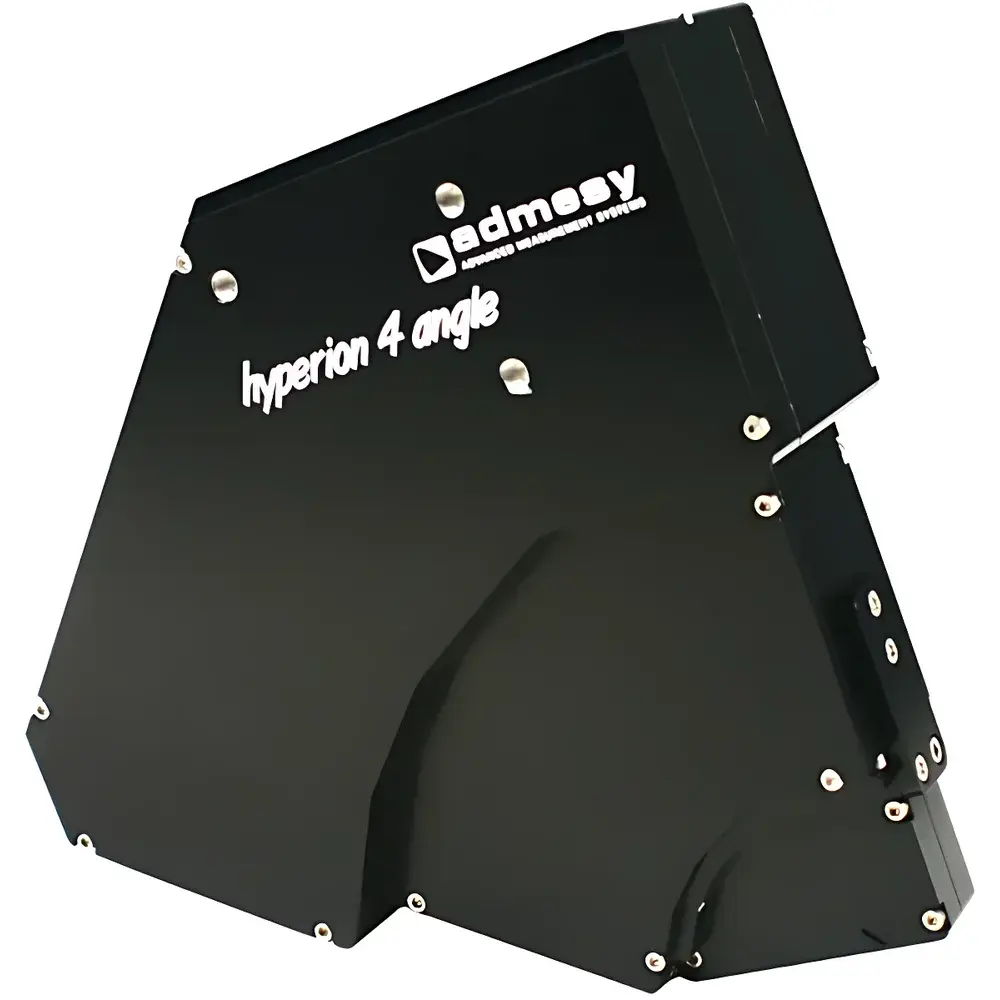
Admesy Hyperion Quad-Angle High-Speed Photometric and Colorimetric Measurement System for Displays and Light Sources
| Brand | Admesy |
|---|---|
| Origin | Netherlands |
| Model | Hyperion |
| Detection Angles | 0°, 30°, 45°, 60° |
| Spectral Response | CIE 1931-compliant XYZ tristimulus |
| Luminance Range | 0.02–20,000 cd/m² |
| Chromaticity Accuracy (x,y) | ±0.001 (post-calibration), down to ±0.0002 at 150 cd/m² |
| Flicker Measurement Speed | 2000 samples/sec (flicker mode) |
| Color Measurement Speed | ≤22 ms per acquisition |
| Dynamic Range | >80 dB |
| A/D Resolution | 16-bit (X,Y,Z) |
| Interface | USB 2.0, RS-232 |
| Operating Temperature | 10–35 °C |
| Weight | 1.5 kg |
| Dimensions (w/o lens) | 195 × 194 × 64 mm |
Overview
The Admesy Hyperion Quad-Angle Photometric and Colorimetric Measurement System is an engineered solution for high-speed, multi-angle characterization of emissive displays (OLED, microLED, LCD, Mini-LED) and light sources (LED modules, automotive lighting, backlight units). Based on the proven Hyperion single-angle platform, this quad-angle configuration integrates four independently calibrated Hyperion sensors—rigidly mounted at precisely defined viewing geometries: 0° (normal incidence), 30°, 45°, and 60°—within a single mechanical housing. Each sensor employs a proprietary XYZ interference filter stack deposited directly onto three high-stability silicon photodiodes, delivering spectral responsivity closely aligned with the CIE 1931 standard observer functions. Unlike traditional filter-wheel or scanning-based systems, the Hyperion architecture eliminates mechanical movement during measurement, enabling true simultaneous multi-angle acquisition with sub-22 ms per-color-point latency. Its ultra-low electronic noise floor (80 dB) ensure metrological integrity across low-luminance display states (e.g., black-level uniformity, dark-room HDR verification) and high-brightness operation (e.g., outdoor-readable panels, automotive headlamps).
Key Features
- Simultaneous four-angle acquisition at 0°, 30°, 45°, and 60°—no moving parts, no time skew between angles
- CIE 1931-compliant XYZ spectral response achieved via monolithic thin-film interference filters—no post-acquisition correction required
- High-sensitivity detection down to 0.02 cd/m² with <±0.0002 chromaticity repeatability at 150 cd/m²
- Dedicated flicker engine supporting both JEITA-compliant contrast-ratio method and IEEE 1789-based temporal light modulation (TLM) analysis at up to 2000 samples/sec
- Integrated shutter with >1 million actuation cycles and 250–300 ms switching time for stable dark-reference capture
- Native support for industry-standard color spaces: CIE XYZ, Yxy, Yu’v’, CCT (Correlated Color Temperature), Duv, Dominant Wavelength (DWL), and Peak Wavelength
- USB 2.0 and RS-232 dual-interface architecture for seamless integration into automated test stations, inline QC lines, and R&D labs
Sample Compatibility & Compliance
The Hyperion Quad-Angle system is optimized for flat-panel display validation, including pixel-level uniformity mapping, viewing angle dependency (Lambertian/non-Lambertian analysis), angular color shift (Δu’v’ vs. θ), and specular reflection characterization. Its fixed optical geometry (4.8° field-of-view ±2.4°, 32 mm working distance) supports repeatable measurements across diverse sample sizes—from 5 mm spot at 0° to 10 × 5 mm elliptical area at 60°. The system complies with key international standards governing photometric and colorimetric instrumentation: ISO/CIE 11664 (colorimetry fundamentals), CIE Publication 127 (LED measurement), and JEITA CP-3406 (flicker evaluation for displays). While not FDA-certified as a medical device, its data traceability, calibration certificate traceable to NPL (UK) or PTB (Germany), and audit-ready metadata logging make it suitable for GLP/GMP-aligned environments where measurement integrity and instrument qualification are mandated.
Software & Data Management
Admesy provides the Hyperion Control Suite—a native Windows application supporting real-time visualization, batch scripting, and export to CSV, XML, or HDF5 formats. The SDK (C++, .NET, Python) enables full control over integration gain (3 selectable ranges), integration time (0.5 ms – 1 s), and trigger modes (software, hardware TTL, or free-run). All acquired data includes embedded metadata: timestamp, sensor ID, angle, exposure settings, calibration ID, and environmental temperature. For regulated environments, optional software modules support 21 CFR Part 11 compliance—including electronic signatures, audit trails, and role-based access control—when deployed on validated IT infrastructure. Data synchronization across all four angles is hardware-timestamped with <1 µs jitter, ensuring phase-coherent flicker and temporal uniformity analysis.
Applications
- Display manufacturing: Angular luminance/chromacity uniformity mapping, Mura detection, viewing cone profiling
- R&D of next-gen emissive technologies: OLED aging studies, microLED binning, quantum dot stability under angular stress
- Automotive lighting QA: Headlamp beam pattern color consistency across multiple viewing angles per ISO 15007-2
- AR/VR near-eye display testing: Angular-dependent chromatic aberration quantification and virtual image quality assessment
- Standards laboratories: Reference-grade verification of integrating sphere outputs and goniophotometer cross-validation
- Content creation workflows: HDR mastering monitor calibration across typical viewing angles in broadcast control rooms
FAQ
Is the Hyperion Quad-Angle system supplied with factory calibration certificates?
Yes—each unit ships with a NIST-traceable calibration report covering XYZ responsivity, luminance linearity, and angular alignment verification.
Can the system measure pulsed or PWM-driven displays without aliasing artifacts?
Yes—the internal high-speed sampling engine (up to 2000 Hz) and programmable integration timing allow precise synchronization with display frame rates and PWM frequencies.
What is the minimum measurable spot size at 60°?
At 60°, the effective measurement area is 10 mm × 5 mm (elliptical projection); spot size is determined by optical geometry and working distance—not adjustable via aperture.
Does the system support automated pass/fail judgment against user-defined tolerances?
Yes—via the Hyperion Control Suite’s built-in limit-checking engine or through custom logic implemented in the SDK.
Is firmware upgrade capability available remotely?
Yes—firmware updates are delivered via signed binary packages through the Admesy Support Portal and applied via USB interface with rollback protection.




