
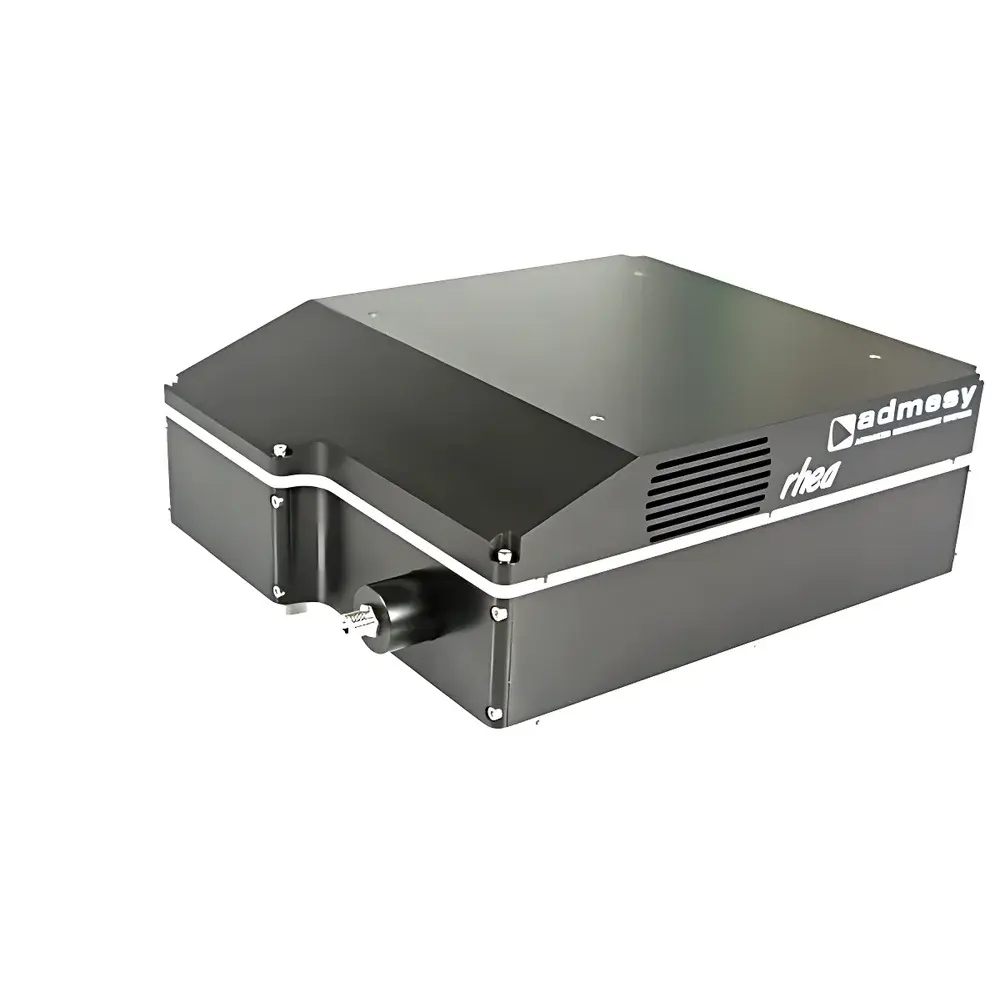
Admesy Hyperion Wide-Spectrum Low-Noise Spectroradiometer (200–1100 nm)
| Brand | Admesy |
|---|---|
| Origin | Netherlands |
| Model | Hyperion Wide-Spectrum Series |
| Spectral Range | 200–1100 nm |
| Spectral Resolution (FWHM) | 2.3 nm |
| Integration Time | 4.8 ms – 60 min |
| Dark Noise (RMS) | ~3–5 counts (16-bit ADC) |
| Stray Light | <0.03% |
| Nonlinearity | <1% |
| Detector Cooling | Thermoelectrically cooled CCD to −10 °C |
| Optical Interface | 20 mm lens (spot size: 20.5 mm @ 50 mm WD, 21 mm @ 100 mm WD, 21.5 mm @ 150 mm WD) |
| Field of View | ±0.3° |
| Interfaces | High-Speed USB (USBTMC compliant), RS232, Ethernet, External Trigger |
| Dimensions (L×W×H) | 230 × 195 × 82.5 mm (body only) |
| Weight | 3.3 kg |
| Operating Temperature | 10–35 °C |
| Power Supply | 15 V DC (14.5–15.5 V range) |
Overview
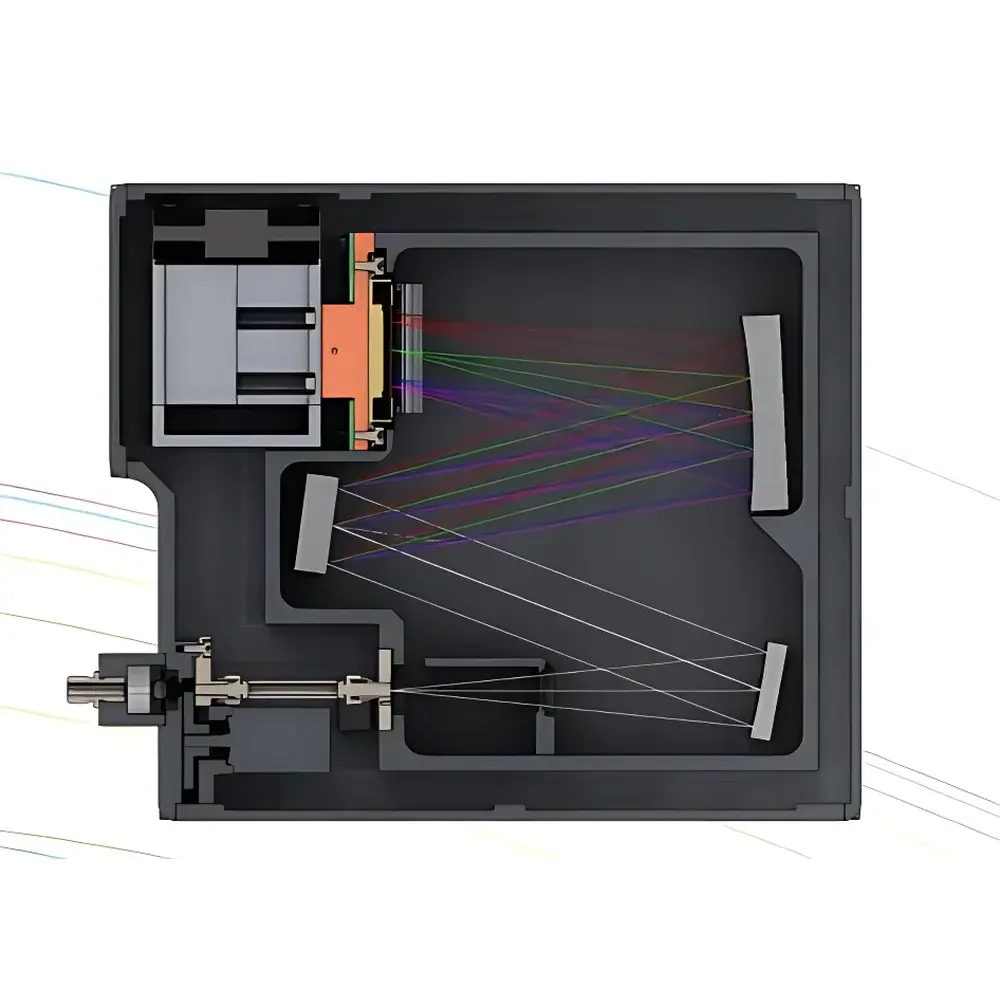
The Admesy Hyperion Wide-Spectrum Low-Noise Spectroradiometer is a laboratory-grade optical measurement instrument engineered for high-fidelity spectral radiance and irradiance characterization across the deep ultraviolet to near-infrared spectrum (200–1100 nm). Unlike conventional colorimeters relying on tristimulus filter-based approximations, the Hyperion employs a thermoelectrically cooled back-illuminated CCD detector coupled with precision diffraction optics to deliver true spectroradiometric data—enabling traceable, first-principles-based colorimetric calibration. Its core architecture follows CIE-recommended measurement geometry (f/4 input optics, ±0.3° field acceptance) and supports absolute spectral responsivity calibration per NIST-traceable standards. Designed for metrology-critical environments—including national labs, display manufacturing QA, LED phosphor R&D, and photobiological safety testing—the Hyperion serves as both a primary reference instrument for colorimeter validation and a standalone spectroradiometric platform compliant with ISO/CIE 13406-2, IEC 62471, and CIE S 026/E:2019.
Key Features
- Thermoelectrically stabilized CCD detector operating at −10 °C, reducing dark current by >95% versus ambient operation and enabling sub-5-count RMS dark noise performance
- Integrated neutral-density filter wheel providing automatic dynamic range extension up to 6 orders of magnitude without manual gain adjustment
- Fully embedded real-time signal processing: all spectral correction (dark subtraction, nonlinearity compensation, stray-light correction), CIE color space transformation (XYZ, u’v’, CCT, Duv), and photometric weighting (V(λ), erythemal, scotopic) executed onboard
- High optical throughput f/4 fore-optics with calibrated 20 mm focal-length lens; spot size precisely characterized at multiple working distances (20.5 mm @ 50 mm WD)
- Hardware-level compliance with USBTMC 1.0 and SCPI command sets, ensuring seamless integration into automated test benches governed by LabVIEW, Python (PyVISA), or MATLAB environments
- Auto-ranging integration engine dynamically selects optimal exposure time and ND filter position based on incoming signal intensity—eliminating saturation risk during rapid spectral scans
- Linearity deviation <1% over full 16-bit dynamic range, verified per ASTM E308-22 Annex A3 procedures using calibrated tungsten-halogen and deuterium lamp sources
Sample Compatibility & Compliance
The Hyperion accommodates diverse emission and reflection geometries via interchangeable optical modules (integrating spheres, collimators, fiber inputs, and cosine correctors), supporting measurements of LEDs, OLEDs, micro-LED arrays, laser diodes, reflective standards (e.g., BaSO₄, Spectralon®), and transmissive filters. All firmware and calibration data are stored in tamper-resistant EEPROM with cryptographic checksums. Instrument firmware conforms to ISO/IEC 17025:2017 requirements for measurement uncertainty propagation, and raw spectral data exports include full metadata (calibration date, serial number, integration parameters, temperature log) required for GLP/GMP audit trails. Factory calibration certificates include uncertainty budgets traceable to PTB (Physikalisch-Technische Bundesanstalt) reference standards.
Software & Data Management
Admesy’s SpectraWin software provides a validated, FDA 21 CFR Part 11–ready environment with role-based access control, electronic signatures, and immutable audit logging for all acquisition, analysis, and export events. Spectral datasets are saved in vendor-neutral HDF5 format with embedded CIE 15:2018-compliant metadata schemas. Batch processing supports automated pass/fail evaluation against user-defined tolerances for chromaticity coordinates, CCT drift, or spectral similarity (CIEDE2000 ΔE₀₀). API support includes RESTful endpoints for cloud synchronization and native drivers for NI TestStand and Keysight PathWave.
Applications
- Primary calibration of handheld and benchtop colorimeters and spectrophotometers per CIE Publication 15:2018 and ISO 13655:2017
- LED binning and phosphor consistency verification in high-volume packaging lines
- Display white-point stability monitoring under thermal and aging stress (e.g., OLED burn-in studies)
- UV-C disinfection source spectral power distribution (SPD) validation per IEC 62471 Ed. 2.0
- Material reflectance/transmittance characterization for automotive interior lighting and AR/VR waveguide development
- Photobiomodulation light source dosimetry requiring accurate action spectrum weighting (e.g., cytochrome c oxidase activation)
FAQ
Is the Hyperion suitable for calibrating industrial colorimeters used in production line QC?
Yes. Its NIST-traceable factory calibration, integrated dark-current compensation, and real-time nonlinearity correction meet the repeatability (±0.001 Δu’v’) and reproducibility (±0.002 Δu’v’) requirements specified in ISO 13655:2017 Annex B for reference-grade instruments.
Can the instrument operate unattended for long-duration stability tests?
Yes. With programmable integration time up to 60 minutes and internal temperature stabilization, the Hyperion supports continuous spectral logging at user-defined intervals—data automatically timestamped and archived with environmental sensor logs (internal temperature, supply voltage).
Does it support spectral irradiance measurements in µW/cm²/nm?
Yes. When paired with an NIST-calibrated irradiance standard and configured with the optional cosine corrector, the Hyperion reports absolute spectral irradiance with expanded uncertainty <3.5% (k=2) across 350–800 nm per CIE TN 006:2021 guidelines.
How is stray light corrected in post-processing?
Stray-light contribution is modeled using a pre-measured system-specific matrix derived from monochromator-based characterization; correction is applied in real time during acquisition using onboard FPGA resources, not interpolated post-hoc.
Is remote firmware update supported over Ethernet?
Yes. Secure OTA updates are performed via TLS 1.2-encrypted HTTP POST requests authenticated with device-specific X.509 certificates—fully auditable within SpectraWin’s Part 11 compliance log.




