
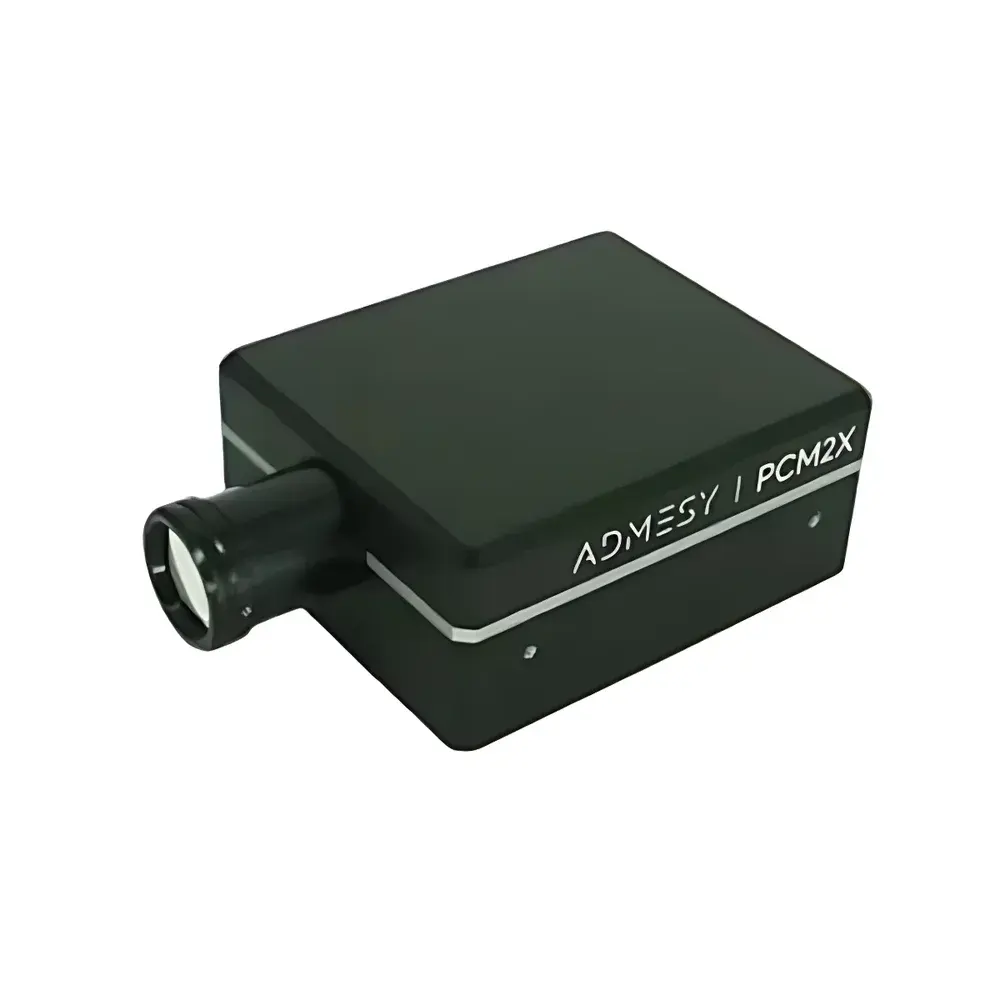
Admesy PCM2X-271 Low-Luminance High-Precision Colorimeter
| Brand | Admesy |
|---|---|
| Origin | Netherlands |
| Model | PCM2X-271 |
| Luminance Range | 2.5×10⁻⁵ to 3×10⁴ cd/m² |
| Chromaticity Accuracy Range | 2.5×10⁻⁴ to 3×10⁴ cd/m² |
| Sampling Rate (XYZ) | 600 kS/s |
| Field of View | ±5° |
| Spot Size | 30 mm @ 25 mm Working Distance |
| CIE Standard Observer | 2° CIE 1931 & CIE 170-2:2015 |
| Flicker Analysis | FFT-based (FMA, JEITA, user-defined), time-domain FMA (VRR), FIR-filtered |
| Shutter | Mechanical, USB-MTC compliant |
| OS Compatibility | Windows, Linux, macOS |
| Software Interface | VISA, LabVIEW, LabWindows CVI, Visual Studio |
Overview
The Admesy PCM2X-271 is a next-generation low-luminance colorimeter engineered for photometric and colorimetric metrology in demanding display, lighting, and R&D environments. Operating on the fundamental principles of tristimulus colorimetry, it captures spectral power distribution via precision CIE 1931 2° standard observer-matched XYZ filter arrays, coupled with high-stability silicon photodiodes. Its optical architecture minimizes photon loss through optimized light-path design and proprietary internal black coating—eliminating polarization artifacts and ensuring consistent angular response across its ±5° field of view. Unlike conventional colorimeters, the PCM2X-271 integrates dual-stage amplification per channel: a precision integrating amplifier for stable DC-level luminance quantification and a high-bandwidth transimpedance amplifier enabling real-time XYZ waveform capture at up to 600,000 samples per second. This architecture supports both static color measurement and dynamic flicker analysis under ultra-low-light conditions down to 0.000025 cd/m²—making it uniquely suited for OLED, microLED, and HDR display validation, as well as ambient-light-sensitive applications such as automotive HUD calibration and dark-room photobiological safety testing.
Key Features
- Ultra-low luminance capability: Reliable measurement from 2.5×10⁻⁵ cd/m² with <1 s integration time
- Dual-amplifier electronics per XYZ channel: Simultaneous high-precision DC luminance and high-speed AC flicker acquisition
- Optimized optical train with Admesy’s proprietary non-polarizing internal coating—ensuring repeatable angular response and eliminating polarization-induced chromatic shift
- Compliant with CIE 1931 2° and CIE 170-2:2015 observer functions; calibrated traceably to NIST-traceable standards
- Integrated mechanical shutter meeting USB-MTC timing specifications for synchronized external triggering
- Auto-ranging functionality with seamless gain switching—maintaining signal integrity across six orders of magnitude in luminance
- Onboard MCU supporting real-time FFT-based flicker metrics (FMA, JEITA, user-defined) and time-domain VRR-aware FMA calculation
Sample Compatibility & Compliance
The PCM2X-271 is designed for direct measurement of emissive surfaces including OLED, QD-OLED, microLED, LCD with local dimming, and projection systems. Its 30 mm spot size at 25 mm working distance enables uniform sampling of pixel-level emission without spatial averaging artifacts. The ±5° reception angle ensures compatibility with wide-viewing-angle displays while suppressing off-axis stray light—a critical requirement for ISO 9241-307, IEC 62341-6-3, and VESA DisplayHDR™ test protocols. All firmware and calibration data comply with GLP/GMP audit requirements: full calibration history, timestamped measurement logs, and secure digital signature support for traceability. Device drivers and API libraries conform to IVI-C and USBTMC-USB488 standards, facilitating integration into automated test systems validated under ISO/IEC 17025.
Software & Data Management
The PCM2X-271 operates natively via Admesy’s Spectra software suite (Windows/macOS/Linux), offering real-time spectral visualization, flicker waveform export (CSV, HDF5), and customizable pass/fail thresholds per CIE u’v’, ΔE₀₀, or flicker percentage. For system integrators, the instrument exposes a full VISA-compliant SCPI command set and native DLLs for LabVIEW, LabWindows/CVI, and Visual Studio (.NET/C++). All data streams include embedded metadata: timestamp (UTC), integration time, gain setting, shutter state, and calibration ID. Audit trails record operator login, configuration changes, and firmware updates—supporting compliance with FDA 21 CFR Part 11 when deployed in regulated QC environments.
Applications
- Display manufacturing: Pixel-level uniformity mapping, burn-in assessment, and temporal stability analysis of next-gen emissive panels
- R&D labs: Human visual system modeling, mesopic photometry, and circadian light metric derivation (e.g., melanopic EDI)
- Automotive: HUD and instrument cluster luminance homogeneity verification under simulated nighttime conditions
- Medical device validation: Photometric safety testing of surgical lighting and diagnostic displays per IEC 62471
- AR/VR headset characterization: Near-eye display luminance, chromaticity, and flicker evaluation at sub-0.001 cd/m² levels
FAQ
What CIE observer standards does the PCM2X-271 support?
It implements both the CIE 1931 2° standard observer and the updated CIE 170-2:2015 2° observer function, with factory calibration traceable to NIST SRM 2241.
Is the mechanical shutter synchronized to external triggers?
Yes—the shutter complies with USB-MTC v1.0 and supports hardware-triggered exposure with jitter <1 µs, enabling lock-step operation with pattern generators or camera systems.
Can flicker metrics be calculated onboard, or is post-processing required?
All flicker algorithms—including JEITA, VESA FMA, and user-defined FFT windows—are executed in real time by the onboard MCU; no external computation is necessary for basic metrics.
Does the device support automated calibration verification?
Yes—integrated self-test routines verify photodiode linearity, amplifier offset drift, and filter spectral responsivity at startup and on-demand, generating ISO/IEC 17025-compliant verification reports.
What operating systems are supported for direct driver integration?
Native VISA drivers are provided for Windows (x64), Linux (Ubuntu 20.04+, kernel 5.4+), and macOS (12.0+), with source-level compatibility for embedded RTOS platforms via Admesy’s SDK.





