
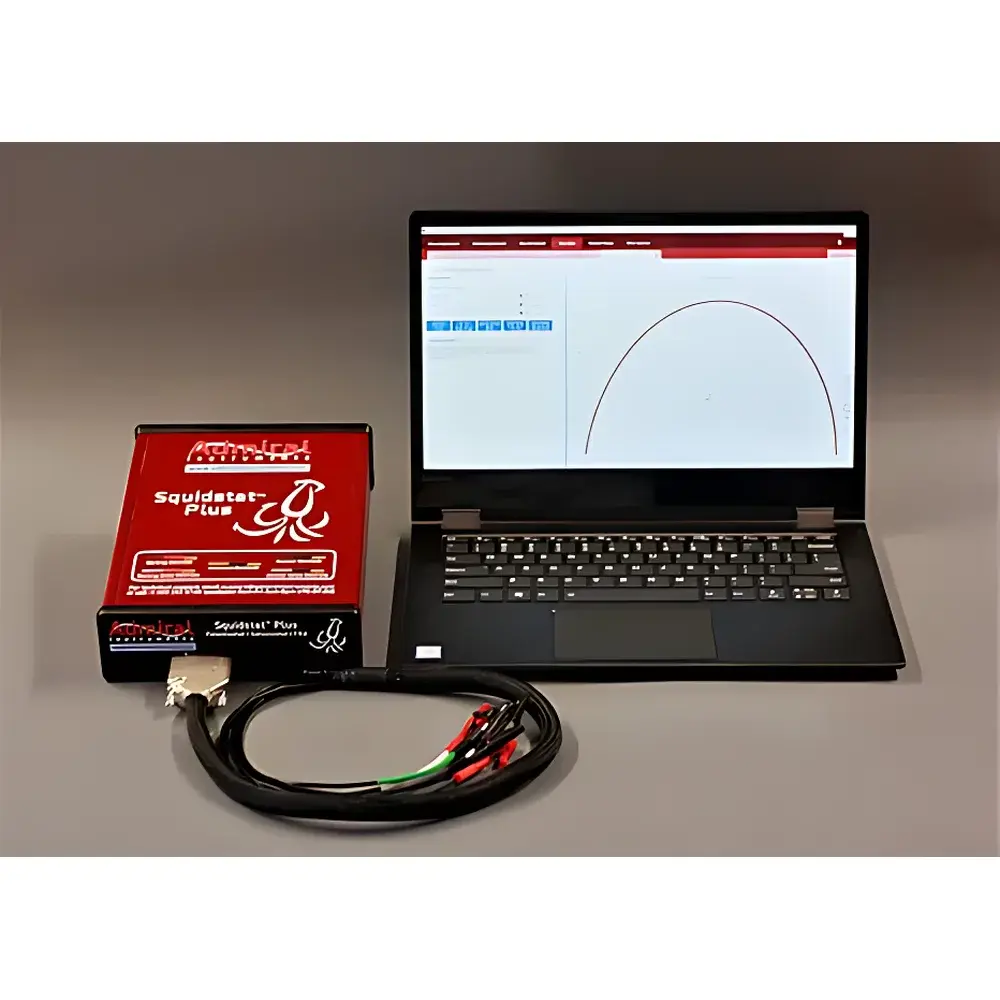
Admiral Squidstat Plus Electrochemical Workstation
| Brand | Admiral |
|---|---|
| Origin | USA |
| Model | Squidstat Plus |
| Instrument Type | Portable Electrochemical Workstation |
| Channel Count | Single-Channel |
| Current Range | ±1 A |
| Current Accuracy | ±1 A |
| Potential Accuracy | ±300 µV |
| Potentiostatic Range | ±10 V |
| EIS Frequency Range | 10 µHz – 1 MHz |
| Current Resolution | 3 pA (0.003% of full scale) |
| Voltage Resolution | 300 µV |
| Data Storage | Internal 16 GB Flash Memory |
| Output Format | CSV (up to millions of data points) |
Overview
The Admiral Squidstat Plus Electrochemical Workstation is a compact, single-channel potentiostat/galvanostat engineered for precision electrochemical characterization in research laboratories, quality control environments, and academic teaching settings. It operates on a bipotentiostatic architecture with integrated digital signal processing, enabling high-fidelity control of potential and current waveforms across a broad dynamic range. Its core measurement capabilities include potentiostatic and galvanostatic DC techniques, as well as frequency-domain electrochemical impedance spectroscopy (EIS) from 10 µHz to 1 MHz — a range sufficient to resolve interfacial processes spanning charge transfer, diffusion, and double-layer relaxation. Designed for portability without compromising analytical integrity, the Squidstat Plus features a robust aluminum chassis, low-noise analog front-end circuitry, and real-time parameter optimization during experiment execution. Its modular firmware supports future protocol expansion via software updates, ensuring long-term adaptability to evolving experimental requirements.
Key Features
- Single-channel portable workstation with ±1 A current compliance and ±10 V potential range, suitable for both low-current microelectrode studies and high-current battery cycling
- High-resolution current measurement down to 3 pA (0.003% of full scale), enabling accurate quantification of faradaic processes in corrosion, sensor, and bioelectrochemical applications
- Electrochemical Impedance Spectroscopy (EIS) with 10 µHz–1 MHz frequency coverage, supporting both potentiostatic and galvanostatic excitation modes
- Onboard 16 GB non-volatile flash memory for autonomous data logging; all acquired datasets are automatically saved in industry-standard CSV format upon acquisition
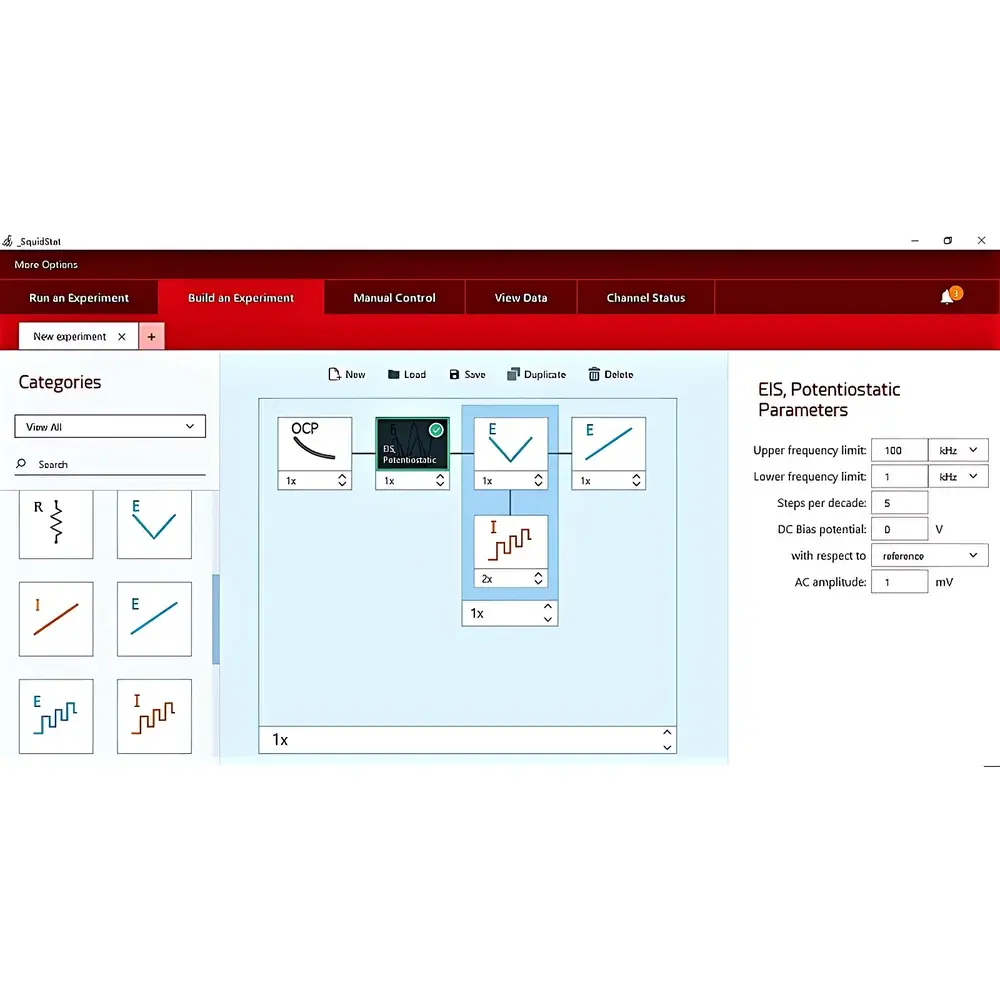
- Drag-and-drop method builder within Squidstat software, allowing users to construct custom sequences combining multiple DC and AC techniques without scripting
- Real-time parameter adjustment during active experiments, including scan rate, pulse width, AC amplitude, and frequency sweep parameters
- Support for multi-instrument synchronization: up to eight Squidstat Plus units can be daisy-chained and controlled simultaneously from a single host PC via USB hub or Ethernet interface
Sample Compatibility & Compliance
The Squidstat Plus interfaces seamlessly with standard three-electrode electrochemical cells (working, reference, counter), as well as rotating ring-disk electrodes (RRDE), microelectrodes, and thin-film battery test fixtures. Its hardware design complies with IEC 61010-1 safety standards for laboratory electrical equipment. While not certified for GMP manufacturing environments, its data integrity features — including timestamped CSV export, audit-ready metadata embedding (e.g., instrument ID, firmware version, user-defined notes), and deterministic file naming — align with GLP documentation practices. The system supports traceable calibration using NIST-traceable reference standards, and raw data files retain unprocessed voltage/current time-series for retrospective reanalysis.
Software & Data Management
Squidstat software (v5.x, Windows 10/11 compatible) provides an intuitive graphical interface built on Qt framework, featuring live plotting, overlay comparison of multiple experiments, and batch analysis tools for CV peak integration, Tafel slope fitting, and EIS equivalent circuit modeling (via ZView-compatible import/export). All data files embed metadata such as experiment start time, applied waveform parameters, environmental temperature (if connected to optional external probe), and operator ID. Software includes built-in support for ASTM G102 (corrosion rate calculation), ASTM D1148 (rubber aging), and ISO 16773-2 (coating impedance evaluation). Remote technical assistance is provided via secure TeamViewer sessions under signed NDA, with firmware patches delivered through encrypted download portals.
Applications
- Battery R&D: GITT/PITT for lithium-ion diffusion coefficient estimation; CC-CV-EIS for in-situ impedance evolution during charge/discharge cycles
- Corrosion Science: Linear polarization resistance (LPR), electrochemical noise analysis (ENA), and Mott-Schottky capacitance-voltage profiling of passive films
- Electrocatalysis: Tafel analysis, cyclic voltammetry for HER/OER activity assessment, and dual-potential-step chronoamperometry for catalyst stability screening
- Sensor Development: Amperometric detection limits determination, DPV/SWV for trace metal ion quantification, and enzyme electrode kinetics modeling
- Materials Characterization: Conducting polymer redox switching, semiconductor bandgap estimation via Mott-Schottky plots, and organic photovoltaic interfacial charge recombination analysis
FAQ
Can the Squidstat Plus perform true galvanostatic EIS?
Yes — it delivers controlled current perturbation across the full 10 µHz–1 MHz range with phase-locked feedback loop stability verified per ASTM E2917.
Is the 16 GB internal memory accessible as a removable drive?
No — the flash memory is soldered and managed exclusively by firmware; data export occurs via USB or network transfer after acquisition completion.
Does the system support FDA 21 CFR Part 11-compliant electronic signatures?
Not natively; however, third-party LIMS integration (e.g., LabWare, Thermo SampleManager) enables compliant audit trails when deployed in regulated QC labs.
What is the minimum detectable current step size in chronoamperometry?
With 24-bit DAC resolution and auto-ranging, the smallest programmable current increment is 3 pA at the ±1 nA range setting.
Can I run impedance measurements while applying a DC bias for battery half-cell testing?
Yes — potentiostatic EIS allows superimposing sinusoidal perturbations (1–50 mV RMS) on user-defined DC bias potentials between –10 V and +10 V.
Related Products




