
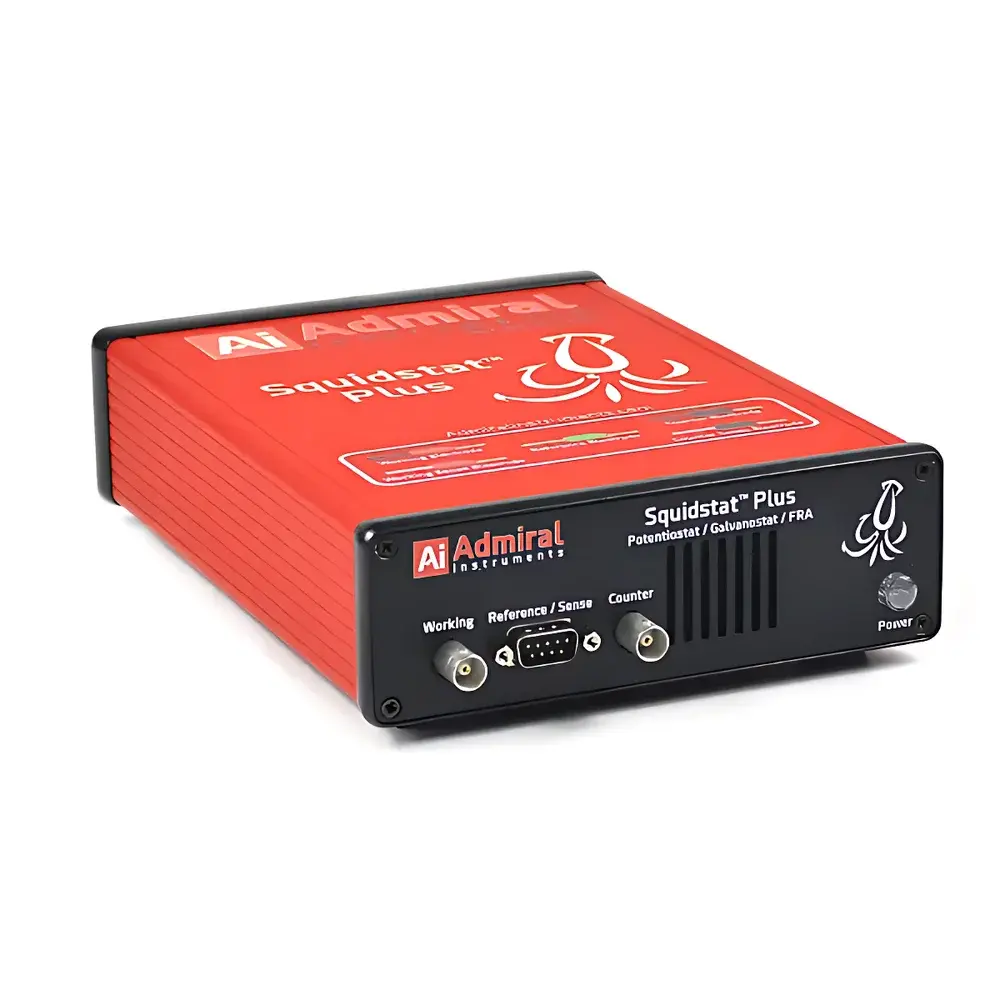

Admiral Squidstat Plus Electrochemical Workstation
| Brand | Admiral |
|---|---|
| Origin | USA |
| Model | Squidstat Plus |
| Instrument Type | Electrochemical Workstation |
| Channel Count | Single-Channel |
| Current Range | ±1 A |
| Current Accuracy | ±0.2% of reading (typ.) |
| Potential Accuracy | ±300 µV |
| Potentiostatic Range | ±10 V |
| EIS Frequency Range | 10 µHz – 1 MHz |
| Current Resolution | 3 pA (at 1 A range) |
| Potential Resolution | 15 µV |
| Onboard Memory | 16 GB internal storage |
| Data Format | CSV export |
| Supported DC Techniques | CV, LSV, OCP, Tafel, CA, CP, DPV, NPV, SWV, RRDE, Staircase Voltammetry, GITT, PITT |
| Supported AC Techniques | Potentiostatic EIS, Galvanostatic EIS, Mott-Schottky (1/C² vs. E) |
| Battery Testing Modes | CC-CV, CC-CV-EIS, CP/CR, dQ/dV analysis, Coulombic & energy efficiency calculation |
Overview
The Admiral Squidstat Plus Electrochemical Workstation is a compact, high-fidelity single-channel potentiostat/galvanostat engineered for precision electrochemical characterization in academic research, battery development, corrosion studies, and sensor validation laboratories. Built on a robust digital signal processing architecture, it implements true four-quadrant operation with galvanostatic and potentiostatic control modes, enabling accurate measurement of current response under applied potential or vice versa. Its core design adheres to fundamental electrochemical instrumentation principles—employing a high-stability analog front-end, low-noise current-to-voltage conversion, and active probe technology at voltage sensing terminals to minimize lead impedance effects and improve interfacial potential fidelity. With a wide EIS frequency bandwidth spanning six decades (10 µHz to 1 MHz), the Squidstat Plus supports both slow kinetic processes (e.g., passive film growth, diffusion-limited reactions) and fast interfacial phenomena (e.g., double-layer charging, charge-transfer resistance), making it suitable for comprehensive mechanistic analysis across diverse electrochemical systems.
Key Features
- Single-channel architecture with ±1 A maximum current output and ±10 V compliance voltage, optimized for flexible cell configurations including three-electrode, two-electrode, and pseudo-reference setups
- High-resolution potential control (15 µV) and current measurement (down to 3 pA), ensuring sensitivity for low-current applications such as microelectrode studies or ultrathin film electrochemistry
- Onboard 16 GB non-volatile memory enables autonomous data logging independent of host PC—critical for long-duration experiments (e.g., OCP monitoring over days) or environments where computer reliability is constrained
- Active probe technology integrated into voltage input circuitry reduces cable-induced phase shift and improves high-frequency EIS accuracy, particularly above 10 kHz
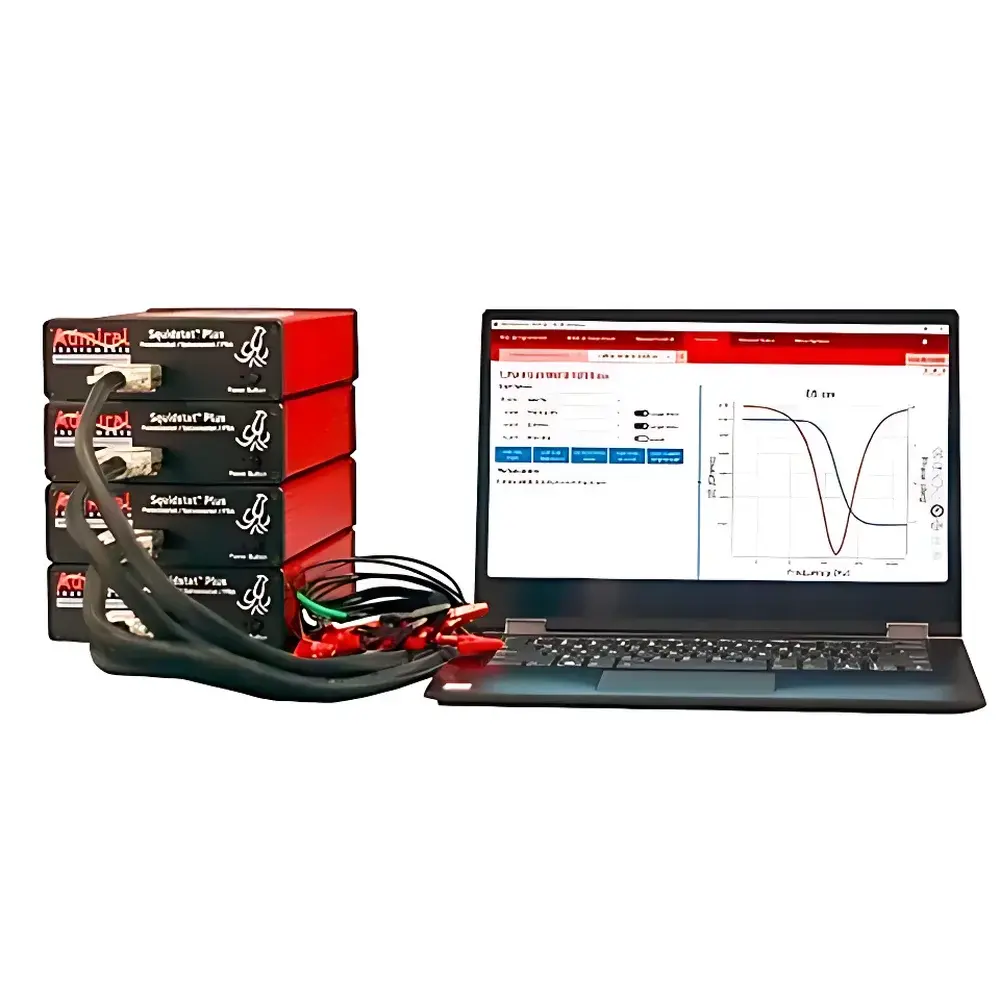
- Modular scalability: Multiple Squidstat Plus units can be synchronized via USB or Ethernet to form a multi-channel system controlled from a single software instance—ideal for parallel electrode screening or multi-cell battery testing
- Full support for ASTM G102 (standard practice for calculating corrosion rates), ISO 16773 (EIS for coatings), and USP / (electrochemical validation protocols in pharmaceutical contexts)
Sample Compatibility & Compliance
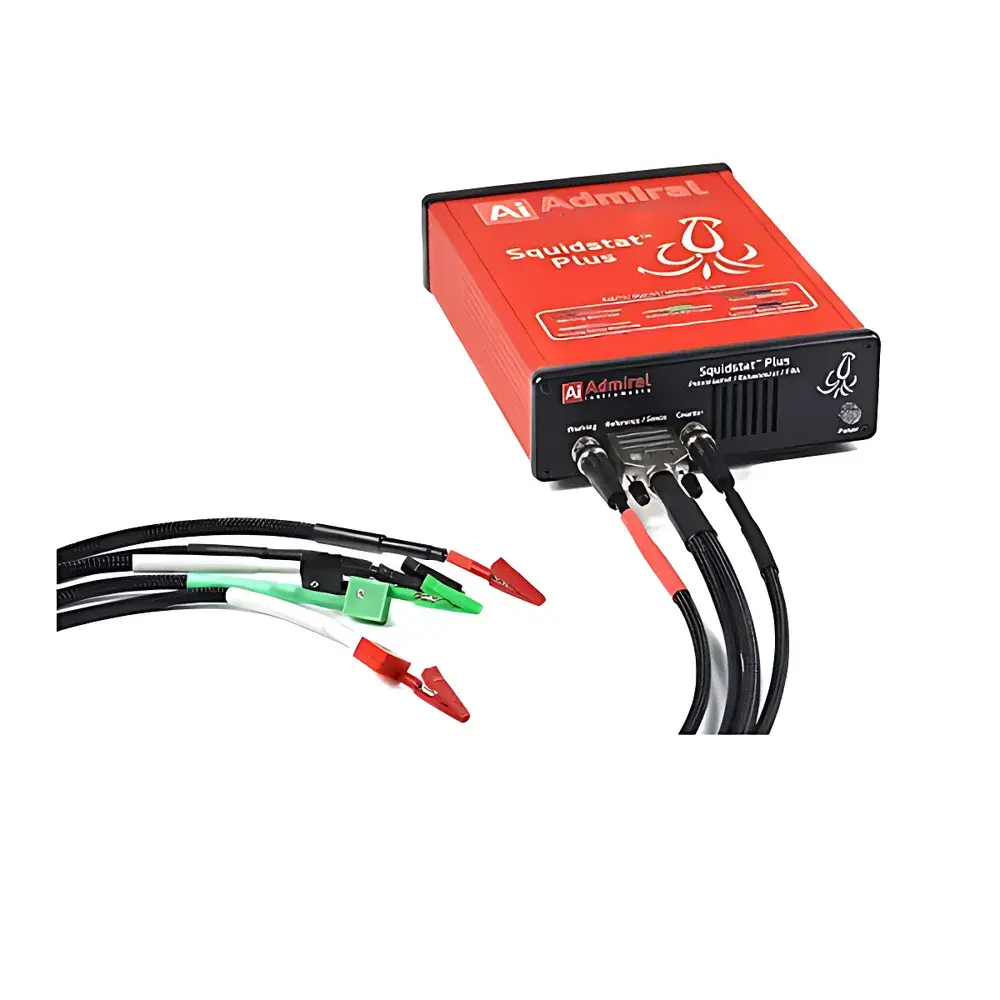
The Squidstat Plus interfaces seamlessly with standard electrochemical cells—including conventional glassware (e.g., three-neck flasks), sealed coin cells, Swagelok-type reactors, and custom flow cells—via industry-standard BNC and banana jack connections. Its isolated analog I/O architecture ensures safe operation with grounded or floating reference electrodes and eliminates ground-loop artifacts during measurements involving multiple instruments. The device complies with IEC 61010-1:2012 for electrical safety in laboratory equipment and meets electromagnetic compatibility (EMC) requirements per EN 61326-1:2013. For regulated environments, the bundled software supports audit trail generation, user access control, and electronic signature functionality aligned with FDA 21 CFR Part 11 and EU Annex 11 expectations when configured with appropriate IT infrastructure.
Software & Data Management
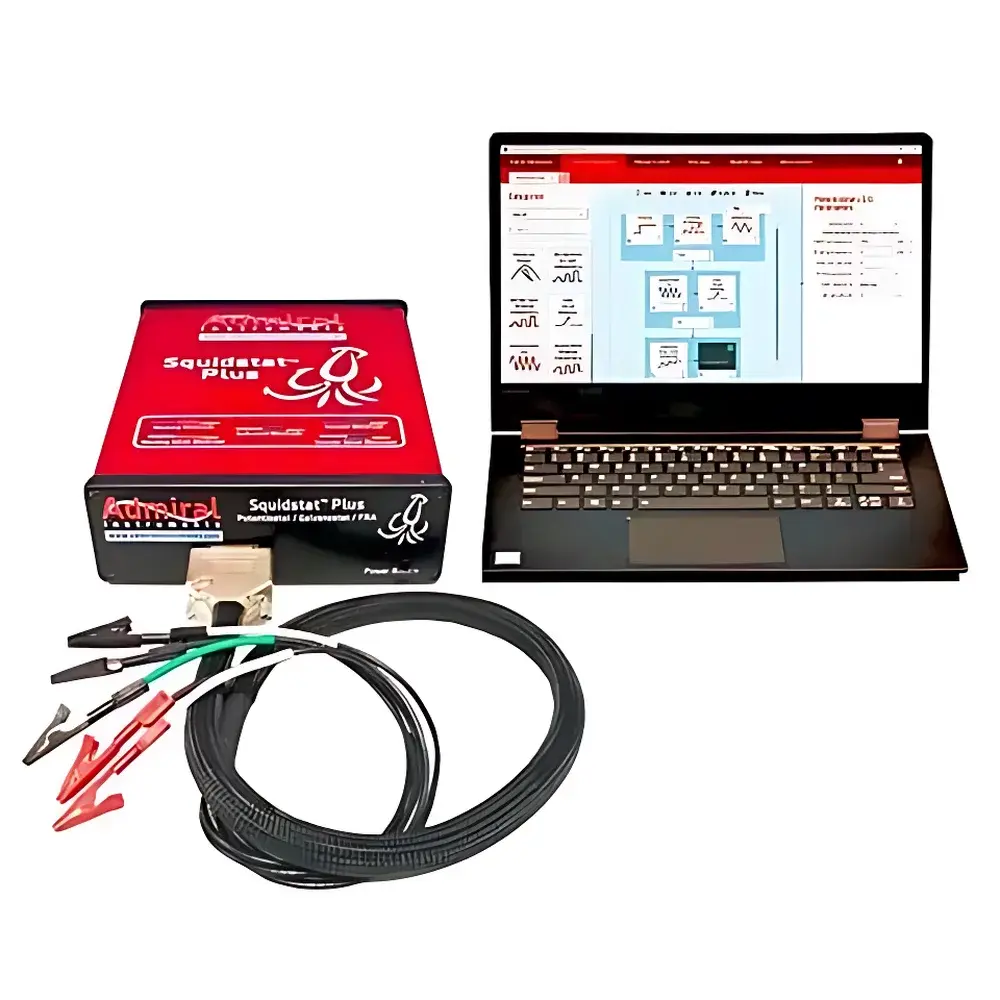
The workstation ships with the proprietary Squidstat Control Suite—a Windows-based application built on .NET Framework with native 64-bit support. It offers two method definition paradigms: (1) preconfigured templates for standardized techniques (CV, EIS, GITT), and (2) drag-and-drop visual sequencing for custom protocol assembly—enabling users to define nested loops, conditional branching, and real-time parameter modulation without scripting. All raw data are stored in timestamped CSV files with metadata headers (experiment name, date, technique parameters, instrument firmware version). The software includes post-processing modules for equivalent circuit fitting (using ZView-compatible models), dQ/dV peak deconvolution, differential capacitance mapping, and Mott-Schottky slope analysis. Export options include PNG/SVG graphics, MATLAB (.mat), and Excel-compatible formats. Remote diagnostics and firmware updates are supported via secure HTTPS connection to Admiral’s technical support portal.
Applications
- Battery R&D: Real-time CC-CV cycling with embedded EIS at defined SOC points; determination of SEI growth kinetics via low-frequency impedance tracking; quantification of Li-ion diffusion coefficients using GITT/PITT
- Corrosion Science: Polarization resistance (Rp) mapping, electrochemical noise analysis (ENA), and breakdown potential assessment in chloride-containing electrolytes per ASTM G59 and G102
- Electrocatalysis: Tafel slope extraction from LSV scans, double-layer capacitance (Cdl) estimation via CV scan-rate dependence, and stability evaluation through accelerated degradation protocols
- Sensor Development: Amperometric detection limits, calibration curve linearity verification (R² > 0.999), and interference rejection profiling using DPV/SWV selectivity assays
- Materials Characterization: Mott-Schottky analysis of semiconductor electrode band edges; redox-active polymer film thickness estimation via charge integration; pseudocapacitive contribution separation in hybrid electrodes
FAQ
Does the Squidstat Plus support hardware synchronization across multiple units?
Yes—up to eight Squidstat Plus units can be synchronized via USB hub or Ethernet switch using the master-slave trigger interface, enabling time-aligned acquisition for comparative studies or distributed sensor networks.
Is the onboard memory used exclusively for buffering, or does it retain data permanently?
Data written to the 16 GB internal flash memory are retained until manually cleared or overwritten; no external PC is required for storage integrity.
Can the software generate reports compliant with GLP/GMP documentation standards?
When deployed with validated installation and change control procedures, the Squidstat Control Suite supports ALCOA+ data integrity principles—including attributable, legible, contemporaneous, original, and accurate records—with optional electronic signatures and audit trail export.
What is the typical current noise floor at the 10 nA range?
RMS current noise is ≤1.2 pA (10 Hz–100 kHz bandwidth), measured with shorted inputs and optimized filtering settings.
Is third-party software integration possible (e.g., Python, LabVIEW)?
Yes—the device exposes a documented COM port API and provides DLL libraries for direct integration into custom automation frameworks, including MATLAB, Python (pySerial/pyVisa), and LabVIEW.
Related Products





