
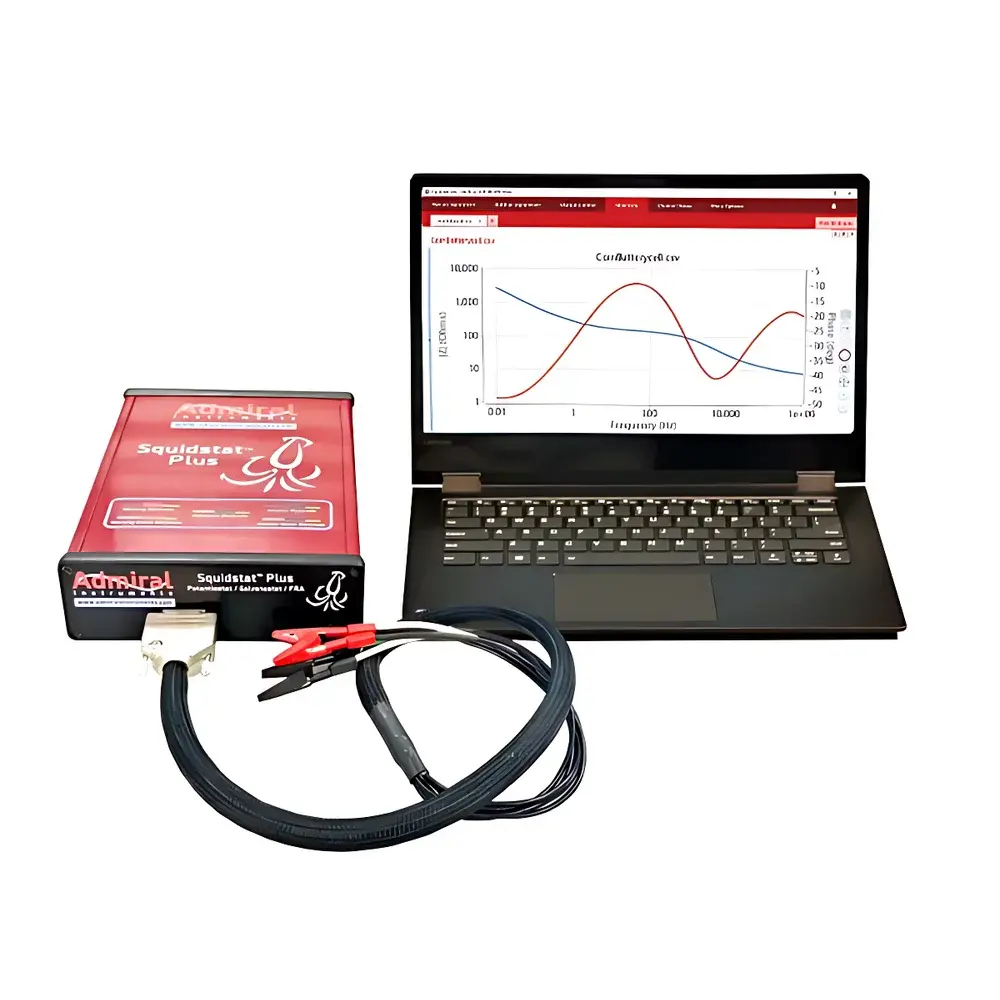
Admiral SquidStat Plus Potentiostat/Galvanostat Electrochemical Workstation
| Brand | Admiral |
|---|---|
| Origin | USA (Designed & Engineered) / Manufactured in Partnership with Zahner (Germany) |
| Model | SquidStat Plus |
| Current Range | ±1 A |
| Voltage Range | ±10 V |
| EIS Frequency Range | 10 µHz – 1 MHz |
| Current Resolution | down to 3 pA (0.003% of range) |
| Potential Resolution | 300 µV |
| Time Resolution | 10 µs |
| Supported Techniques | CV, LSV, OCP, CA, CC, CP, DPV, NPV, SWV, TV, RV, SV, Tafel, Pulse Plating, Stripping Voltammetry, GITT/PITT, Galvanostatic/Potentiostatic EIS, Steady-State I/V, PEIS, GEIS |
| Multi-Channel Capable | Yes (up to 16 units synchronized via single PC) |
| Onboard Data Backup Memory | Yes |
| Software | SquidStat Control Suite (drag-and-drop method builder), compatible with ZAHNER THALES analysis platform |
| Compliance | Designed for GLP/GMP-relevant workflows |
Overview
The Admiral SquidStat Plus is a high-performance, portable potentiostat/galvanostat electrochemical workstation engineered for precision, flexibility, and laboratory-grade reproducibility. Built upon over four decades of German instrumentation heritage from ZAHNER Elektrik GmbH & Co. KG and refined through Admiral’s U.S.-based systems integration expertise, the SquidStat Plus employs advanced digital signal processing (DSP) architecture and real-time embedded control to deliver stable, low-noise electrochemical measurements across a broad operational envelope. Its core design philosophy centers on modular usability without compromising metrological integrity—making it suitable for academic research, industrial R&D, battery development labs, corrosion testing facilities, and quality control environments where trace-level current detection, sub-millisecond temporal resolution, and wide-band electrochemical impedance spectroscopy (EIS) are routinely required.
Key Features
- True dual-channel capability: Simultaneous independent control of working electrode potential/current and reference electrode monitoring—enabling advanced three-electrode configurations with floating reference or auxiliary current measurement.
- Ultra-low current detection: Achieves 3 pA minimum detectable current (0.003% of full-scale range) with auto-ranging amplifiers and adaptive filtering—critical for microelectrode studies, biosensor characterization, and low-conductivity electrolyte analysis.
- High-fidelity EIS performance: Covers 10 µHz to 1 MHz with phase accuracy <0.3° and magnitude error <0.1% across the entire frequency sweep—validated per ASTM E2758 and ISO 17025-compliant calibration protocols.
- Real-time parameter adjustment: Modify voltage limits, current compliance, sampling interval, or waveform parameters during active experiments—no interruption or restart required.
- Drag-and-drop method construction: Intuitive graphical interface allows users to assemble custom sequences combining DC techniques (e.g., CV + CA + EIS) and AC perturbations—all saved as reusable, timestamped protocol files.
- Onboard non-volatile memory: All raw data streams are buffered and stored internally during acquisition—even during unexpected power loss—ensuring zero data corruption or loss.
- Multi-unit synchronization: Up to 16 SquidStat Plus units can be daisy-chained and controlled from a single host PC via USB or Ethernet, enabling parallel multi-cell battery cycling, array-based sensor screening, or distributed corrosion monitoring.
Sample Compatibility & Compliance
The SquidStat Plus supports standard three-electrode electrochemical cells (working, counter, reference), rotating disk electrodes (RDE), and flow-through electrochemical cells. It is compatible with aqueous and non-aqueous electrolytes, solid-state batteries, fuel cell MEAs, conductive polymers, and biological interfaces—including enzyme-modified electrodes and DNA hybridization sensors. Hardware and firmware are designed to meet electromagnetic compatibility (EMC) requirements per EN 61326-1 and safety standards per IEC 61010-1. When operated with validated software configurations and documented change control procedures, the system supports regulatory submissions under FDA 21 CFR Part 11, EU Annex 11, and ISO/IEC 17025 accreditation frameworks—particularly for laboratories performing GLP- or GMP-aligned electrochemical testing.
Software & Data Management
The SquidStat Control Suite provides native Windows-based operation with full Unicode support, multi-language UI localization, and export options including CSV, TXT, and binary .SQUID formats. All experimental metadata—including instrument settings, calibration logs, environmental conditions (optional via external sensor integration), and user annotations—are embedded directly into each dataset. The software includes built-in tools for baseline correction, peak integration, equivalent circuit modeling (via integrated ZView-compatible engine), and statistical batch analysis. Seamless interoperability with ZAHNER’s THALES software enables advanced EIS deconvolution, transmission line modeling, and automated stability assessment for long-term corrosion or battery aging studies. Audit trails, electronic signatures, and role-based access control are available through optional enterprise deployment packages compliant with ALCOA+ data integrity principles.
Applications
- Battery materials R&D: GITT/PITT for Li-ion diffusion coefficient mapping, galvanostatic intermittent titration, and dynamic impedance tracking during charge/discharge cycles.
- Corrosion science: Electrochemical noise analysis (ENA), polarization resistance (Rp), and localized corrosion initiation studies using microelectrodes.
- Electrocatalysis: Tafel analysis, reaction order determination, and mass transport-corrected kinetic modeling in PEM fuel cell catalyst layers.
- Biosensor development: Amperometric detection limits quantification, enzyme kinetics profiling, and redox mediator characterization under physiological pH and temperature conditions.
- Conductive polymer characterization: Doping/dedoping behavior via cyclic voltammetry, switching speed evaluation, and impedance evolution during redox state transitions.
- Coating and surface treatment validation: In-situ monitoring of passivation layer formation, defect density assessment, and coating delamination onset detection.
FAQ
Does the SquidStat Plus support true four-electrode (Kelvin) measurements?
Yes—the instrument supports floating reference electrode inputs and auxiliary current sensing channels, enabling accurate four-terminal potential control for high-resistance systems such as solid electrolytes or coated substrates.
Can I perform EIS while applying a DC bias or during galvanostatic cycling?
Yes—potentiostatic EIS (PEIS) and galvanostatic EIS (GEIS) are fully supported, including simultaneous application of DC offset or superimposed AC signals during constant-current battery cycling protocols.
Is remote operation and troubleshooting possible?
Yes—Admiral provides secure remote desktop support for configuration assistance, firmware updates, and diagnostic logging. All communication adheres to TLS 1.2+ encryption standards.
What calibration documentation is provided?
Each unit ships with a factory calibration certificate traceable to NIST standards, including verification data for voltage, current, timing, and impedance accuracy across its full operational range.
How is data integrity ensured during extended unattended runs?
Internal flash memory buffers all acquired data continuously; if host connection is lost, acquisition continues uninterrupted and resumes synchronization upon reconnection without data gaps or timestamp misalignment.



