
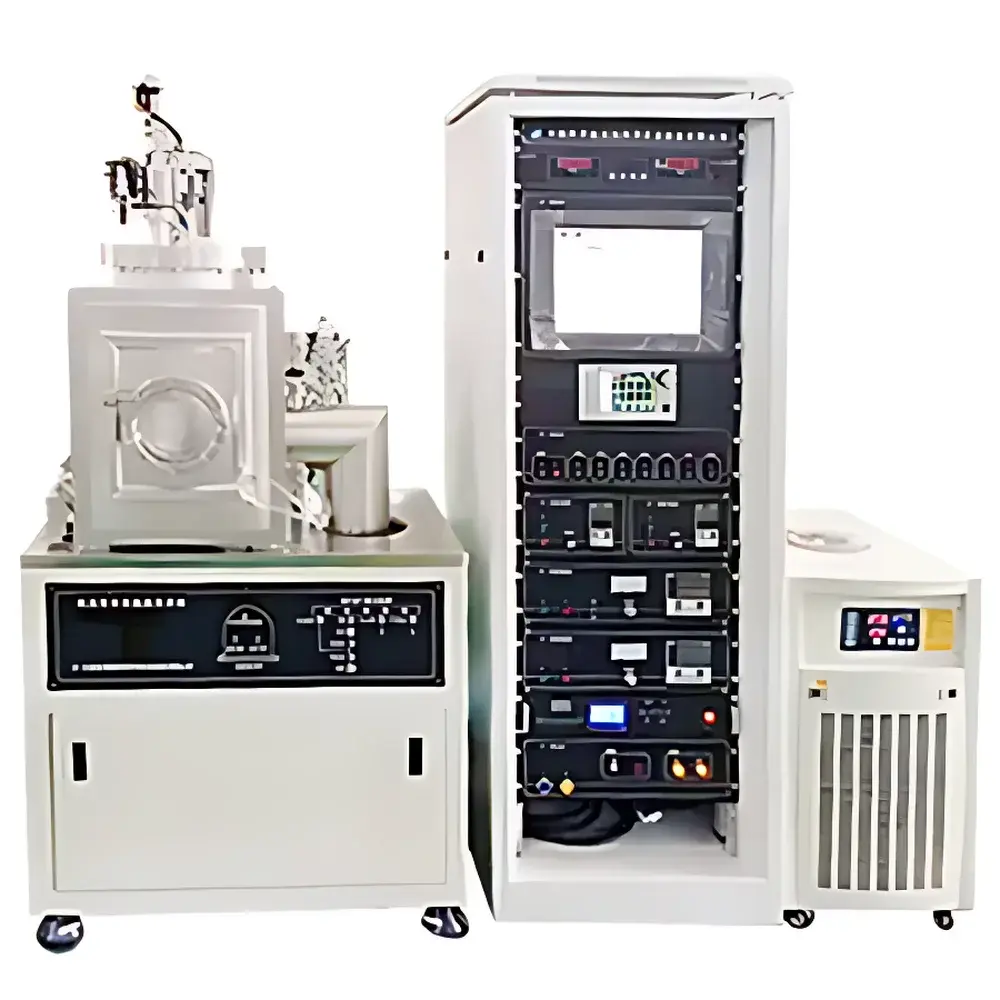
AdNaNo Customized-5 Thermal Evaporation Coater
| Brand | AdNaNo |
|---|---|
| Origin | USA |
| Model | Customized-5 |
| Maximum Substrate Size | 8-inch |
| Vacuum System | High-vacuum compatible (customizable base pressure ≤ 5×10⁻⁷ Torr) |
| Evaporation Sources | Dual resistive-heating crucibles (compatible with metals & organics) |
| Control Options | Manual and fully automated PLC-based operation |
| Substrate Heating | Integrated temperature-controlled stage (up to 300 °C, ±1 °C stability) |
| Compliance | Designed for ISO 14644-1 Class 5 cleanroom integration |
| Software Interface | RS-485/Modbus-enabled for SCADA or LabVIEW integration |
Overview
The AdNaNo Customized-5 Thermal Evaporation Coater is a high-vacuum physical vapor deposition (PVD) system engineered for reproducible, thickness-controlled thin-film fabrication on substrates up to 200 mm (8-inch) in diameter. Based on resistive thermal evaporation—where solid source materials are heated under vacuum to generate directional vapor flux—the system enables precise monolayer-to-micron-scale deposition of conductive, reflective, or functional coatings. Unlike sputtering or e-beam evaporation, thermal evaporation offers low-energy deposition kinetics, minimizing substrate heating and ion bombardment, making it ideal for temperature-sensitive substrates (e.g., polymers, OLED intermediates, or pre-patterned wafers). The chamber operates at ultimate pressures ≤ 5×10⁻⁷ Torr (achievable with turbomolecular pumping), ensuring low residual gas contamination and high film purity—critical for optical interference layers, electrode fabrication, and fundamental surface science studies.
Key Features
- Modular high-vacuum deposition chamber constructed from 304 stainless steel with all-metal CF flanges and helium-leak-tested sealing (≤ 1×10⁻⁹ mbar·L/s).
- Dual independent resistive evaporation sources: Tungsten or molybdenum boats rated for ≥ 1800 °C, supporting sequential or co-evaporation of metals (Au, Cr, Al, Cu, Ag, In) and small-molecule organics (e.g., Alq₃, NPB, C₆₀).
- Integrated quartz crystal microbalance (QCM) thickness monitor with real-time rate feedback (±0.1 Å/s resolution) and endpoint control via programmable deposition setpoints.
- Motorized shutter assembly with <10 ms actuation time, enabling sharp layer interfaces and multilayer heterostructure growth.
- Substrate stage with precision temperature regulation (ambient to 300 °C, ±1 °C uniformity over 8-inch area) and optional rotation (0–30 rpm) for enhanced thickness uniformity.
- PLC-based control architecture compliant with IEC 61131-3 standards; supports manual mode for rapid prototyping and automated recipe-driven operation for process repeatability.
Sample Compatibility & Compliance
The system accommodates rigid and flexible substrates—including silicon wafers, glass slides, PET films, and ceramic carriers—via customizable fixture plates and kinematic mounting. All wetted components meet ASTM F86 surface finish requirements for implant-grade metal deposition. Vacuum integrity conforms to ISO 2859-1 sampling plans for leak-tightness validation. Electrical safety complies with UL 61010-1 and CE machinery directives. For regulated environments, the control firmware supports audit-trail logging (timestamped parameter changes, alarm events, and user actions) aligned with FDA 21 CFR Part 11 principles when integrated with validated LIMS or MES platforms.
Software & Data Management
Operation is managed through a ruggedized industrial HMI touchscreen running embedded Linux. Process recipes—including source power ramps, shutter timing, QCM setpoints, and stage temperature profiles—are stored in encrypted binary files with SHA-256 checksum verification. Raw deposition data (rate, thickness, pressure, thermocouple readings) is exported in CSV or HDF5 format via USB or Ethernet. Optional API access (RESTful JSON over TCP/IP) enables bidirectional integration with laboratory information management systems (LIMS), statistical process control (SPC) dashboards, or Python-based automation frameworks (e.g., PyVISA, LabScript). All software modules undergo annual regression testing per ISO/IEC 17025 calibration traceability protocols.
Applications
- Front-side metallization of photovoltaic cells (Al back contacts, Ag grid lines).
- Deposition of electron/hole transport layers in organic light-emitting diodes (OLEDs) and perovskite solar cells.
- Fabrication of reference electrodes (e.g., Au/Cr bilayers) for electrochemical impedance spectroscopy (EIS).
- Optical coatings for interferometric sensors: quarter-wave stacks of MgF₂/TiO₂ or SiO₂/Ta₂O₅.
- Masked lift-off patterning for microelectrode arrays used in neural interface research.
- In-situ calibration standards for X-ray photoelectron spectroscopy (XPS) and Auger electron spectroscopy (AES).
FAQ
What vacuum level is required for high-purity metal film deposition?
For sub-nanometer roughness and minimal oxide incorporation in metals like Al or Ag, a base pressure ≤ 5×10⁻⁷ Torr is recommended—achievable with a 700 L/s turbomolecular pump backed by a dry scroll pump.
Can the system deposit multilayer structures with abrupt interfaces?
Yes—motorized shutters synchronized with QCM feedback enable layer-by-layer growth with interfacial roughness < 0.3 nm (RMS), verified by cross-sectional TEM.
Is remote monitoring supported for facility-wide tool integration?
Standard Modbus TCP and optional OPC UA server modules allow real-time telemetry and centralized supervisory control within semiconductor fab AMHS environments.
How is process reproducibility ensured across multiple runs?
Each recipe stores calibrated source resistance curves, thermal lag compensation coefficients, and QCM crystal aging offsets—enabling run-to-run thickness deviation < ±1.5% (n=50, 100 nm Al on Si).
Does the system support reactive evaporation (e.g., oxide formation)?
Not natively—reactive processes require O₂ or N₂ partial pressure control, which demands mass flow controllers and plasma assistance; such configurations are available as factory-engineered options under model suffix “-RE”.



