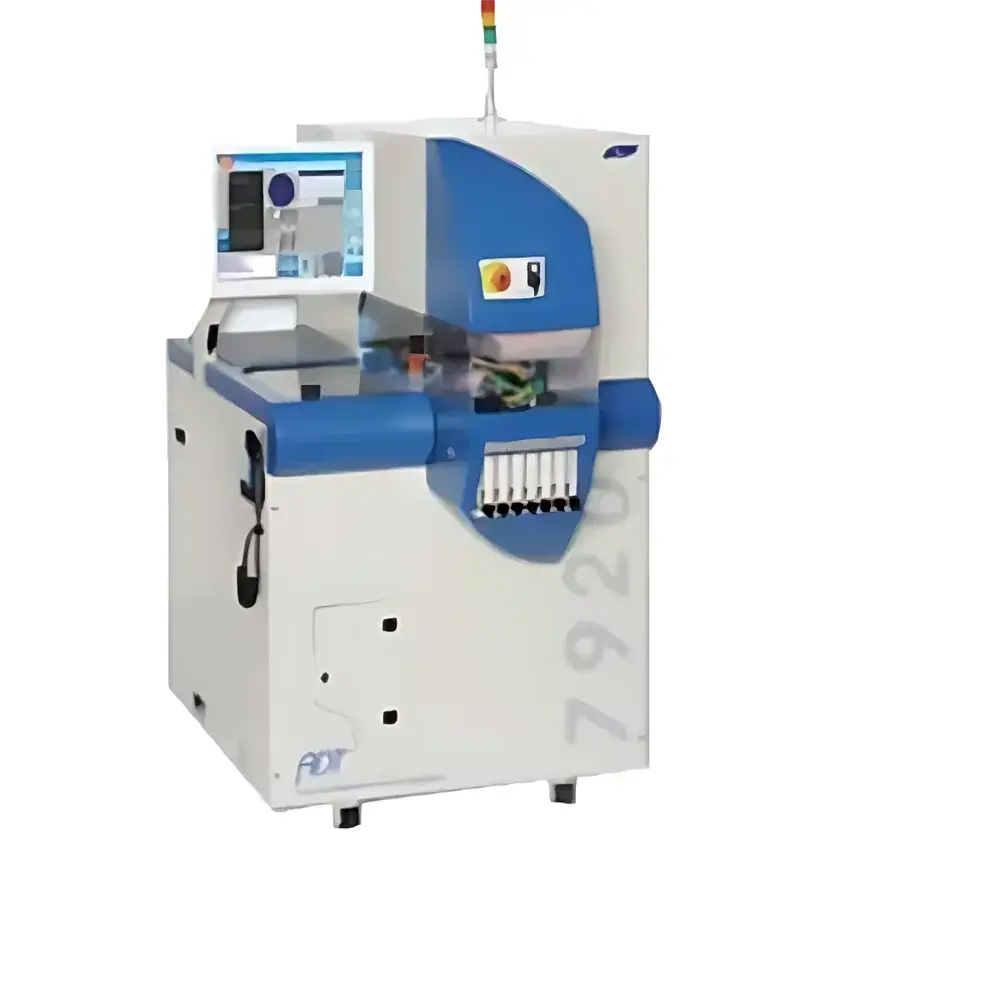
ADT 7920 Dual-Axis Semi-Automatic Dicing Saw
| Brand | ADT |
|---|---|
| Origin | Shanghai, China |
| Model | 7920 |
| Blade Diameter Range | 2"–3" |
| Maximum Spindle Speed | 60,000 rpm |
| Spindle Power | 1.2 kW per axis |
| Workpiece Capacity | Ø12" or 12" × 10" |
| X-Axis | Pneumatic Linear Slide |
| Y-Axis Resolution | 0.1 µm |
| Z1/Z2-Axis Resolution | 0.2 µm |
| Z1/Z2 Travel | 30 mm |
| Z1/Z2 Repeatability | ±1.0 µm |
| θ-Axis Repeatability | ±4 arc-sec |
| θ-Axis Travel | 350° |
| Cumulative Positioning Accuracy | ±1.5 µm |
| Step Positioning Accuracy | ±1.0 µm |
| Electrical Supply | 200–240 VAC, 50–60 Hz, Single-Phase |
| Dimensions (W×D×H) | 875 × 975 × 1450 mm |
| Weight | 900 kg |
Overview
The ADT 7920 Dual-Axis Semi-Automatic Dicing Saw is a precision semiconductor wafer dicing system engineered for high-fidelity separation of silicon, compound semiconductor, and advanced packaging substrates. It operates on the principle of controlled mechanical abrasion using diamond-impregnated rotating blades under precisely regulated coolant flow and dynamic force compensation. Unlike fully automated platforms, the 7920 integrates manual loading/unloading with CNC-driven dual-spindle kinematics—enabling rapid setup, process validation, and low-volume R&D or pilot-line production where flexibility and operator intervention are critical. Its dual-opposed spindle architecture allows simultaneous front-side and back-side dicing, trenching, or partial-depth scribing without repositioning, reducing thermal drift and mechanical registration error. Designed for Class 1000 cleanroom environments, the system meets baseline mechanical stability requirements for sub-10 µm kerf width control and edge chipping < 2 µm on 300 mm wafers.
Key Features
- Dual independent high-speed spindles (60,000 rpm, 1.2 kW each) with active vibration damping and real-time speed monitoring for consistent blade engagement and minimal harmonic resonance.
- Sub-micron motion control architecture: Y-axis linear encoder feedback with 0.1 µm resolution; Z1/Z2 axes with 0.2 µm resolution and ±1.0 µm repeatability over 30 mm travel—critical for multi-layer die singulation and stacked-die profiling.
- θ-axis rotary stage with ±4 arc-second repeatability and 350° continuous rotation enables angular alignment of non-orthogonal scribe lanes, enabling dicing of MEMS arrays, RF devices, and fan-out wafer-level packages (FOWLP).
- Pneumatically actuated X-axis slide ensures low-friction, high-stiffness lateral translation—minimizing deflection during high-feed-rate cutting while maintaining positional fidelity across full work envelope (Ø12″ or 12″ × 10″).
- Integrated coolant delivery manifold with adjustable flow rate and pressure control to suppress debris accumulation, manage localized heating, and extend blade life—compatible with deionized water, ethanol-based coolants, and low-residue synthetic formulations.
- Modular mechanical frame constructed from stress-relieved granite composite base and reinforced aluminum alloy gantry—designed to maintain geometric integrity under thermal cycling and long-duration operation (>16 hrs/day).
Sample Compatibility & Compliance
The ADT 7920 accommodates standard semiconductor substrates including silicon (150–300 mm), SiC, GaN-on-Si, glass interposers, LTCC/HTCC ceramics, and organic laminate substrates used in advanced packaging. It supports both full-severance dicing and controlled-depth scribing for tape-and-reel, chip-scale package (CSP), and panel-level processing. The system conforms to ISO 14644-1 Class 7 (10,000) air cleanliness recommendations when operated within appropriate enclosures. Mechanical safety complies with IEC 60204-1 (electrical equipment of machines) and ISO 13857 (safety distances). While not certified to SEMI S2/S8 out-of-the-box, its design permits integration with external exhaust, solvent recovery, and interlocked access systems required for full SEMI compliance in production settings.
Software & Data Management
The ADT 7920 utilizes a deterministic real-time motion controller with embedded PLC logic and an intuitive Windows-based HMI interface. All motion parameters—including feed rate, spindle acceleration ramp, Z-depth profiling, and θ-indexing sequences—are programmable via graphical job templates. The system logs timestamped operational data (spindle load, coolant pressure, axis position error, emergency stops) to internal SSD storage with optional export to CSV or OPC UA for MES integration. Audit trails comply with GLP/GMP principles: user login authentication, parameter change history with operator ID and timestamp, and immutable log archiving. Though not natively 21 CFR Part 11 compliant, the platform supports third-party electronic signature modules and encrypted database backups for regulated environments.
Applications
- Low-volume prototyping of power devices (IGBTs, SiC MOSFETs) requiring precise trench geometry and minimal subsurface damage.
- R&D dicing of heterogeneous integration test vehicles—e.g., hybrid bonding demonstrators with copper pillar interconnects and ultra-thin TSV substrates.
- Back-grinding alignment verification and post-thinning dicing where Z-axis repeatability and thermal stability directly impact die strength and warpage.
- MEMS sensor singulation with angular scribe patterns for inertial measurement units (IMUs) and optical MEMS mirror arrays.
- Failure analysis sample preparation—enabling cross-sectional cuts at defined depths and orientations without delamination or artifact generation.
- Advanced packaging development including redistribution layer (RDL) trimming, substrate edge isolation, and cavity formation for embedded die applications.
FAQ
What wafer sizes does the ADT 7920 support?
The system accepts round wafers up to Ø12″ (300 mm) and rectangular substrates up to 12″ × 10″, accommodating both standard semiconductor formats and emerging panel-level substrates.
Is the dual-spindle configuration synchronized or independently controllable?
Both spindles operate independently with separate motion control loops and programmable start/stop timing—enabling staggered cutting, sequential front/back processing, or differential feed strategies.
Can the ADT 7920 be integrated into an automated material handling system?
While semi-automatic by design, the machine provides digital I/O ports, RS-485/Modbus RTU, and optional Ethernet/IP support for integration with overhead hoists, robotic end-effectors, and factory-level SCADA.
What blade types and mounting interfaces are compatible?
Standard ISO 200 flange mounts for 2″–3″ diameter blades; compatible with resin-bonded, metal-bonded, and electroplated diamond blades—including ultra-thin (<20 µm) kerf variants for high-aspect-ratio structures.
Does the system include environmental monitoring capabilities?
The base configuration includes internal temperature and vibration sensors with threshold alarms; optional add-ons include ambient humidity logging, particulate counters, and coolant conductivity monitoring for extended process traceability.