
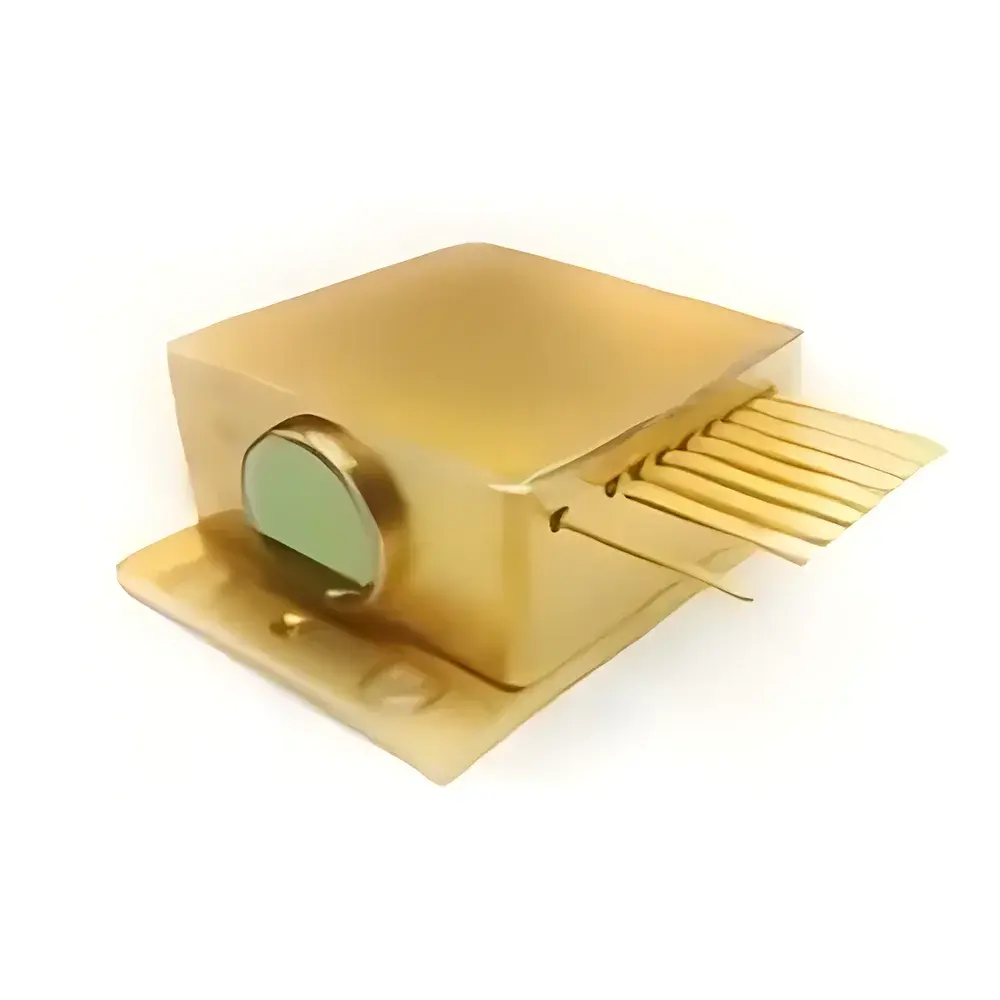
AdTech Optics 4μm–12μm Tunable QCL DFB Laser Source
| Brand | AdTech Optics |
|---|---|
| Origin | USA |
| Model | 4μm–12μm QCL-DFB Laser |
| Output Modes | Continuous-wave (CW) and Pulsed |
| Wavelength Range | 4.0–12.0 μm (2500–833 cm⁻¹) |
| Typical CW Output Power | Up to 300 mW (wavelength-dependent) |
| Pulsed Output | Nanosecond-scale pulses, peak power >1 W |
| Operating Temperature Range | 15–45 °C |
| Threshold Current | 0.33–0.40 A |
| Max Drive Current | 0.46 A |
| Threshold Voltage | 12.1–12.8 V |
| Max Voltage | 13.6 V |
| Wall-Plug Efficiency | 0.2–1.6% |
| Spectral Linewidth | <0.001 cm⁻¹ (DFB-stabilized) |
| Beam Delivery | Collimated free-space output (HHL package) |
Overview
The AdTech Optics 4μm–12μm Tunable QCL DFB Laser Source is a high-stability, single-mode mid-infrared laser system engineered for precision molecular spectroscopy, trace gas sensing, and industrial process monitoring. Based on distributed feedback quantum cascade laser (QCL-DFB) technology, it operates across the fundamental vibrational absorption bands of key industrial and environmental analytes—including NO, CO, CO₂, N₂O, CH₄, NH₃, SO₂, H₂O, and volatile organic compounds. Unlike broadband thermal sources or optical parametric oscillators, this laser delivers narrow-linewidth (<0.001 cm⁻¹), mode-hop-free emission with precise wavelength selectivity—enabling direct absorption spectroscopy (DAS), wavelength modulation spectroscopy (WMS), and cavity-enhanced techniques with sub-ppb detection limits. Its monolithic DFB grating structure ensures intrinsic wavelength stability without external cavity components, while thermoelectric cooling (TEC) and integrated temperature sensors support closed-loop thermal control compliant with ISO/IEC 17025 calibration traceability requirements.
Key Features
- Wide spectral coverage from 4.0 to 12.0 μm (2500–833 cm⁻¹), spanning the strongest fundamental rovibrational transitions of target gases
- Two operational modes: continuous-wave (CW) output up to 300 mW and nanosecond-pulsed operation with peak powers exceeding 1 W
- DFB architecture guarantees single longitudinal mode (SLM) emission with side-mode suppression ratio >30 dB
- HHL (High-Heat-Load) hermetically sealed package with integrated TEC, thermistor, and collimated output beam (M² < 1.3)
- Real-time current and temperature monitoring via analog monitor photodiode and digital I²C interface
- Compliant with RoHS and REACH directives; designed for integration into OEM gas analyzers requiring FDA 21 CFR Part 11–ready data integrity frameworks
Sample Compatibility & Compliance
This QCL source is optimized for use in extractive and in-situ gas measurement systems employing multipass cells (e.g., White or Herriott cells), photoacoustic spectroscopy (PAS) resonators, and quartz-enhanced photoacoustic spectroscopy (QEPAS) modules. It supports quantitative analysis of gaseous samples under ambient, elevated pressure (up to 10 bar), and variable humidity conditions—provided optical path contamination is minimized per ASTM D6245 guidance for infrared gas analysis. The device meets IEC 61000-6-3 (EMI emissions) and IEC 61000-6-2 (immunity) standards. For regulated pharmaceutical or environmental applications, its stable wavelength referencing enables compliance with USP , ISO 17025 clause 5.9 (method validation), and EPA Method TO-14/TO-15 traceability protocols.
Software & Data Management
AdTech provides a Windows/Linux-compatible SDK supporting USB and RS-232 communication for full parameter control—including setpoint temperature (±0.01 °C resolution), drive current ramping profiles, pulse timing (10 ns–100 µs), and real-time photodiode feedback logging. All instrument commands generate timestamped audit trails compatible with GLP/GMP-compliant electronic lab notebooks (ELNs). Firmware supports SCPI command syntax and can be embedded within LabVIEW, Python (PyVISA), or MATLAB environments. Data export formats include CSV and HDF5, preserving metadata such as ambient temperature, laser junction voltage, and spectral calibration coefficients traceable to NIST SRM 2034 reference standards.
Applications
- Real-time stack emission monitoring for NOₓ, SO₂, and CO in power generation and cement manufacturing (aligned with EN 15267 and EPA PS-18)
- Medical breath analysis for nitric oxide (NO) biomarkers in asthma diagnostics (ISO 16761-compliant sampling interfaces)
- In-line quality control of semiconductor process gases (NH₃, SiH₄, WF₆) per SEMI F20 specifications
- Atmospheric research platforms measuring CH₄ and N₂O fluxes using eddy covariance with open-path configurations
- Explosives detection via standoff IR backscattering spectroscopy in security screening systems
- Calibration source for Fourier-transform infrared (FTIR) spectrometers operating in the MIR region
FAQ
What wavelength accuracy and long-term stability does this QCL achieve?
Typical absolute wavelength accuracy is ±0.02 cm⁻¹ (±0.6 GHz at 10 µm) when referenced to a stabilized etalon or gas cell. Drift is <0.005 cm⁻¹ over 8 hours under constant temperature and current conditions.
Is spectral calibration traceable to national standards?
Yes—each unit includes a factory calibration report referencing NIST-traceable gas absorption lines (e.g., N₂O at 1285.5 cm⁻¹, CO at 2143.3 cm⁻¹), with uncertainty budgets provided per ISO/IEC Guide 98-3.
Can this laser be integrated into a portable battery-powered analyzer?
The HHL package draws ≤6.5 W in CW mode (13.6 V × 0.46 A); low-power pulsed operation reduces average power consumption to <1.2 W, enabling integration with Li-ion battery packs meeting UL 2054 safety certification.
Does AdTech provide application-specific optical alignment fixtures?
Yes—custom kinematic mounts, fiber-coupling adapters (ZnSe lensed fibers), and beam-shaping optics (aspheric collimators, wire-grid polarizers) are available under NRE agreements.
What is the expected lifetime under continuous operation?
MTTF exceeds 20,000 hours at 25 °C case temperature, validated per Telcordia GR-468-CORE reliability testing for optoelectronic devices.





