
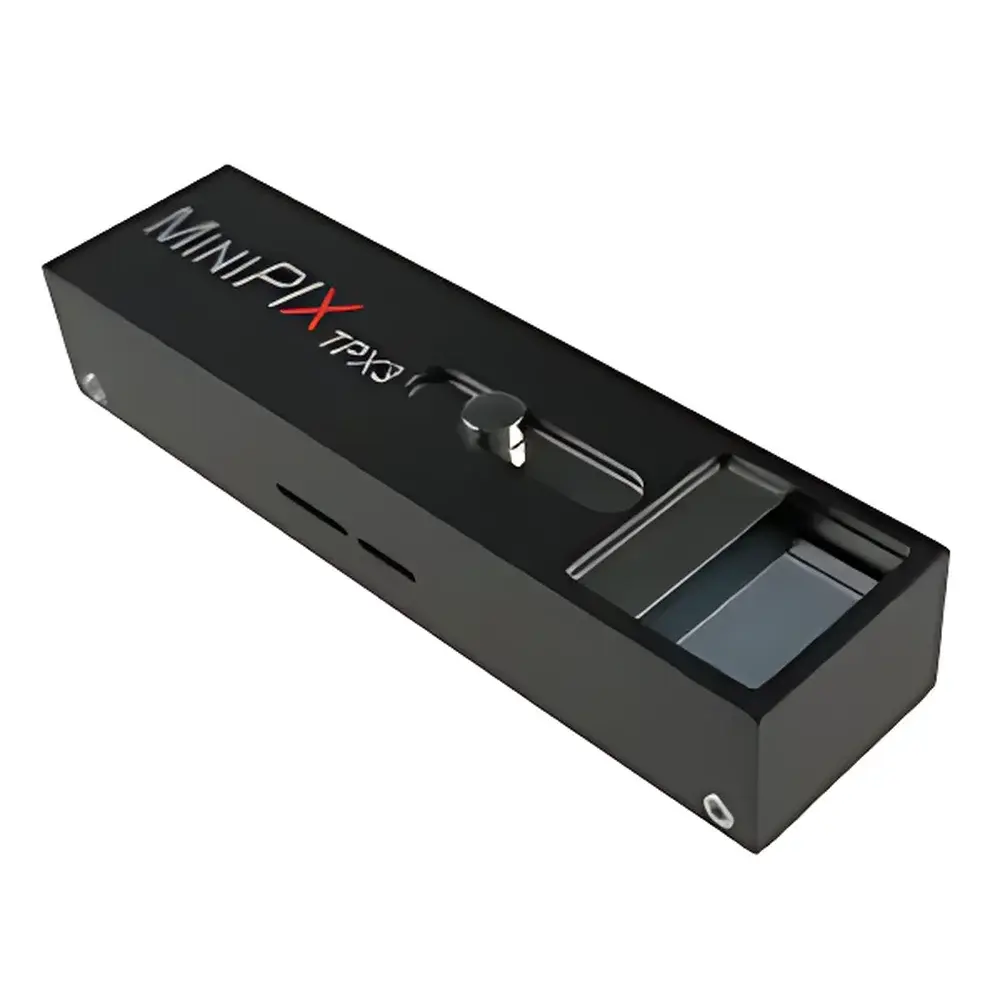
Advacam MiniPIX TPX3 Photon-Counting X-ray Detector
| Brand | Advacam |
|---|---|
| Origin | Czech Republic |
| Model | MiniPIX TPX3 |
| Sensor Material | Si or CdTe |
| Sensor Thickness | 100 µm, 300 µm, 500 µm (Si) |
| Sensitive Area | 14 mm × 14 mm |
| Time Resolution | 1.6 ns |
| Readout Speed | 2.35 million hits/s |
| Frame Rate | 16 fps |
| Pixel Array | 256 × 256 |
| Pixel Pitch | 55 µm |
| Energy Resolution | 0.5–1 keV (Si), 1.1–3.6 keV (CdTe) |
| Minimum Detectable Energy | 3 keV (Si), 5 keV (CdTe) |
| Readout Chip | Timepix3 |
| Operating Modes | Time-over-Threshold (ToT), Time-of-Arrival (ToA) |
| Connectivity | µUSB 2.0 |
| Weight | 30 g |
| Dimensions | 80 mm × 21 mm × 14 mm |
| Software | Pixet Pro |
Overview
The Advacam MiniPIX TPX3 is a compact, photon-counting X-ray detector engineered for high-fidelity radiation imaging and particle tracking at the single-photon level. Built around the CERN-developed Timepix3 readout chip, it implements hybrid pixel detector architecture with per-pixel time-stamping, energy discrimination, and trajectory reconstruction capabilities. Unlike integrating detectors, the MiniPIX TPX3 operates in event-driven mode—recording the precise (x, y) position, deposited energy (via Time-over-Threshold), arrival time (with 1.6 ns resolution), and temporal sequence of every individual ionizing interaction. This enables simultaneous acquisition of spatial, spectral, and temporal information from X-ray photons, electrons, alpha particles, or low-energy ions—making it suitable for both laboratory-based analytical instrumentation and field-deployable radiation monitoring systems.
Key Features
- Timepix3-based architecture: Delivers synchronized spatial, energy, and timing data per pixel—enabling time-resolved spectro-imaging and coincidence analysis without frame-based dead time penalties.
- Multi-material sensor compatibility: Supports silicon sensors (100 µm, 300 µm, 500 µm thicknesses) for soft-to-medium X-ray detection (≥3 keV), and cadmium telluride (CdTe, 1 mm standard, up to 2 mm custom) for higher stopping power in hard X-ray and gamma regimes (≥5 keV).
- Sub-55 µm spatial resolution: 256 × 256 pixel array with 55 µm pitch provides high-resolution imaging across a 14 mm × 14 mm active area—ideal for micro-XRF mapping, small-angle scattering alignment, and beamline diagnostics.
- Real-time, high-throughput readout: Sustains 2.35 million hit events per second with 16 fps full-frame acquisition—optimized for dynamic experiments including pump-probe studies and fast-scanning tomography.
- Ultra-low mass and footprint: Weighing only 30 g and measuring 80 mm × 21 mm × 14 mm, the MiniPIX TPX3 integrates seamlessly into constrained environments such as synchrotron endstations, portable XRD rigs, UAV-mounted radiation survey platforms, or educational neutron imaging setups.
- Onboard ARM+FPGA processing: Enables real-time event filtering, region-of-interest (ROI) binning, and data compression prior to USB 2.0 transmission—reducing host-side computational load and enabling deterministic latency control.
Sample Compatibility & Compliance
The MiniPIX TPX3 is compatible with diverse radiation sources—including sealed X-ray tubes (5–60 kV), synchrotron beamlines, radioactive isotopes (e.g., 241Am, 137Cs), and neutron converters (e.g., 6LiF/ZnS scintillators). Its modular sensor interface supports vacuum-, air-, or helium-filled operation depending on application requirements. While not certified as a medical device, the system adheres to IEC 61000-6-3 (EMC emission limits) and meets RoHS/REACH material compliance standards. Data acquisition workflows are compatible with GLP/GMP-aligned documentation practices when used with Pixet Pro’s audit-trail-enabled acquisition logs (timestamped metadata, user-defined experiment tags, and raw binary export).
Software & Data Management
Pixet Pro software provides a unified interface for hardware control, real-time visualization, offline analysis, and export to industry-standard formats (HDF5, TIFF, CSV, ROOT). It supports advanced processing pipelines including spectral deconvolution (for multi-element XRF), ToF-gated image stacking, Compton scatter cone reconstruction, and hit clustering algorithms for track topology identification. Raw event lists preserve full spatio-temporal metadata—enabling post-acquisition re-binning, energy gating, or time-slice extraction without signal loss. Integration with Python (via pixetlib SDK) and MATLAB allows scripted experiment control and custom algorithm development—facilitating reproducible research workflows compliant with FAIR data principles.
Applications
- X-ray diffraction (XRD) and residual stress analysis: High angular resolution mapping of lattice strain using Bragg peak centroiding and rocking-curve analysis—particularly effective for thin films and additive-manufactured components.
- Energy-dispersive X-ray fluorescence (ED-XRF): Quantitative elemental mapping with sub-ppm sensitivity via spectrum fitting and matrix correction (e.g., fundamental parameters method).
- Small- and wide-angle X-ray scattering (SAXS/WAXS): Beamstop-free scattering pattern acquisition with intrinsic background suppression through event-level energy discrimination.
- Radiation monitoring and dosimetry: Real-time particle identification (e.g., distinguishing X-rays from beta/gamma events), dose rate estimation, and spectral unfolding using library-matched response functions.
- Aerospace and space instrumentation: Flight-qualified heritage via ESA and NASA collaborations—used in cosmic ray telescopes, planetary surface spectrometers, and radiation environment monitors aboard CubeSats.
- Neutron imaging: Coupled with converter screens (e.g., Gd-based or 6LiF), enables thermal/epithermal neutron radiography with inherent energy discrimination capability.
FAQ
What distinguishes the MiniPIX TPX3 from conventional CCD or CMOS X-ray detectors?
Unlike integrating detectors that accumulate charge over exposure time, the TPX3-based MiniPIX records each photon event individually—preserving energy, time, and position with no readout noise floor or dynamic range saturation. This enables true quantitative spectro-imaging without pile-up correction artifacts.
Can the MiniPIX TPX3 be used in vacuum or high-radiation environments?
Yes—the detector head is hermetically sealed and rated for operation in vacuum down to 10−6 mbar. For long-term irradiation, sensor degradation follows predictable NIEL models; lifetime estimates are available upon request based on expected fluence.
Is Pixet Pro software compatible with Linux or macOS?
Pixet Pro is natively supported on Windows 10/11 (64-bit). Linux and macOS users may access core functionality via the documented C/C++ and Python APIs (pixetlib), enabling full integration into cross-platform scientific computing environments.
Does the system support synchronization with external triggers or lasers?
Yes—the MiniPIX TPX3 features TTL-compatible trigger input/output ports, supporting master-slave timing with femtosecond-laser systems, choppers, or motion stages for pump-probe or scanning applications.
How is calibration performed for energy and spatial response?
Factory calibration includes pixel gain/offset maps and threshold dispersion corrections. Users can perform in-situ energy calibration using known X-ray lines (e.g., Cu Kα, Ag Kα) or radioactive sources; spatial calibration uses precision pinhole or edge targets traceable to NIST standards.






