
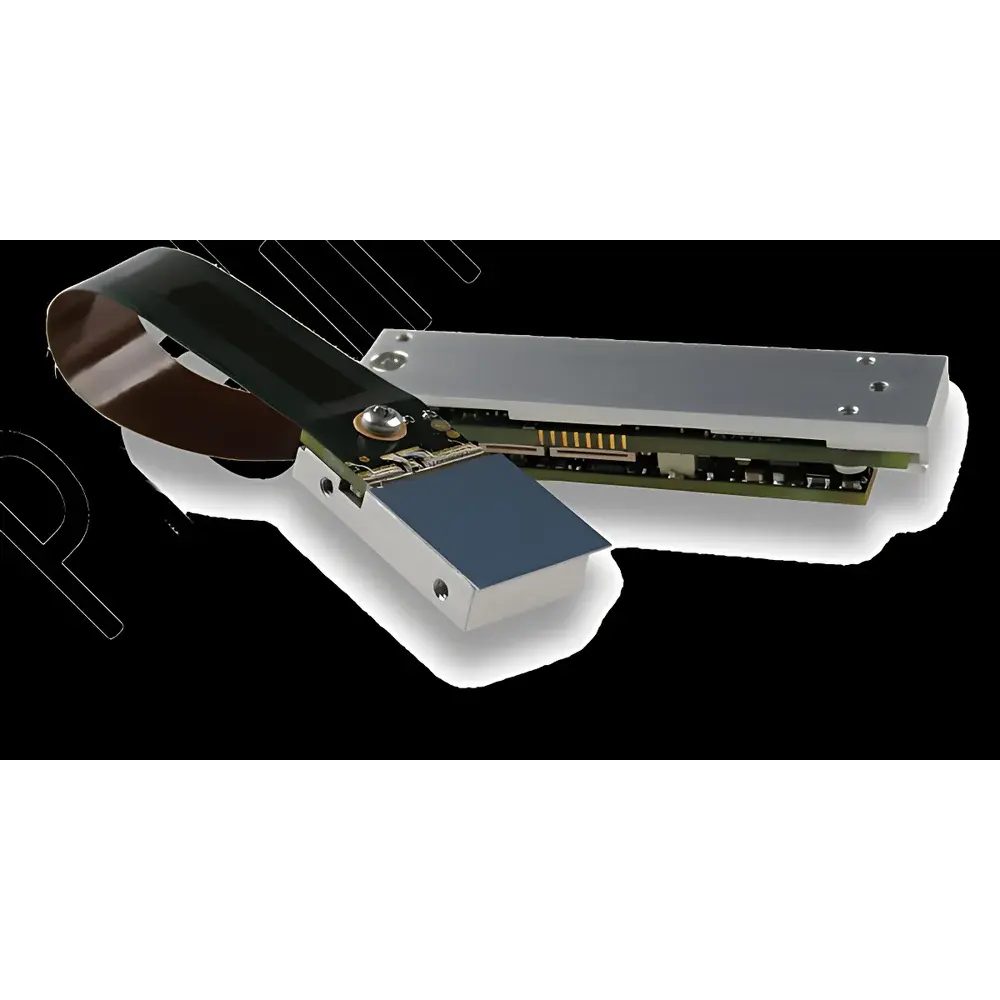
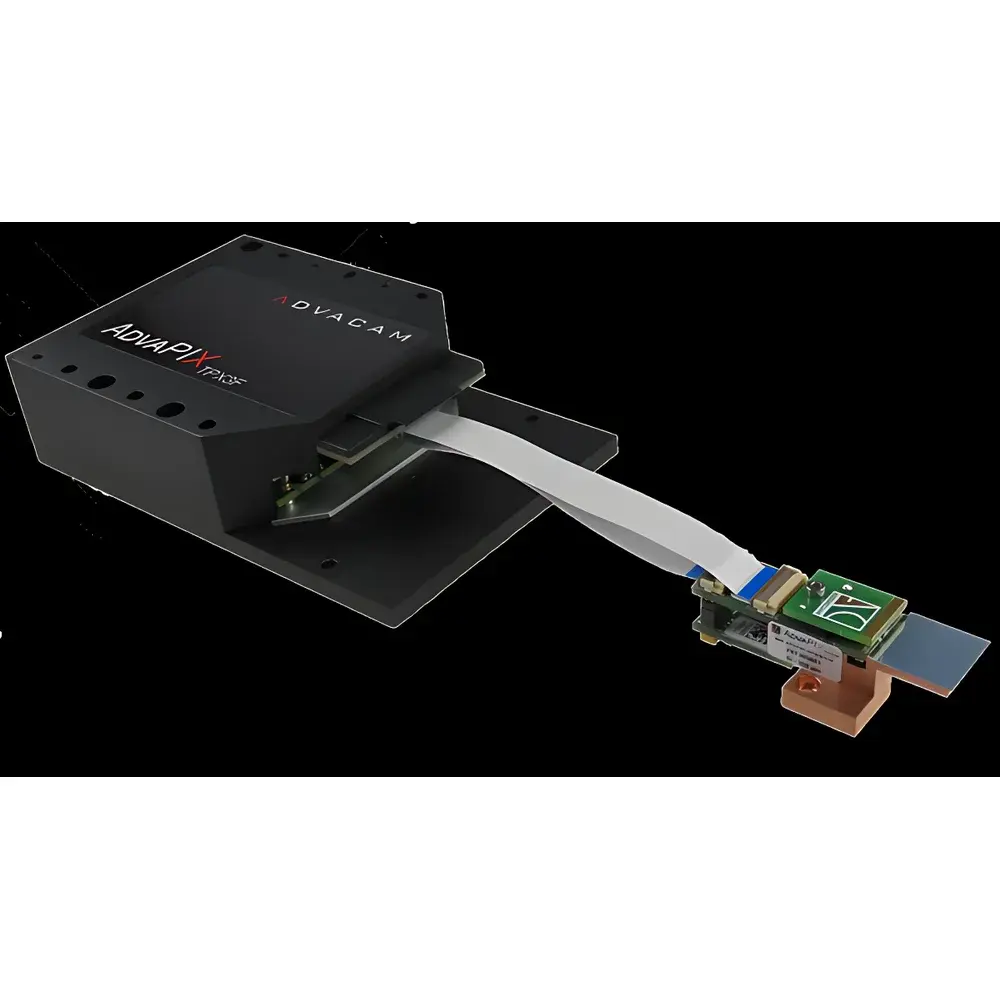
Advacam Timepix3 Direct-Detection Electron Camera
| Brand | Advacam |
|---|---|
| Origin | Czech Republic |
| Model | ADVAPIX TPX3F, MINIPIX TPX3F |
| Sensor Material | Si (100/300/500 µm), CdTe (1 mm) |
| Pixel Size | 55 × 55 µm |
| Array | 256 × 256 pixels |
| Dark Noise | None |
| Time Resolution | 1.6 ns |
| Event Rate (MAX) | 40 × 10⁶ hits/s (ADVAPIX TPX3F), 2.35 × 10⁶ hits/s (MINIPIX TPX3F) |
| Frame Rate | 30 fps (ADVAPIX), 16 fps (MINIPIX) |
| Readout Interface | USB 3.0 (ADVAPIX), USB 2.0 (MINIPIX) |
| Operating Modes | Frame-based (Event+iToT, iToT, ToA), Pixel/Event-driven (ToT+ToA, ToA-only, ToT-only) |
Overview
The Advacam Timepix3 Direct-Detection Electron Camera is a high-performance, hybrid pixel detector engineered for real-time, single-particle-resolved imaging and spectro-timing in electron microscopy and charged-particle analysis. Built around the Medipix3-based Timepix3 application-specific integrated circuit (ASIC), it operates on the principle of time-over-threshold (ToT) and time-of-arrival (ToA) measurement at the individual pixel level—enabling simultaneous spatial, energy, and temporal characterization of each incident particle. Unlike conventional integrating detectors, the Timepix3 architecture implements event-driven readout with zero dead time between hits, delivering true 4D data (x, y, energy, time) per detected electron, proton, alpha particle, or muon. This capability makes it uniquely suited for advanced in situ and dynamic characterization workflows in scanning/transmission electron microscopy (SEM/TEM), micro-electron diffraction (μED), and ptychographic reconstruction.
Key Features
- Single-electron sensitivity with zero readout noise: No dark current or thermal noise due to fully digital, threshold-based hit detection and on-chip timestamping.
- Radiation-hard design: Optimized for prolonged operation under high-flux electron beams and ion irradiation; compatible with UHV environments typical of FIB-SEM and TEM columns.
- Sub-nanosecond timing precision: 1.6 ns time resolution enables precise coincidence detection, time-of-flight differentiation, and pulse-shape discrimination across particle species.
- Multi-mode acquisition flexibility: Supports both frame-based (exposure-triggered) and pixel/event-driven (continuous streaming) modes—configurable via software to match experimental requirements.
- Compact, modular integration: Flexible flex-cable interconnect and minimal form factor facilitate OEM embedding into existing electron optical systems—including Thermo Scientific Helios™ 5 UX DualBeam platforms.
- High dynamic range & linearity: 14-bit iToT (integrated time-over-threshold) and 18-bit ToA provide >10⁴:1 intensity range and sub-microsecond temporal binning without saturation artifacts.
Sample Compatibility & Compliance
The Timepix3 camera supports direct detection of electrons (10–300 keV), protons, alpha particles, and cosmic muons without scintillator conversion—ensuring maximal spatial resolution and energy fidelity. Sensor variants include high-resistivity silicon (100/300/500 µm) for medium-energy electrons and cadmium telluride (1 mm) for higher-Z particle detection. All models comply with CE marking requirements and meet electromagnetic compatibility (EMC) standards per EN 61326-1. The detector firmware and acquisition software support audit-trail logging and user-access controls aligned with GLP and GMP documentation practices. While not FDA-cleared as a medical device, its architecture satisfies core traceability and data integrity criteria referenced in ISO/IEC 17025 and ASTM E2915 for analytical instrument validation.
Software & Data Management
Acquisition and analysis are enabled by Advacam’s open-source Pixet Pro software suite (Windows/Linux), which provides real-time visualization, mode configuration, histogramming, and export to HDF5, TIFF, and ROOT formats. The API supports Python (via PyPixet), MATLAB, and C++ integration for custom pipeline development—critical for automated ptychography, STEM tomography, or machine-learning-assisted diffraction indexing. Raw event streams preserve full spatiotemporal metadata (x, y, ToA, ToT, FToA), enabling post-acquisition re-binning, drift correction, and multi-parameter gating. Data provenance—including acquisition parameters, calibration timestamps, and hardware state—is embedded in file headers to satisfy 21 CFR Part 11-compliant record-keeping when deployed in regulated QA/QC labs.
Applications
- 4D-STEM in SEM/TEM: Enables differential phase contrast (DPC), virtual imaging, and strain mapping through pixel-level electron trajectory analysis.
- Micro-electron diffraction (μED): Delivers high-fidelity, low-dose crystallographic patterns from nanocrystals and beam-sensitive organics.
- EBS/EBSD with time-resolved indexing: Combines orientation mapping with arrival-time correlation to resolve grain boundary dynamics during in situ deformation.
- Ptychography: Provides high-SNR, shot-noise-limited diffraction datasets essential for iterative phase retrieval algorithms.
- Particle identification in mixed-beam environments: Discriminates electrons, protons, and alphas using ToT–ToA scatter plots and energy-loss signatures.
- OEM integration in FIB-SEM platforms: As implemented in Thermo Scientific Helios™ 5 UX DualBeam, enhancing sub-surface imaging fidelity and automated lamella preparation feedback loops.
FAQ
What distinguishes Timepix3 from conventional CCD or CMOS detectors in electron microscopy?
Timepix3 eliminates integration noise and readout dead time by processing each particle hit independently—with precise x, y, ToA, and ToT recorded per pixel. This enables true event-by-event analysis, unlike frame-integrating detectors that average signal and obscure temporal correlations.
Can the detector operate in ultra-high vacuum (UHV) conditions?
Yes—the sensor head is UHV-compatible (≤10⁻⁷ mbar) when equipped with appropriate feedthroughs; the electronics module resides outside the vacuum chamber and connects via flexible cable.
Is calibration required before use?
Factory calibration (threshold, gain, timing offset) is provided; users may perform optional in-situ energy calibration using known electron or alpha sources, with tools included in Pixet Pro.
How is data throughput managed at 40 million hits/second?
The ASIC performs on-chip event filtering and compression; raw data streams are routed via USB 3.0 to host memory with zero packet loss under sustained load, supported by ring-buffer acquisition and parallelized I/O drivers.
Does Advacam provide SDK support for custom software development?
Yes—C/C++, Python, and MATLAB APIs are publicly documented and maintained on GitHub, including examples for real-time event clustering, histogram generation, and integration with SciPy and scikit-image toolchains.






