
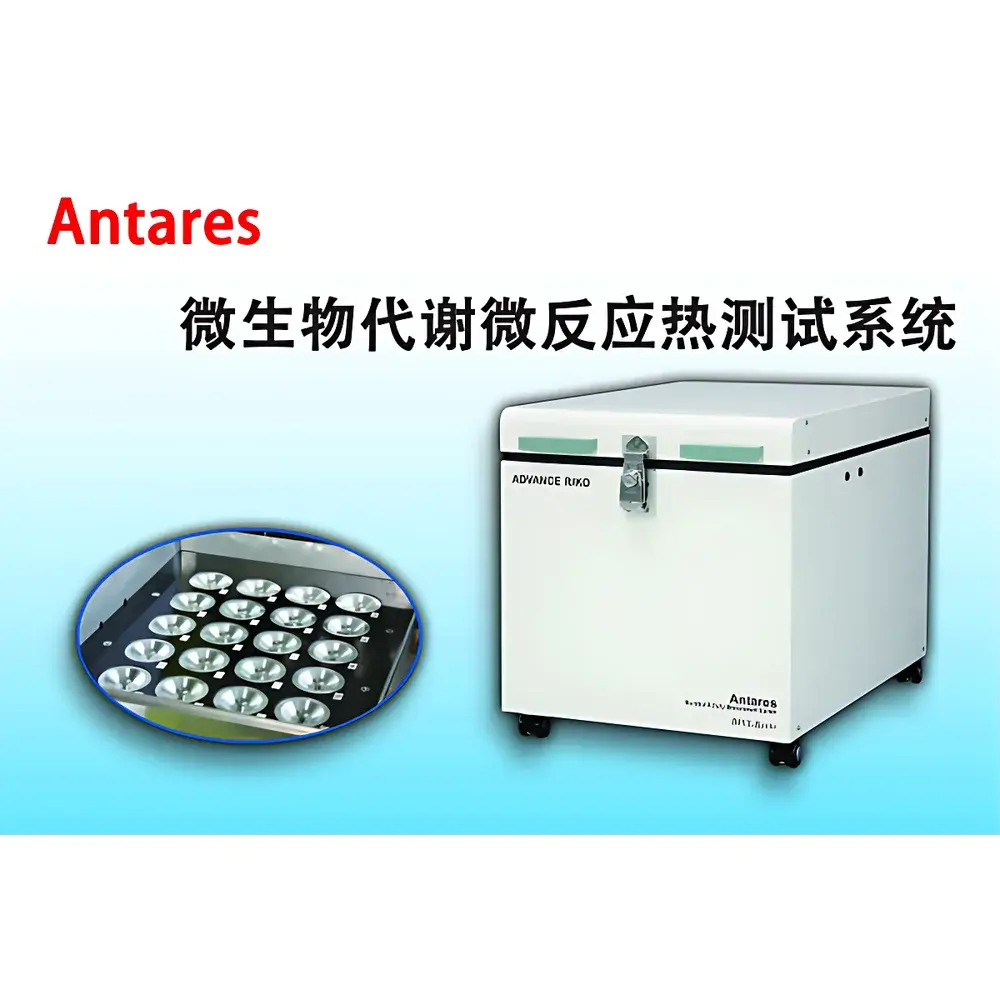
ADVANCE RIKO Antares Microcalorimetric Microbial Metabolic Activity Analyzer
| Brand | ADVANCE RIKO |
|---|---|
| Origin | Japan |
| Manufacturer Type | Authorized Distributor |
| Origin Category | Imported |
| Model | Antares |
| Instrument Type | Automated Microcalorimetric Microbial Activity Monitoring System |
| Throughput | 19 samples |
| Sample Vessel | Ø40 × H86 mm ampoule |
| Temperature Range | 5–50 °C (water-circulating thermostat control) |
| Data Acquisition Interval | 60 s (continuous operation up to 166 days) |
| Dimensions | W465 × D650 × H500 mm |
| Weight | ~100 kg |
| Power Supply | AC 100 V, 10 A |
| Installation Requirement | Temperature-stabilized laboratory environment |
Overview
The ADVANCE RIKO Antares Microcalorimetric Microbial Metabolic Activity Analyzer is a high-precision, real-time isothermal microcalorimetry (IMC) platform engineered for quantitative assessment of microbial metabolic heat flow. Unlike optical or impedance-based methods, the Antares system directly measures the minute thermal power (µW) generated by living microbial cells during catabolic and anabolic processes—providing a label-free, non-invasive, and thermodynamically grounded metric of physiological activity. This principle enables detection of viable but non-culturable (VBNC) states, sub-lethal stress responses, and subtle shifts in growth kinetics that conventional colony-forming unit (CFU) assays often miss. The system operates under tightly controlled isothermal conditions (5–50 °C) via integrated water-circulating temperature regulation, ensuring thermal stability ±0.02 °C—critical for baseline resolution and long-term signal fidelity over multi-day or multi-week experiments.
Key Features
- Non-destructive, real-time monitoring of microbial metabolic heat output without sample preparation, labeling, or disruption of native morphology—preserving integrity of solid matrices (e.g., food tissue, biofilms, cosmetic emulsions) and liquid suspensions alike.
- Parallel analysis of up to 19 independent samples within a single run, each housed in standardized Ø40 × H86 mm glass ampoules, enabling statistically robust comparative studies across strains, concentrations, or time points.
- High-temporal-resolution data acquisition at 60-second intervals, supporting kinetic modeling of lag phase duration, exponential growth rate (µmax), and stationary-phase thermal decay profiles.
- Extended operational capacity: continuous unattended measurement for up to 166 days, facilitating longitudinal studies of slow-growing organisms, preservative efficacy testing, or fermentation process optimization.
- Modular architecture comprising a thermally shielded sample measurement module, precision thermopile sensor array, dedicated data acquisition unit, industrial-grade PC with embedded control software, and closed-loop water circulation thermostat—designed for laboratory-grade reproducibility and minimal maintenance.
Sample Compatibility & Compliance
The Antares system accommodates a broad spectrum of microbiologically relevant matrices—including raw and processed foods (meat, dairy, produce), pharmaceutical excipients, cosmetic formulations, environmental water samples, and clinical isolates—without requiring dilution, filtration, or plating. Its ampoule-based format maintains sample geometry and interfacial conditions, eliminating artifacts from agitation or surface adhesion common in stirred bioreactors. From a regulatory standpoint, microcalorimetric activity data aligns with principles outlined in ISO 8587:2021 (sensory analysis—methodology—general guidance), ASTM E2538-22 (standard guide for microcalorimetry), and supports GLP-compliant documentation workflows. While not a direct replacement for pharmacopeial compendial methods (e.g., USP /), it serves as a scientifically rigorous orthogonal assay for antimicrobial susceptibility screening, preservative challenge testing, and bioburden trend analysis—particularly valuable in early-stage formulation development where rapid feedback is essential.
Software & Data Management
The Antares Control & Analysis Suite (v3.x) provides instrument orchestration, real-time thermal power visualization, and post-acquisition kinetic modeling. Raw heat flow data (µW) is timestamped and stored in vendor-neutral CSV format, compatible with third-party statistical platforms (e.g., R, Python SciPy, GraphPad Prism). The software supports automated baseline correction, peak integration, and derivation of key parameters including doubling time, area-under-curve (AUC) of metabolic activity, and time-to-detection (TTD) thresholds. Audit trails record user actions, method changes, and calibration events in accordance with FDA 21 CFR Part 11 requirements when deployed on validated Windows OS configurations. Data export modules comply with LIMS interface standards (e.g., ASTM E1467), enabling seamless integration into enterprise quality management systems.
Applications
- Quantitative evaluation of preservative efficacy in food and beverage products—correlating thermal response delay with minimum inhibitory concentration (MIC) and determining optimal dosage without culture-dependent endpoints.
- Monitoring microbial dynamics during fermentation and brewing—tracking yeast viability, bacterial contamination onset, and metabolic shift points (e.g., ethanol tolerance thresholds) in real time.
- Rapid screening of novel antimicrobial agents (e.g., peptides, plant extracts, nano-antibacterials) using heat-flow inhibition kinetics—reducing assay turnaround from days to hours relative to standard broth microdilution.
- Stability assessment of cosmetic preservative systems under accelerated aging conditions, detecting subtle microbial reactivation preceding visible spoilage.
- Pharmaceutical microbiological quality control—complementing traditional sterility testing by identifying low-level metabolic activity in aseptically filled products or assessing bioburden resilience following terminal sterilization validation.
FAQ
What types of microorganisms can be detected using the Antares system?
The system detects any metabolically active microorganism—including bacteria (Gram-positive/negative), yeasts, molds, and spores—that generate measurable heat under the selected incubation conditions. Detection sensitivity is organism- and substrate-dependent, typically ranging from 10³ to 10⁴ CFU/mL in liquid media.
Is calibration traceable to national standards?
Yes. The thermopile sensor array undergoes factory calibration against NIST-traceable thermal reference standards; users perform routine verification using certified Joule-effect calibrators supplied with the system.
Can the system operate unattended for extended periods?
Yes. With stable power, uninterrupted water circulation, and ambient temperature control (±1 °C), the Antares supports fully autonomous operation for up to 166 days—ideal for chronic toxicity or slow-growth studies.
Does the system require specialized training for operation?
Basic operation requires familiarity with microbiological safety practices and calorimetric concepts; ADVANCE RIKO provides on-site installation qualification (IQ), operational qualification (OQ), and application-specific training for method development and data interpretation.
How is data integrity ensured during long-duration runs?
The acquisition system implements cyclic redundancy check (CRC) error detection, automatic file segmentation, and dual-storage buffering to prevent data loss. All timestamps are synchronized to the host PC’s real-time clock, which can be configured for NTP synchronization in networked environments.
Related Products





