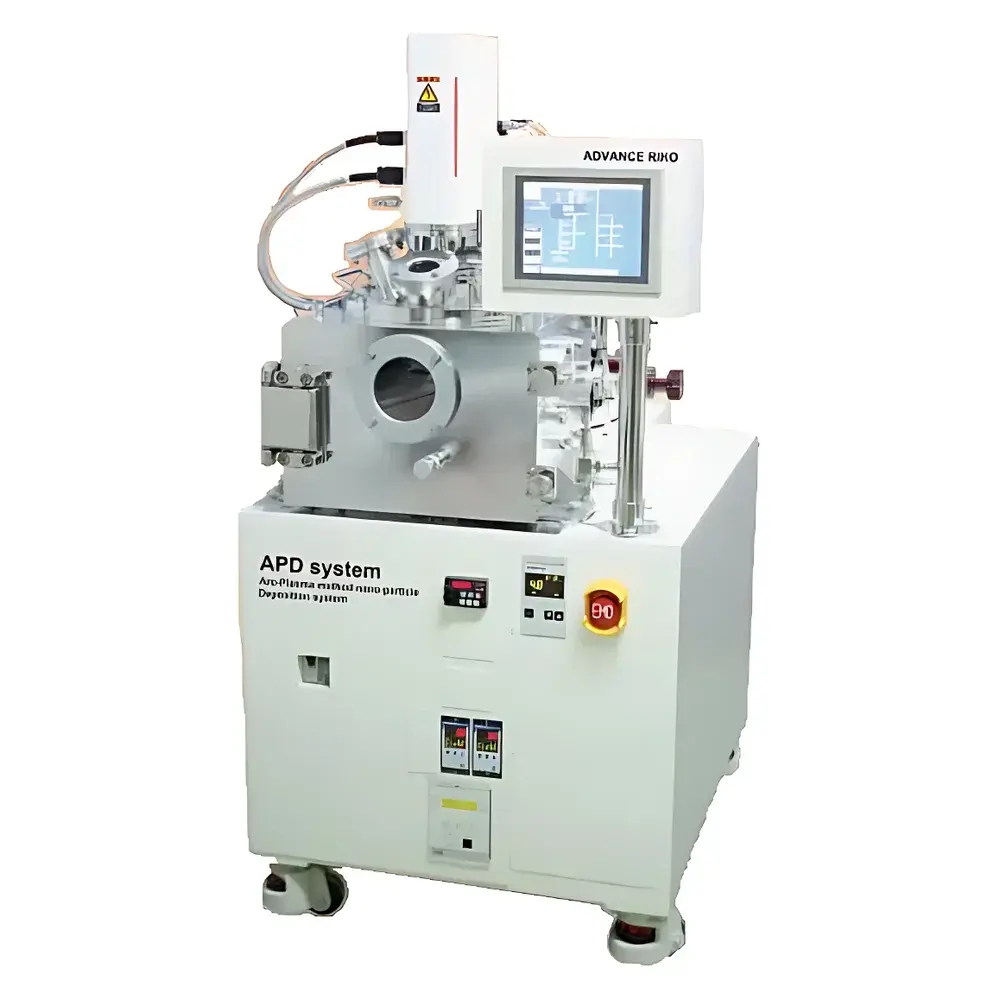
ADVANCE RIKO APD Series Arc Plasma Deposition System
| [Brand | ADVANCE RIKO |
|---|---|
| Origin | Japan |
| Model | APD |
| Vacuum Chamber Dimensions | 400 × 400 × 300 mm (L×W×H) |
| Pumping System | 450 L/s Turbomolecular Pump |
| Plasma Source | Up to 3 Configurable Arc Cathodes |
| Operating Pressure Range | High Vacuum to Low-Pressure Reactive Gases (N₂, O₂, H₂, Ar) |
| Target Geometry | Cylindrical or Tubular, Ø10 mm × 17 mm |
| Target Resistivity | < 0.01 Ω·cm |
| Energy Storage Capacitance | 360 µF × 5 (Optional Expansion) |
| Pulse Frequency | 1–5 Hz |
| Discharge Voltage | 70–400 V (Max 150 V at 1800 µF) |
| Human-Machine Interface | Integrated Touchscreen Control Panel |
| Powder Collection Module (APD-P) | Ø95 mm × 30 mm Vessel, 1–50 rpm Rotation, Yield: 13–20 cm³/h (Density- and Size-Dependent) |
| Thin-Film Configuration (APD-S) | Uniform Deposition on 2-inch Substrates] |
Overview
The ADVANCE RIKO APD Series Arc Plasma Deposition System is a precision-engineered physical vapor deposition (PVD) platform designed for the dry, solvent-free synthesis of ultrasmall metallic, semiconducting, and carbon-based nanomaterials. Unlike conventional thermal evaporation or sputtering systems, the APD employs pulsed arc discharge in high vacuum or controlled reactive atmospheres to generate high-energy, highly ionized plasma plumes directly from conductive targets. This non-equilibrium plasma process enables rapid, stoichiometric transfer of material from cathode to substrate—without intermediate chemical precursors—resulting in nanoparticles with narrow size distribution (1.5–6 nm), high surface reactivity, and tunable crystallinity. The system operates on the principle of capacitive discharge-driven cathodic arc erosion: energy stored in high-voltage capacitor banks is released across a vacuum gap between anode and resistive target cathode, initiating electron avalanche, localized target heating (>4000 K), and explosive phase transition into dense metal vapor and multiply charged ions. Magnetic field steering ensures directional delivery of energetic species onto substrates or into inert gas streams for powder collection.
Key Features
- Sub-6 nm Nanoparticle Synthesis: Precise control over pulse energy (via capacitance and voltage tuning) enables reproducible generation of monodisperse metallic, bimetallic (e.g., Fe-Co), and oxide/nitride nanoparticles within 1.5–6 nm diameter range—validated by HAADF-STEM and EDS quantification.
- Universal Conductive Target Compatibility: Accepts cylindrical or tubular targets (Ø10 mm × 17 mm) with bulk resistivity < 0.01 Ω·cm—including pure metals (Fe, Co, Pt, Ir), alloys (NiFe, CuZn), semiconductors (Si, Ge), and graphite—enabling direct plasma-phase conversion without binder or precursor decomposition.
- Reactive Atmosphere Integration: Programmable gas dosing (O₂, N₂, H₂, Ar) permits in situ oxidation, nitridation, or hydrogenation during deposition—facilitating synthesis of catalytically active Fe₃O₄, Co₃O₄, TiN, or diamond-like carbon (DLC) films and nanoparticles.
- Dual-Mode Operation: APD-S configuration supports uniform thin-film growth on 2-inch wafers or TEM grids; APD-P variant integrates rotating powder collector for scalable batch production of free-standing nanocatalysts—ideal for PEMFC electrode ink formulation or VOC abatement studies.
- Robust Vacuum Architecture: 400 × 400 × 300 mm stainless-steel chamber coupled with 450 L/s turbomolecular pumping achieves base pressure < 5 × 10⁻⁷ Pa, ensuring minimal background contamination and stable arc ignition.
- Full Process Traceability: Touchscreen HMI logs all operational parameters—including pulse count, voltage, pressure, gas flow rates, and rotation speed—with timestamped export capability for GLP-compliant documentation.
Sample Compatibility & Compliance
The APD system accommodates targets spanning >70 elements across the periodic table—primarily those with high electrical conductivity (Group 8–11 transition metals, lanthanides, Si, Ge, B, C). Target geometry is strictly limited to solid or hollow cylinders (Ø10 mm × 17 mm); porous or insulating targets require conductive backing or composite fabrication. All deposition processes comply with ISO 14001 environmental handling protocols for nanomaterial synthesis. For regulated research environments, the system’s parameter logging architecture supports audit trails aligned with FDA 21 CFR Part 11 requirements when paired with validated third-party data management software. No hazardous precursors, solvents, or reducing agents are employed—eliminating VOC emissions and simplifying EHS reporting under REACH Annex XVII.
Software & Data Management
The embedded control firmware provides real-time monitoring of arc stability (voltage/current waveforms), chamber pressure dynamics, and gas flow synchronization. Process recipes—including pulse frequency (1–5 Hz), discharge voltage ramp profiles, gas partial pressures, and substrate bias settings—are saved as encrypted .apd files with version control. Raw operational logs export in CSV format compatible with MATLAB, Python (pandas), or LabArchives ELN integration. Optional API access enables remote orchestration via TCP/IP for multi-system labs. All timestamped datasets include metadata fields for operator ID, sample ID, and calibration certificate references—supporting traceability in ISO/IEC 17025-accredited testing laboratories.
Applications
- Catalyst Development: Dry synthesis of Pt/C, Ir/TiO₂, and Fe-Co/C nanocomposites for PEMFC cathodes, low-temperature water-gas shift reactors, and photocatalytic H₂ evolution—demonstrating 3–5× higher mass activity vs. colloidal counterparts due to clean interfaces and absence of surfactant poisoning.
- Functional Thin Films: Growth of thermoelectric Bi₂Te₃, Sb₂Te₃, and Mg₂Si films on Si/SiO₂ or flexible polyimide substrates under controlled Ar/H₂ mixtures—enabling Seebeck coefficient optimization via plasma-induced defect engineering.
- Carbon Nanostructure Engineering: Hydrogen-assisted arc discharge on graphite targets yields ultrananocrystalline diamond (UNCD) particles (<5 nm) and vertically aligned single-walled carbon nanotubes (SWCNTs) on Ir-decorated substrates—characterized by HRTEM-EELS and synchrotron XANES.
- Advanced Oxide/Nitride Layers: Direct synthesis of epitaxy-ready NiO, Co₃O₄, and TiN gate dielectrics on GaN or SiC wafers—achieving stoichiometric control unattainable via ALD at comparable throughput.
- Reference Material Production: Certified nanoparticle standards (e.g., Fe₃O₄, Pt) for TEM calibration, DLS validation, and ICP-MS quantification—traceable to NIST SRM protocols through interlaboratory round-robin studies.
FAQ
What target materials are incompatible with the APD system?
Targets with resistivity ≥ 0.01 Ω·cm—including oxides (Al₂O₃, SiO₂), polymers, ceramics, and heavily doped semiconductors—cannot sustain stable arc discharge and require alternative PVD methods such as magnetron sputtering.
Can the APD deposit multilayer heterostructures?
Yes—sequential target mounting with automated cathode indexing (optional upgrade) enables layer-by-layer deposition of dissimilar materials (e.g., Pt/Co/Pt spin valves) without breaking vacuum, provided interlayer diffusion is kinetically suppressed by low substrate temperature (<150 °C).
Is post-deposition annealing required to crystallize as-deposited films?
Not typically—the high kinetic energy of arc-generated ions promotes in-flight condensation with inherent crystallinity; however, optional in-situ heating stage (up to 600 °C) is available for strain relaxation or phase transformation (e.g., amorphous-to-crystalline Si).
How is nanoparticle size distribution verified?
Size histograms are generated from TEM micrographs of collected powders using ImageJ with calibrated scale bars; statistical confidence intervals (95%) are reported per ISO 20957-2:2021 for nanoparticle characterization.
Does ADVANCE RIKO provide application support for catalyst testing?
Yes—comprehensive technical documentation includes electrochemical testing protocols (CV, LSV, EIS) for ORR, HER, and CO oxidation on APD-synthesized catalysts, aligned with DOE Hydrogen Program guidelines and ASTM D7212 for catalyst durability assessment.