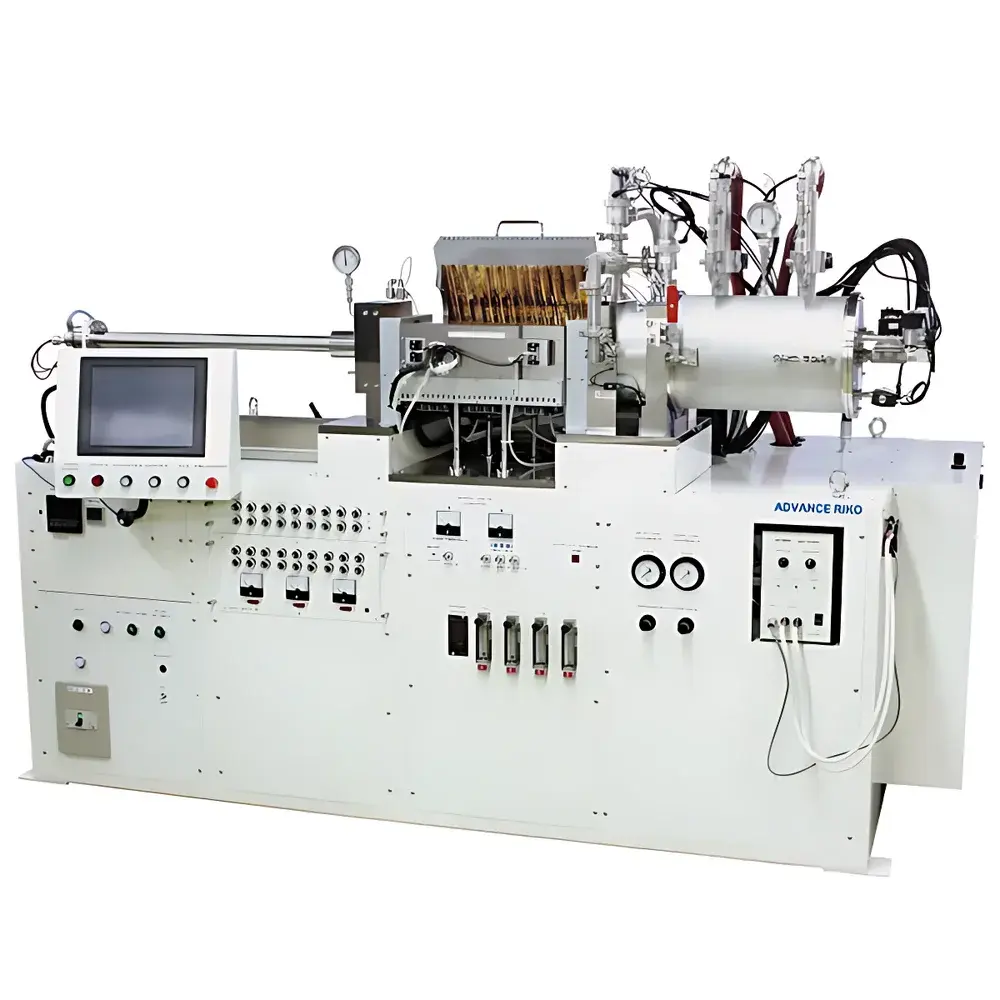
ADVANCE RIKO CAS-AYII Continuous Annealing Simulation System
| Brand | ADVANCE RIKO |
|---|---|
| Origin | Japan |
| Manufacturer Type | Authorized Distributor |
| Origin Category | Imported |
| Model | CAS-AYII |
| Instrument Type | Non-Vacuum Rapid Thermal Annealing System |
| Sample Dimensions | 70 mm (W) × 220 mm (L) × 0.5–2.0 mm (T) |
| Temperature Range | 50 °C to 1000 °C (max. 1150 °C) |
| Max. Heating Rate | 30 °C/s |
| Max. Cooling Rate | −70 °C/s (from 1000 °C to 400 °C) |
| Annealing Temperature Accuracy | High |
| Annealing Temperature Uniformity | High |
Overview
The ADVANCE RIKO CAS-AYII Continuous Annealing Simulation System is a high-precision, non-vacuum rapid thermal processing platform engineered for the experimental simulation and parametric optimization of industrial continuous annealing processes—specifically tailored for metallic strip materials including carbon steel, stainless steel, and electromagnetic steels. Unlike conventional batch-type furnaces, the CAS-AYII implements a dual-zone architecture: a high-intensity infrared gold-reflector heating chamber followed by an independent, actively controlled gas- or mist-cooled quenching zone. This configuration enables true dynamic thermal profiling—reproducing real-world thermal histories experienced during hot-rolled coil processing lines, including soaking, intercritical heating, rapid heating to peak temperature, and precisely timed forced cooling. The system operates under programmable atmospheric conditions (N₂, air, or custom gas mixtures), supporting both oxidative and inert annealing environments essential for surface property control, oxide scale formation studies, and recrystallization kinetics validation.
Key Features
- Dual-chamber modular design: Separated IR heating and active cooling zones allow independent thermal trajectory control—enabling accurate replication of industrial continuous annealing cycles with millisecond-level temporal resolution.
- Gold-coated parabolic reflector furnace: Delivers uniform radiant heating across the full 70 mm × 220 mm sample area, achieving ±1.5 °C spatial temperature uniformity at 900 °C (measured per ASTM E220).
- High-speed thermal response: Capable of ramping from ambient to 1000 °C at up to 30 °C/s and cooling from 1000 °C to 400 °C at −70 °C/s—parameters validated using calibrated thin-film thermocouples embedded in representative steel substrates.
- Atmosphere-flexible operation: Integrated mass flow controllers support stable N₂ purging (dew point < −40 °C), ambient air annealing, or mixed-gas environments (e.g., N₂ + H₂) for decarburization or reduction studies.
- Integrated thermal monitoring: Four independently addressable Type-K thermocouples (two surface-contact, two embedded) provide real-time feedback for closed-loop PID regulation and post-process thermal history reconstruction.
- Robust mechanical architecture: Stainless-steel frame with water-cooled outer casing ensures long-term dimensional stability and operator safety during repeated high-temperature cycling.
Sample Compatibility & Compliance
The CAS-AYII accommodates flat metallic specimens up to 70 mm wide, 220 mm long, and 0.5–2.0 mm thick—compatible with standard tensile coupons (ASTM E8/E8M), metallographic cross-sections, and coated strip samples. Its design complies with ISO 9001-certified manufacturing protocols and incorporates hardware-level safeguards aligned with IEC 61000-6-2 (EMC immunity) and IEC 61000-6-4 (EMC emission) standards. All thermal control firmware supports audit-trail logging compliant with GLP and GMP requirements, and optional 21 CFR Part 11-compliant user access controls and electronic signature modules are available upon request.
Software & Data Management
The system is operated via ADVANCE RIKO’s proprietary ThermalSim™ control suite, running on a Windows-based industrial PC with deterministic real-time kernel extension. The software provides synchronized multi-channel data acquisition (200 Hz sampling), customizable thermal ramp/soak/cool profiles, and automated cycle sequencing. Exported datasets include time-stamped temperature traces, atmosphere composition logs, and power consumption metrics—all formatted in ASCII CSV and HDF5 for seamless integration with MATLAB, Python (NumPy/Pandas), or Thermo-Calc® thermodynamic modeling workflows. Raw data files are timestamped, checksum-verified, and stored with immutable metadata (operator ID, sample ID, ambient conditions), satisfying traceability requirements for R&D reporting and regulatory submissions.
Applications
- Kinetic modeling of ferrite recrystallization and austenite grain growth in low-carbon steels.
- Optimization of final microstructure in cold-rolled stainless steel grades (e.g., 304, 430) through controlled intercritical annealing.
- Surface oxide evolution studies under varying O₂ partial pressures and cooling rates—correlating with magnetic permeability in non-oriented electrical steels.
- Process window definition for continuous galvannealing line (CGL) simulations, including Zn-Fe alloy layer formation kinetics.
- Validation of CALPHAD-based phase transformation predictions against experimentally derived TTT/CCT diagrams.
- Accelerated aging studies of precipitation-hardened alloys (e.g., Al-Mg-Si, Cu-Ni-Be) under industrially relevant thermal transients.
FAQ
What maximum sample thickness can the CAS-AYII accommodate while maintaining thermal uniformity?
The system is optimized for specimens 0.5–2.0 mm thick; uniformity specifications (±1.5 °C) are guaranteed at 1.2 mm thickness per ASTM E220 calibration protocol.
Is the cooling rate of −70 °C/s achievable across the full sample area?
Yes—this rate is verified at the geometric center and all four corners of the 70 mm × 220 mm zone using embedded thermocouple arrays under nitrogen quench conditions.
Can the system be integrated with in-situ XRD or optical pyrometry?
The front-access quartz viewport (Φ80 mm, fused silica, transmission >85% from 200–2500 nm) supports external synchrotron/XRD beamlines and high-speed spectral pyrometers with trigger synchronization.
Does the system support custom atmosphere gas mixtures beyond N₂ and air?
Yes—optional MFC expansion supports up to four gases (e.g., H₂, CO, NH₃, Ar); gas mixing precision is ±0.5% FS per channel with auto-leak detection.
What level of software validation documentation is provided?
A complete IQ/OQ package—including installation qualification reports, operational qualification test scripts, and firmware version traceability—is supplied with each system.