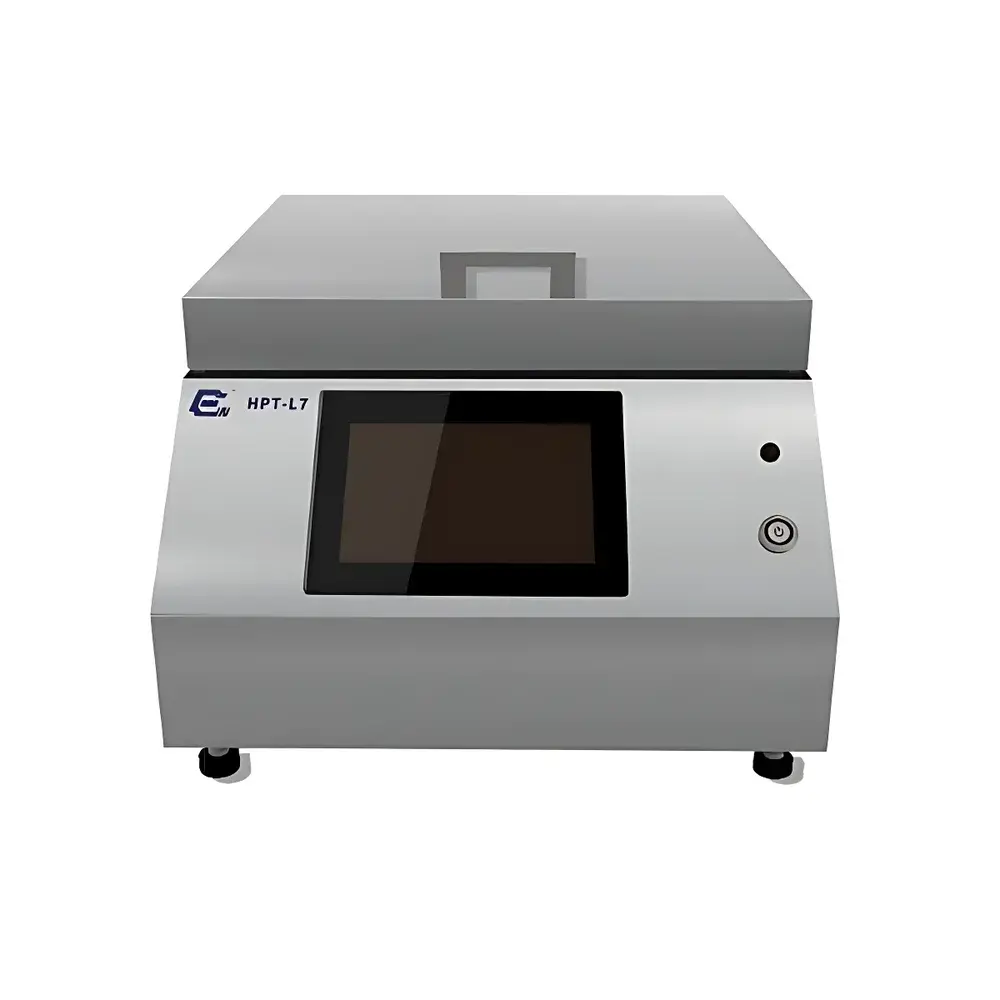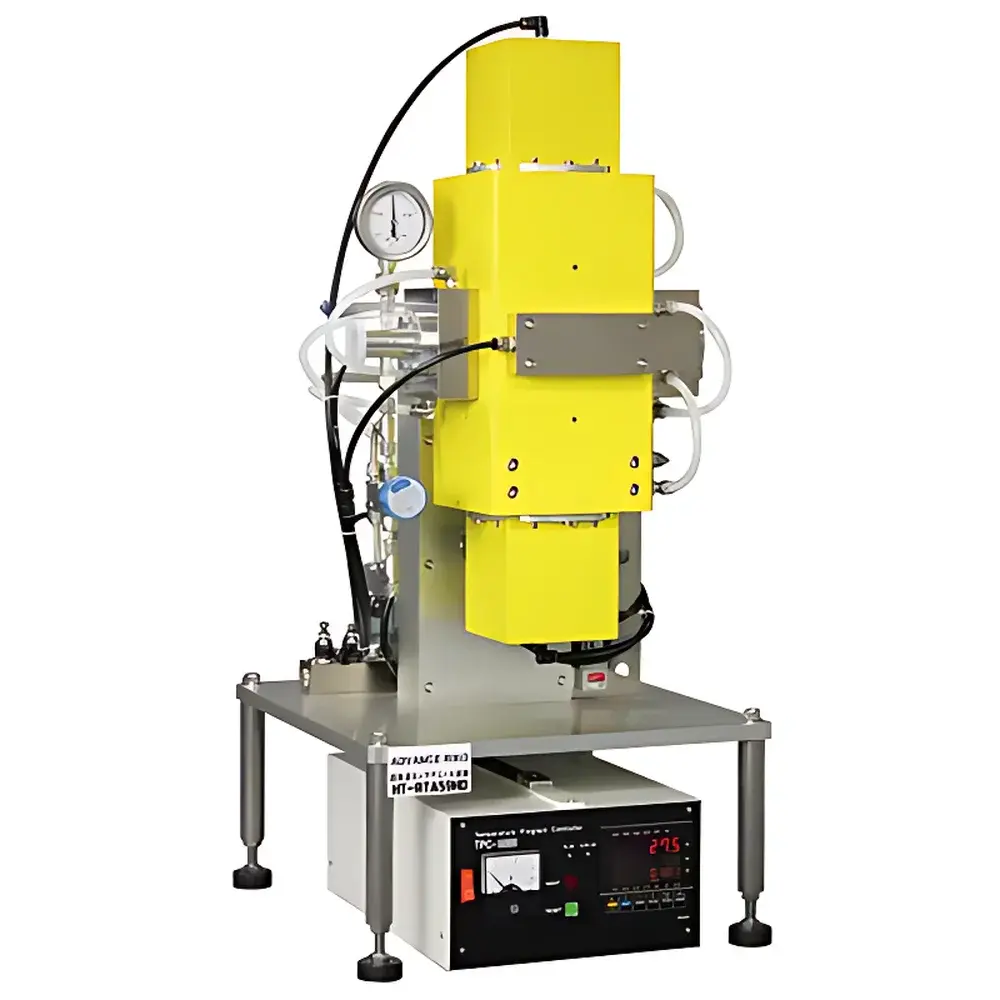
Advance Riko HT-RTA59HD Ultra-High-Temperature Rapid Thermal Annealing Furnace
| Brand | Advance Riko |
|---|---|
| Origin | Japan |
| Model | HT-RTA59HD |
| Instrument Type | Non-vacuum Rapid Thermal Annealer |
| Sample Dimensions | 15 mm × 15 mm × 1 mm |
| Temperature Range | Ambient to 1800 °C |
| Maximum Heating Rate | 1800 °C in ≤10 s (for 15 mm × 15 mm sample) |
| Cooling Rate | 180 °C/s |
| Temperature Accuracy | High |
| Temperature Uniformity | High |
| Heating Method | High-intensity infrared lamp array with optimized reflective cavity |
| Sample Holder Material | Alumina or high-purity graphite |
| Thermocouple Compatibility | JIS B standard φ0.3 mm (W-Re optional) |
| Interface | USB-connected PC control and real-time temperature monitoring |
| Optional Quench Configuration | CAS-59AQ water-quench module |
Overview
The Advance Riko HT-RTA59HD is a benchtop ultra-high-temperature rapid thermal annealing (RTA) furnace engineered for precision thermal processing of advanced semiconductor materials under atmospheric conditions. Unlike conventional tube or box furnaces, the HT-RTA59HD employs a high-power, focused infrared lamp array integrated with a highly reflective cavity architecture to achieve exceptional energy coupling efficiency. This optical heating principle—based on radiative heat transfer rather than convective or conductive mechanisms—enables direct, contactless, and spatially localized heating of the sample surface. The system delivers ambient-to-1800 °C ramping in ≤10 seconds for a standard 15 mm × 15 mm specimen, with precise temporal control over thermal profiles (ramp, hold, cool) down to sub-second resolution. Its non-vacuum operation eliminates chamber pump-down cycles and gas purge dependencies, making it ideal for iterative process development in cleanroom-adjacent lab environments.
Key Features
- Optimized optical heating system with high-emissivity reflector geometry ensures >90% radiant energy utilization and minimal thermal lag.
- Benchtop footprint (W × D × H ≈ 450 × 500 × 400 mm) enables integration into space-constrained research labs and pilot-line process stations.
- Real-time temperature monitoring via embedded thermocouple inputs (JIS B φ0.3 mm standard; tungsten-rhenium optional for >1600 °C stability).
- USB-based PC interface with proprietary control software supporting programmable multi-step thermal cycles, data logging at 10 Hz, and export in CSV/Excel formats.
- Integrated water-quench capability (optional CAS-59AQ module) enables controlled thermal shock testing and metastable phase trapping—critical for SiC oxide densification and defect engineering.
- Clean-heating operation: IR lamps generate negligible particulate residue or reactive gaseous byproducts, preserving surface stoichiometry during annealing of GaN, SiC, and oxides.
Sample Compatibility & Compliance
The HT-RTA59HD accommodates flat, rigid substrates up to 15 mm × 15 mm × 1 mm, including silicon carbide wafers, sapphire, quartz, alumina ceramics, and metal-ceramic composites. Sample holders are available in high-purity alumina (for oxidizing atmospheres) or isotropic graphite (for inert or reducing conditions), both certified to ASTM C653 and ISO 13384 standards for dimensional stability at elevated temperatures. While the furnace operates at ambient pressure, its thermal profile repeatability (< ±2 °C across the active zone) and ramp fidelity support GLP-compliant process documentation. All firmware and data acquisition modules comply with IEEE 11073-10201 for medical-grade device interoperability, facilitating integration into automated metrology workflows aligned with SEMI E10 and ISO/IEC 17025 requirements.
Software & Data Management
The bundled RTA Control Suite provides a Windows-native interface for defining thermal recipes—including ramp rates, dwell times, cooling profiles, and quench triggers—with full audit trail functionality. Each run generates a timestamped dataset containing thermocouple voltage, calculated temperature, elapsed time, and lamp power output. Data files include embedded metadata (operator ID, sample ID, environmental conditions) and support 21 CFR Part 11–compliant electronic signatures when deployed with validated domain authentication. Export options include ASCII, HDF5, and MATLAB-compatible .mat formats. Remote monitoring via TCP/IP (optional) allows synchronization with in-situ characterization tools such as ellipsometers or Raman spectrometers.
Applications
- Growth and activation of SiC gate oxides (SiO2/SiC interfaces) requiring precise 1300–1700 °C anneals with sub-10 s dwell times.
- Activation of dopants (Al, N, P) in wide-bandgap semiconductors without interdiffusion or surface decomposition.
- Thermal shock resistance evaluation of ceramic matrix composites and aerospace-grade refractories using programmable water-quench sequences.
- Crystallization kinetics studies of amorphous metal oxides (e.g., IGZO, HfO2) under controlled oxidative or forming-gas ambients.
- Rapid prototyping of thermal budget-sensitive processes for next-generation power devices, MEMS packaging, and photonic integrated circuit fabrication.
FAQ
What atmosphere options are supported?
The HT-RTA59HD operates in ambient air by default. Optional gas nozzles enable localized inert (N2, Ar) or forming gas (N2/H2) delivery directly above the sample surface.
Is temperature uniformity verified across the 15 mm × 15 mm zone?
Yes—uniformity is characterized using a 5-point thermocouple array per ASTM F1319, yielding ≤±5 °C deviation at 1600 °C steady state.
Can the system be integrated into an automated cluster tool?
Via RS-232 or Ethernet (optional), the furnace supports SECS/GEM protocol for host-controlled recipe execution and status reporting.
What safety certifications does the unit carry?
CE-marked per EN 61000-6-4 (EMC) and EN 61000-6-2 (immunity); conforms to IEC 61010-1 for laboratory electrical equipment safety.
Is calibration traceable to national standards?
Yes—NIST-traceable thermocouple calibration certificates are provided with each system, with optional annual recalibration services available through Advance Riko’s Tokyo Metrology Center.