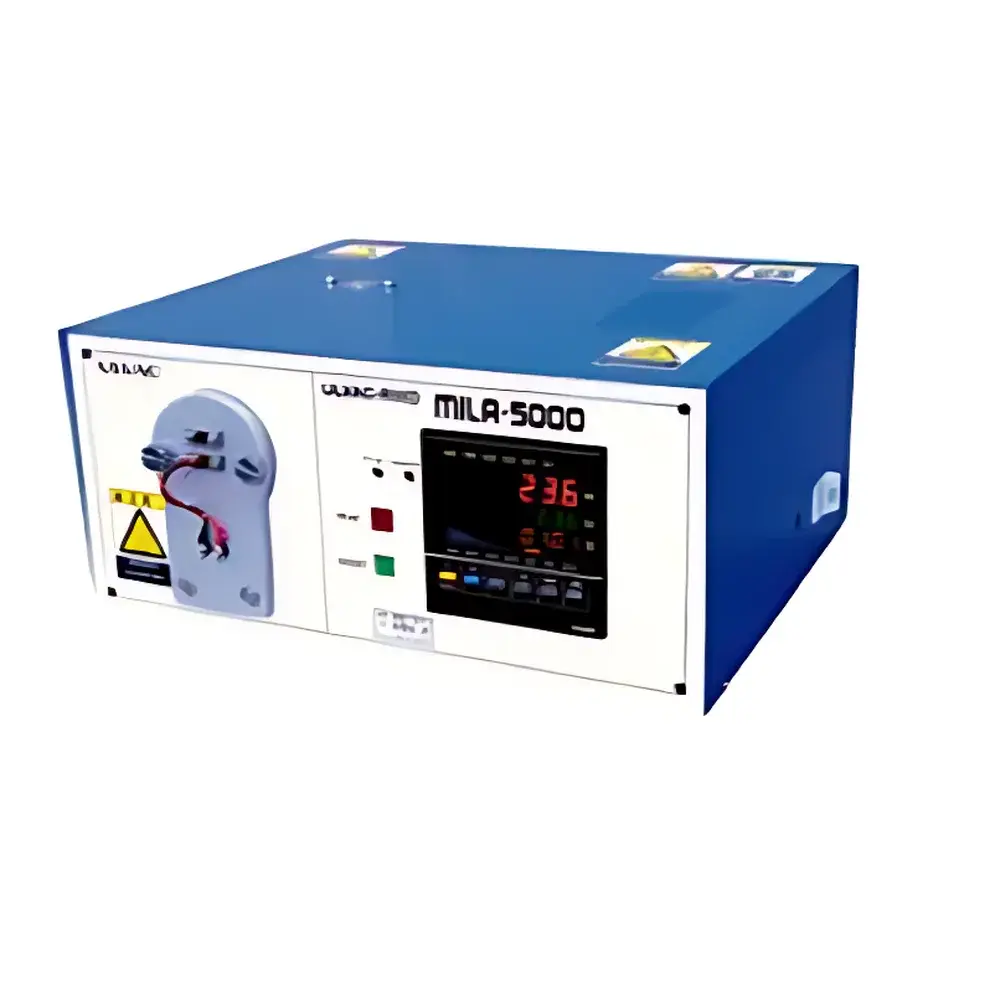
ADVANCE RIKO Mila-5000 Series Desktop High-Vacuum Rapid Thermal Annealing System
| Brand | ADVANCE RIKO |
|---|---|
| Origin | Japan |
| Model | Mila-5000 Series |
| Instrument Type | High-Vacuum Rapid Thermal Annealing Furnace |
| Vacuum Level (Mila-5000UHV) | ≤1×10⁻⁵ Pa |
| Max Heating Rate | Up to 50 °C/s |
| Cooling Method | Integrated Water-Cooled Chamber |
| Atmosphere Options | Vacuum, Inert Gas (N₂, Ar), Ambient Air, Controlled Flow Gas |
| Sample Environment | O-Ring Sealed Quartz Tube |
| Real-Time Monitoring | Top-Mount Optical Viewport + Optional USB Camera Integration |
| Temperature Control | Built-in Programmable PID Controller with Dual Display (Setpoint vs. Actual) |
| Interface | USB 2.0 for PC-Based Program Configuration and Data Logging |
Overview
The ADVANCE RIKO Mila-5000 Series is a compact, high-precision desktop rapid thermal annealing (RTA) system engineered for semiconductor process development, thin-film optimization, and materials research in cleanroom and laboratory environments. Unlike conventional box furnaces, the Mila-5000 employs high-intensity infrared (IR) irradiation from gold-coated reflector lamps—optimized for spectral matching with quartz transparency and silicon absorption—to achieve non-contact, volumetric heating of substrates. This design enables ultra-fast thermal transients with minimal thermal mass interference, supporting ramp rates up to 50 °C/s and sub-second temperature stabilization at target setpoints. The system’s core architecture integrates the IR heating module, quartz reaction chamber, vacuum/gas handling manifold, and digital temperature controller into a single benchtop footprint, minimizing footprint while preserving engineering-grade repeatability and cross-wafer uniformity.
Key Features
- High-Vacuum Capability (Mila-5000UHV variant): Equipped with turbomolecular pumping and active pressure regulation, achieving base pressures ≤1×10⁻⁵ Pa—enabling oxide suppression, dopant activation without ambient contamination, and surface-sensitive anneals compatible with UHV-compatible metrology workflows.
- Multi-Atmosphere Flexibility: Seamless switching between vacuum, static inert gas (N₂ or Ar), dynamic gas flow (up to 500 sccm), and ambient air modes via integrated mass flow controllers and pneumatic isolation valves—ensuring compatibility with oxidation, nitridation, passivation, and reduction processes.
- Optical Process Monitoring: A fused silica viewport (UV–NIR transparent) positioned above the sample stage allows real-time visual inspection during annealing; optional high-frame-rate USB camera integration supports time-resolved morphological tracking (e.g., dewetting, crystallization, phase segregation) with synchronized thermal logging.
- Dual-Mode Temperature Management: Combines fast-response K-type thermocouple feedback with emissivity-compensated pyrometric monitoring for closed-loop control across 100–1200 °C (depending on configuration); programmable 32-segment ramp-soak profiles stored locally or loaded via USB-connected PC software.
- Contamination-Controlled Sample Environment: Samples are mounted inside an O-ring sealed, low-outgassing quartz tube—preventing particulate ingress, metal diffusion, and residual hydrocarbon adsorption—critical for gate oxide integrity and epitaxial layer fidelity.
Sample Compatibility & Compliance
The Mila-5000 accommodates standard semiconductor wafers (up to 6-inch diameter), TEM grids, thin-film coupons (glass, Si, SiC, sapphire), and nanostructured substrates. Its quartz chamber complies with SEMI F47 mechanical stress standards and meets ISO Class 5 cleanroom compatibility requirements when operated under inert purge. For regulated environments, the system supports audit-ready operation: temperature profiles, timestamps, operator IDs, and vacuum/gas logs are timestamped and exportable in CSV/ASCII format—aligning with GLP documentation practices and FDA 21 CFR Part 11 electronic record readiness (when paired with validated PC software). All electrical components conform to IEC 61000-6-3 (EMC) and IEC 61010-1 (safety) standards.
Software & Data Management
The Mila-5000 is controlled via ADVANCE RIKO’s proprietary RTAControl Suite—a Windows-based application accessible through standard USB 2.0 interface. The software provides full remote access to all hardware parameters: real-time temperature curves, vacuum pressure trends, gas flow status, and lamp power output. Users may define multi-step thermal cycles with conditional branching (e.g., “hold until pressure <1×10⁻⁴ Pa”), trigger external devices (e.g., shutter control, data acquisition systems), and export synchronized datasets with metadata tags (sample ID, operator, date/time, version stamp). Raw data files include embedded calibration coefficients and sensor health diagnostics—facilitating traceable analysis per ISO/IEC 17025 quality management frameworks.
Applications
- Silicon device processing: Activation annealing of ion-implanted dopants (e.g., B, P, As) with minimal diffusion length (<5 nm junction depth control).
- 2D material engineering: Defect healing in MoS₂, graphene, and h-BN layers; interfacial reaction control in van der Waals heterostructures.
- Perovskite optoelectronics: Crystallinity optimization of MAPbI₃ films without decomposition—enabled by millisecond-scale thermal dwell control.
- Metal–insulator–semiconductor (MIS) contact formation: Low-temperature silicidation and ohmic contact stabilization on GaN and SiC substrates.
- MEMS/NEMS release annealing: Stress relief and hermetic seal formation in encapsulated resonators under controlled partial pressure environments.
FAQ
What vacuum level can the Mila-5000UHV achieve, and how is it maintained during thermal cycling?
The Mila-5000UHV reaches ≤1×10⁻⁵ Pa using a hybrid pumping system (turbo + scroll backing pump) with active pressure feedback control; bake-out protocols and cold traps minimize water vapor and hydrocarbon backstreaming during ramp-up.
Is the system compatible with in-situ electrical characterization during annealing?
Yes—the chamber includes four shielded feedthroughs rated for ≤100 V DC and 1 A, supporting four-point probe resistivity measurements or capacitance-voltage profiling with external source meters.
Can the quartz tube be replaced by users, and what is its typical service life under repeated thermal cycling?
Quartz tubes are field-replaceable consumables; under standard usage (≤1100 °C, ≤100 cycles/year), lifespan exceeds 500 cycles with periodic visual inspection for devitrification or microcracking.
Does the system support automated recipe transfer across multiple units in a shared lab environment?
Yes—RTAControl Suite allows encrypted recipe export/import (.rta files) with checksum validation and version-controlled library management for cross-platform reproducibility.
How is temperature uniformity verified across the sample surface?
Uniformity is characterized using calibrated thermal imaging (±1 °C accuracy) and multi-point thermocouple mapping per ASTM E220; typical radial variation is ±2.5 °C over 100 mm diameter at 900 °C.