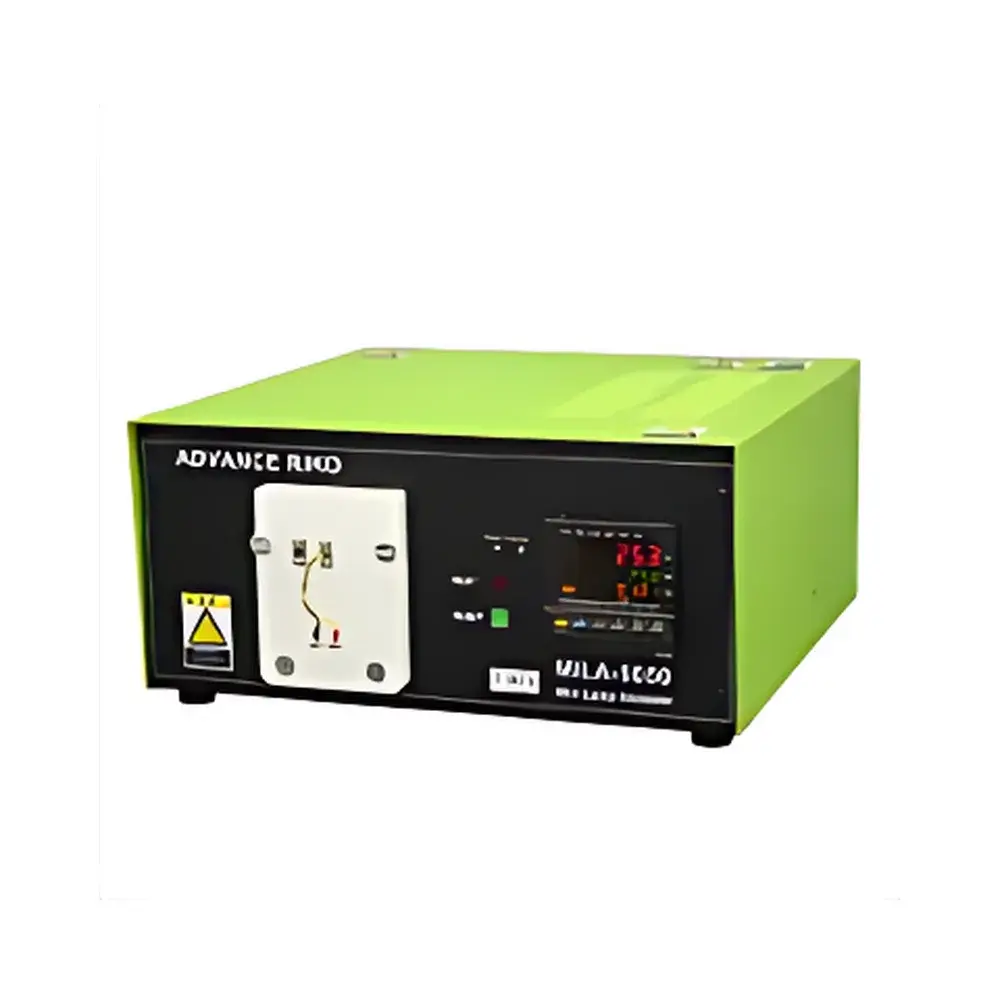
ADVANCE RIKO MILA-5000 Series Desktop Rapid Thermal Annealing Furnace
| Brand | ADVANCE RIKO |
|---|---|
| Origin | Japan |
| Model | MILA-5000 |
| Instrument Type | General-Purpose Vacuum Rapid Thermal Annealer |
| Sample Size | 2-inch wafer |
| Temperature Range | 0–1200 °C |
| Max. Heating Rate | 150 K/s |
| Max. Cooling Rate | 200 K/s |
| Temperature Accuracy | ±1% of setpoint |
| Temperature Uniformity | ±1% across sample surface |
| Atmosphere Options | Vacuum (down to 10⁻⁵ Pa for MILA-5000UHV variant), N₂, Ar, O₂, forming gas, ambient air |
| Heating Source | High-intensity infrared gold-coated halogen lamps |
| Cooling Method | Integrated water-cooled chamber base and forced convection |
| Control Interface | USB-connected PC software + front-panel programmable controller |
| Real-time Monitoring | Top-mounted quartz viewport with optional high-speed camera integration |
| Electrical Measurement Compatibility | Built-in 4-point probe interface for in-situ resistivity monitoring |
Overview
The ADVANCE RIKO MILA-5000 Series Desktop Rapid Thermal Annealing (RTA) Furnace is a compact, high-performance thermal processing system engineered for semiconductor research, thin-film development, and advanced materials characterization. Based on rapid radiative heating principles, the MILA-5000 employs high-power, gold-reflector infrared halogen lamps to deliver precise, localized thermal energy directly to substrates—minimizing thermal mass effects and enabling millisecond-scale thermal transients. Unlike conventional tube or box furnaces, this system operates on rapid thermal processing (RTP) methodology, where temperature ramps are governed by optical power modulation rather than convective or conductive heat transfer. Its integrated quartz reaction chamber—sealed with Viton or Kalrez O-rings depending on process requirements—supports controlled ambient environments ranging from high vacuum (10⁻⁵ Pa in the MILA-5000UHV configuration) to reactive or inert gas flows. Designed for laboratory-scale process optimization, the MILA-5000 meets the stringent demands of dopant activation, silicide formation, oxide densification, and post-lithography bake steps in microelectronics fabrication workflows.
Key Features
- Ultra-fast thermal response: Achieves heating rates up to 150 K/s and cooling rates up to 200 K/s via synchronized lamp modulation and active water-cooled chamber base.
- High spatial and temporal temperature control: Maintains ±1% accuracy relative to setpoint and ±1% uniformity across a standard 2-inch (50.8 mm) diameter substrate surface—validated per ASTM F1936 for RTP uniformity mapping.
- Multi-atmosphere compatibility: Supports vacuum, nitrogen, argon, oxygen, forming gas (N₂/H₂), and ambient air processing through standardized Swagelok fittings and mass flow controller (MFC)-ready ports.
- Real-time process observation: Features a top-mounted fused silica viewport (transmission >85% from 250–2500 nm) compatible with high-speed CMOS cameras (up to 1000 fps) for in situ morphological and emissivity-based temperature validation.
- Integrated electrical characterization interface: Includes four-terminal (Kelvin) probe feedthroughs and low-noise BNC connectors for concurrent resistivity, sheet resistance, or Hall effect measurements during annealing.
- Regulatory-compliant control architecture: Firmware supports audit trail logging, user-level access control, and electronic signature capability—aligned with GLP and FDA 21 CFR Part 11 requirements when paired with validated PC software.
Sample Compatibility & Compliance
The MILA-5000 accommodates standard 2-inch wafers (Si, SiC, GaN, sapphire, glass, or flexible polymer substrates) mounted on a graphite or SiC-coated susceptor. Substrate placement is facilitated by a manual or motorized lift stage with repeatable Z-positioning (±5 µm). The quartz chamber complies with SEMI F27-0201 for particle generation limits (<1 particle/cm² per 30 min at 0.5 µm) under cleanroom Class 100 conditions. All wetted materials—including O-rings, gaskets, and gas lines—are certified for ultra-high-purity semiconductor applications (SEMI C10 compliant). Vacuum configurations (MILA-5000UHV) integrate turbomolecular pumping and capacitance manometry, achieving base pressures ≤1×10⁻⁵ Pa—suitable for native oxide suppression and contamination-sensitive anneals per ISO 14644-1 Class 5 protocols.
Software & Data Management
Operation is managed via ADVANCE RIKO’s proprietary RTAControl software (Windows 10/11, 64-bit), accessible through USB 2.0 interface. The software provides full IEC 61131-3–compliant recipe programming—including multi-step ramp-soak-cool sequences, real-time PID parameter tuning, and dynamic setpoint adjustment based on thermocouple or pyrometer feedback. All thermal profiles, sensor readings, gas flow logs, and user actions are timestamped and stored in HDF5 format with SHA-256 checksum integrity verification. Export options include CSV, MATLAB .mat, and PDF-certified reports containing digital signatures and calibration metadata traceable to JCSS (Japan Calibration Service System). Data archives support automated backup to network drives and integration with LIMS platforms via RESTful API.
Applications
- Dopant activation in ion-implanted silicon and compound semiconductors (e.g., BF₂, As, P, Sb).
- Metal silicide formation (NiSi, CoSi₂, TiSi₂) and phase transformation kinetics studies.
- Low-k dielectric curing and porosity stabilization in BEOL integration schemes.
- Perovskite film crystallization and defect passivation for photovoltaic R&D.
- In-situ monitoring of phase segregation, dewetting, and interdiffusion in multilayer metallization stacks.
- Process window definition for EUV lithography post-exposure bake (PEB) simulation.
FAQ
What vacuum level can the MILA-5000UHV achieve, and how is it measured?
The MILA-5000UHV achieves a base pressure of ≤1×10⁻⁵ Pa, verified using a calibrated cold-cathode gauge and referenced against a JCSS-traceable capacitance manometer.
Is the system compatible with in-situ electrical measurement during annealing?
Yes—the furnace includes four isolated feedthroughs supporting 4-point probe resistivity, Hall effect, and I-V characterization with noise floor <100 nV/√Hz (1 kHz bandwidth).
Can temperature uniformity be mapped across non-standard substrates?
Uniformity mapping is performed using a calibrated thermocouple array per ASTM F1936; custom mapping routines for irregular geometries are available upon request with additional calibration services.
Does the system support automated recipe transfer between instruments?
Yes—RTAControl exports recipes in XML format compliant with the SECS/GEM standard, enabling seamless transfer across ADVANCE RIKO’s MILA platform family.
What maintenance intervals are recommended for lamp and quartz chamber components?
Infrared lamps are rated for ≥10,000 cycles at 1100 °C; quartz chamber inspection is recommended every 200 operating hours or after exposure to corrosive atmospheres, per the maintenance log embedded in firmware v3.2+.
Related Products