
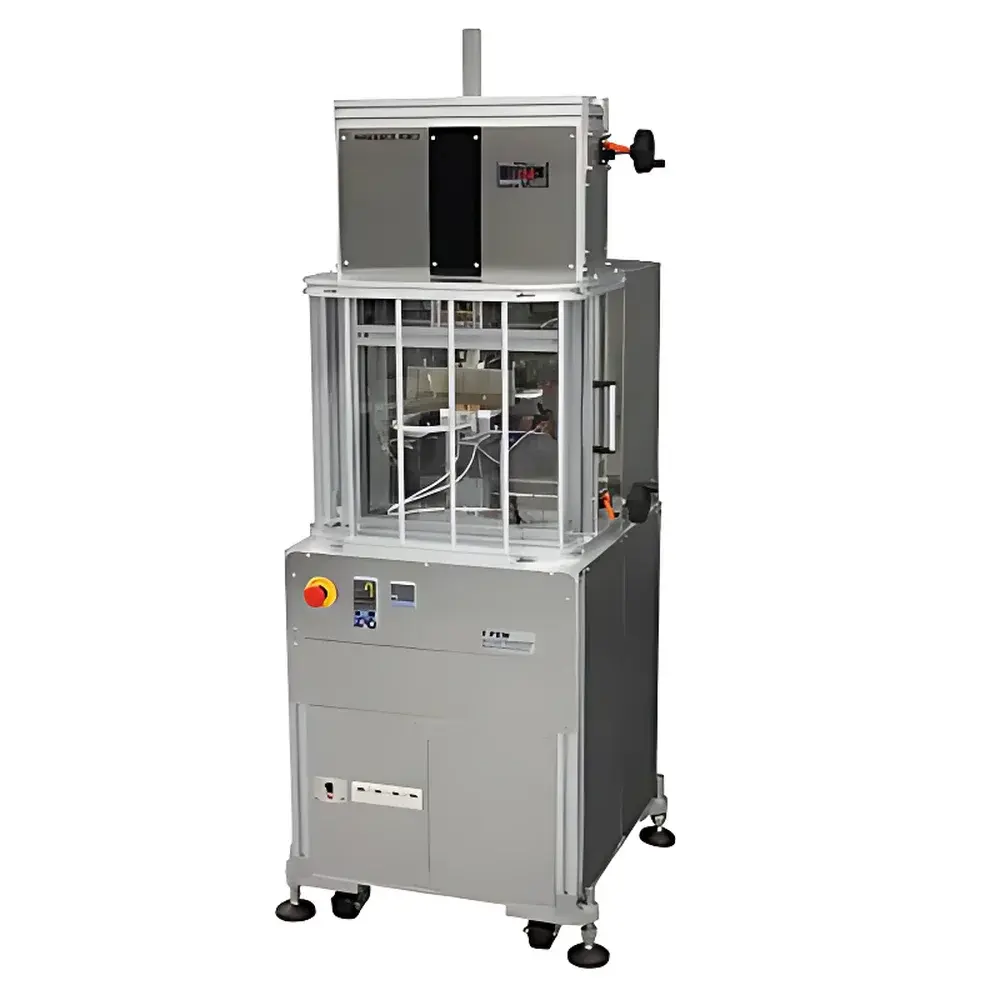
ADVANCE RIKO F-PEM Atmospheric Thermoelectric Property Evaluation System
| Brand | ADVANCE RIKO |
|---|---|
| Origin | Japan |
| Model | F-PEM |
| Operating Atmosphere | Ambient Air |
| Temperature Range | Room Temperature to 600 °C (Heating Zone) |
| Sample Size | Square, 40 mm × 40 mm × (5–30) mm Thickness |
| Power Supply | AC200V, 5 kW (Main Unit) |
| Dimensions | W600 × D600 × H1700 mm |
| Weight | ~120 kg |
| Contact Force | Up to 160 kgf (via Constant-Pressure Spring Mechanism) |
| Measured Parameters | Maximum Output Power (P<sub>max</sub>), Heat Flow Rate (Q), Thermoelectric Conversion Efficiency (η) |
Overview
The ADVANCE RIKO F-PEM Atmospheric Thermoelectric Property Evaluation System is a dedicated benchtop platform engineered for quantitative characterization of thermoelectric generator (TEG) modules under realistic operational conditions—specifically, in ambient air without vacuum or inert gas encapsulation. It employs a dual-sensor calorimetric approach grounded in first-principles energy balance: electrical power output (P = V × I) is measured in real time via precision voltage and current transducers, while heat flow (Q) is determined by calibrated water-cooled heat sink instrumentation using the relation Q = Cp,water × ΔT × ṁ, where ΔT is the temperature differential across the cooling loop and ṁ denotes mass flow rate. The system computes thermoelectric conversion efficiency η as η = P / (P + Q), adhering to ISO 14405-1 and ASTM E3077-20 guidelines for thermoelectric device testing. Designed for reproducible, load-stable evaluation, the F-PEM enables direct correlation between material-level performance and module-level behavior under sustained thermal gradients and constant electrical loading—critical for bridging lab-scale synthesis to industrial deployment.
Key Features
- Atmospheric-operation capability eliminates need for gloveboxes or purge systems—reducing setup complexity and enabling rapid iteration during early-stage TEG development.
- High-fidelity, synchronized acquisition of Pmax, Q, and η with traceable calibration against NIST-traceable reference standards for voltage, current, temperature, and flow.
- Constant-force mechanical interface (up to 160 kgf via precision spring assembly) ensures repeatable thermal contact resistance between TEG, hot-side heater, and cold-side heat sink—minimizing interfacial uncertainty in Q measurement.
- Programmable thermal ramping and dwell profiles (RT to 600 °C on hot side) support accelerated lifetime testing per IEC 63259-2 for thermoelectric module reliability assessment.
- Modular hardware architecture allows integration with external data loggers or PLCs via analog I/O and Modbus RTU interfaces for factory-floor compatibility.
Sample Compatibility & Compliance
The F-PEM accommodates standard commercial and research-grade TEG modules up to 40 mm × 40 mm planar footprint and 5–30 mm thickness—including bismuth telluride (Bi2Te3), skutterudites, half-Heuslers, and oxide-based ceramics. Its open-air configuration reflects real-world mounting constraints encountered in waste-heat recovery systems, automotive exhaust interfaces, and IoT-powered sensor nodes. All measurement protocols comply with GLP-aligned documentation practices, supporting audit-ready data generation for ISO/IEC 17025-accredited laboratories. Thermal sensors are certified to IEC 60584-2 (Type K thermocouples), flow meters meet ISO 4064 Class B accuracy, and electrical measurements conform to IEC 61000-4-30 Class S compliance for harmonic-free power analysis.
Software & Data Management
The proprietary F-PEM Control Suite (v4.2+) provides a validated, password-protected Windows application with role-based access control (Administrator / Operator / Reviewer). Core modules include: real-time temperature monitoring with dual-zone PID tuning; configurable test sequence scripting (e.g., step-load sweeps, thermal cycling with hold periods); automated efficiency calculation with uncertainty propagation per GUM (JCGM 100:2018); and export to CSV, HDF5, or PDF report templates compliant with FDA 21 CFR Part 11 requirements—including electronic signatures, audit trails, and immutable raw-data archiving. All datasets are timestamped, instrument-serial-number-tagged, and linked to calibration certificate metadata.
Applications
- Quantitative benchmarking of novel thermoelectric materials against industry reference modules (e.g., Tellurex C10-12-0.5) under identical atmospheric thermal loading.
- Durability validation of TEG assemblies subjected to ≥500-hour thermal cycling (e.g., 100 °C ↔ 400 °C, 30-min ramps) while maintaining constant resistive load—simulating automotive or industrial duty cycles.
- Thermal interface material (TIM) screening via comparative Q-measurement across identical TEGs mounted with varying thermal pastes or phase-change pads.
- Supporting DOE-funded projects requiring full-assembly efficiency reporting for TEG-integrated heat exchangers per ASHRAE Standard 114-2022 methodology.
- Academic research on degradation mechanisms (e.g., interdiffusion, contact oxidation) through longitudinal η-tracking under controlled ambient humidity exposure.
FAQ
Can the F-PEM operate under controlled humidity or low-oxygen conditions?
No—the system is optimized for ambient air operation only. For inert or humidified environments, users must integrate external environmental chambers compatible with its mechanical interface dimensions and thermal port clearances.
Is calibration verification traceable to national metrology institutes?
Yes. Annual calibration services include NIST-traceable certificates for all primary sensors (thermocouples, shunt resistors, Coriolis flow meters), with uncertainty budgets provided per ISO/IEC 17025 Annex A.3.
Does the software support automated pass/fail criteria for production-line screening?
Yes. Customizable tolerance bands can be defined for Pmax, Q, and η per batch; results trigger visual alerts and generate QC summary reports with statistical process control (SPC) charts (X̄/R, Cpk).
What safety certifications does the F-PEM carry?
CE marking per Machinery Directive 2006/42/EC and Low Voltage Directive 2014/35/EU; conforms to EN 61010-1:2010 for laboratory equipment safety.
Can third-party DAQ systems interface with the F-PEM hardware?
Yes—via isolated analog outputs (0–10 V) for Thot, Tcold, V, I, and flow rate, plus RS-485 Modbus RTU for digital parameter readout and remote start/stop commands.



