
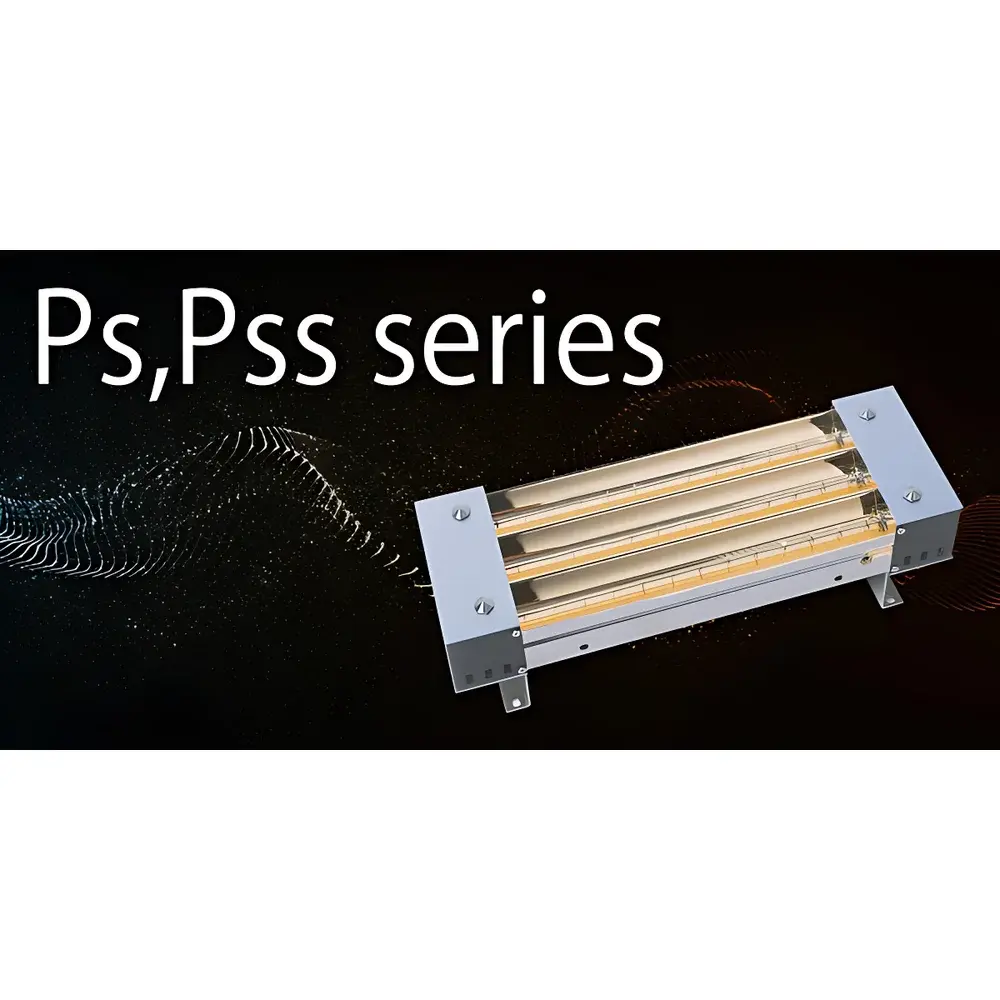
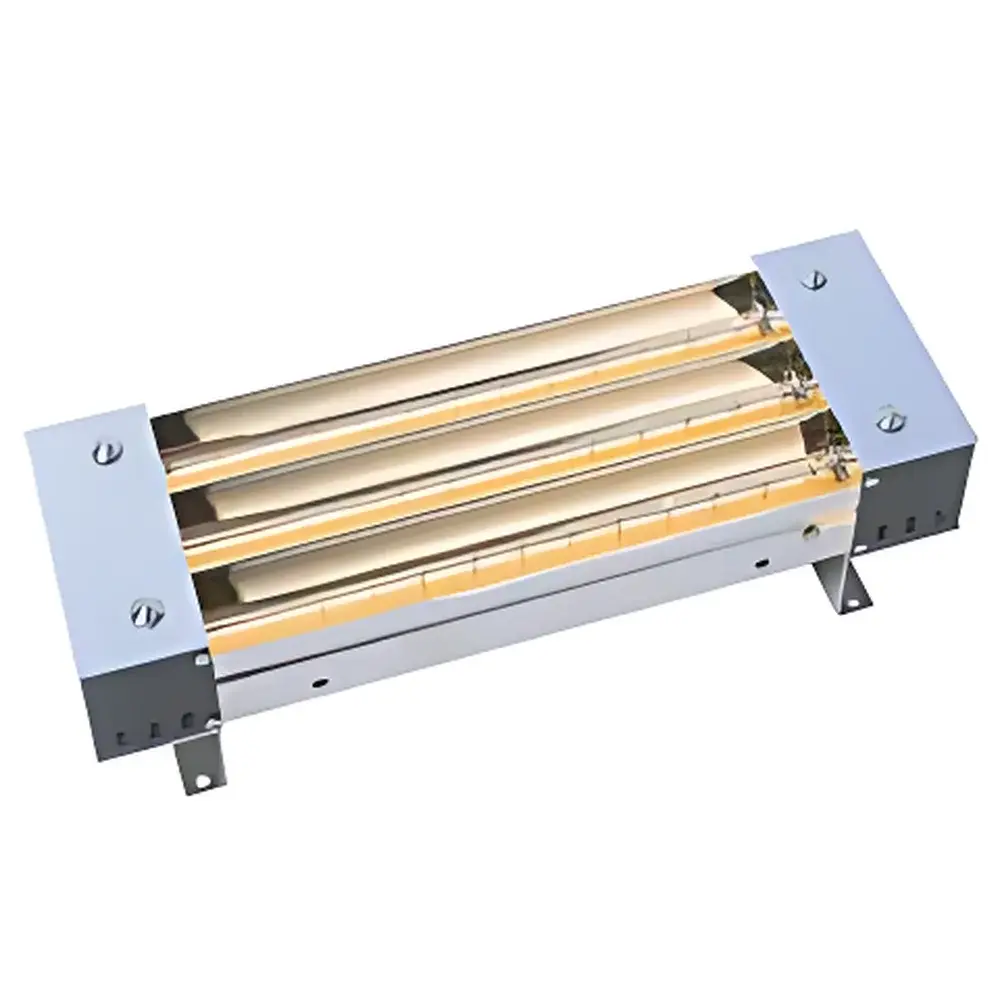
Advance Riko PS and PSS Series Flat-Plate Infrared Gold-Mirror Reflective Furnaces
| Brand | ADVANCE RIKO |
|---|---|
| Origin | Japan |
| Model Series | PS, PSS |
| Heating Zone Width (PS) | 40 mm |
| Heating Zone Width (PSS) | 20 mm |
| Compatible Substrate Diameter | 50–300 mm |
| Application Scope | Rapid thermal processing (RTP), wafer annealing, solar cell sintering, FPD substrate heating, thin-metal foil annealing |
| Configuration | Modular assembly for extended heating zones |
| Compliance | Designed for integration into Class 100–1000 cleanroom-compatible production lines |
Overview
The ADVANCE RIKO PS and PSS Series Flat-Plate Infrared Gold-Mirror Reflective Furnaces are precision-engineered rapid thermal processing (RTP) systems optimized for high-uniformity, contactless radiant heating of large-area substrates in semiconductor, photovoltaic, and flat-panel display manufacturing environments. These furnaces operate on the principle of near-infrared (NIR) radiation—emitted by high-intensity tungsten-halogen or quartz-tube lamps—reflected and focused via a highly polished, vacuum-deposited gold-coated mirror surface. The gold mirror provides >97% reflectivity across the 0.8–2.5 µm spectral band, maximizing energy transfer efficiency while minimizing thermal lag and spatial nonuniformity. Unlike conventional convection or resistive heating, this reflective architecture enables sub-second thermal response times and precise temperature ramp rates (up to 150 °C/s), critical for dopant activation, oxide densification, and metal silicide formation in advanced node fabrication.
Key Features
- Modular gold-mirror reflector design: PS model features a 40 mm wide gold-coated reflective zone; PSS model utilizes a 20 mm width to allow higher lamp density and improved axial irradiance uniformity.
- Scalable planar configuration: Multiple PS/PSS modules can be mechanically and thermally synchronized to form continuous heating zones up to 600 mm in length—suitable for inline conveyor-based RTP integration.
- High-precision radiant temperature control: Closed-loop regulation via dual-wavelength pyrometry (1.0 µm and 1.6 µm) ensures ±1.5 °C stability at setpoints from 300 °C to 1200 °C, traceable to NIST-calibrated references.
- Cleanroom-compatible construction: All internal surfaces employ electropolished stainless steel (316L) and low-outgassing ceramic insulation; optional nitrogen or forming gas (N₂ + 5% H₂) purge ports support oxygen-sensitive processes.
- Thermal uniformity optimization: Asymmetric lamp array layout and dynamic reflector angle adjustment compensate for edge losses, achieving ≤±2.5 °C deviation across 300 mm Si wafers per SEMI F28-0212 test protocol.
Sample Compatibility & Compliance
These furnaces accommodate rigid and semi-rigid substrates ranging from 50 mm to 300 mm in diameter—including silicon, sapphire, glass (e.g., TFT-LCD motherglass), and flexible metal foils (e.g., Ni, Cu, Mo). The flat-plate geometry supports both static batch-mode annealing and continuous motion processing at conveyor speeds of 0.1–1.2 m/min. Systems comply with IEC 61000-6-2 (immunity) and IEC 61000-6-4 (emission) for industrial electromagnetic compatibility. When integrated into GMP-compliant production lines, firmware supports audit trails, user-level access control, and electronic signature per FDA 21 CFR Part 11 requirements. Process recipes are stored with timestamped metadata, enabling full traceability for ISO 9001 and IATF 16949 quality audits.
Software & Data Management
The furnace is controlled via ADVANCE RIKO’s proprietary RTPControl™ software suite, running on a real-time Linux OS platform. It provides synchronized multi-zone lamp power modulation, real-time thermal imaging overlay (via optional IR camera integration), and automated recipe execution with configurable hold/ramp/soak profiles. Data logging occurs at 100 Hz resolution, exporting CSV and HDF5 formats compatible with MATLAB, Python (NumPy/Pandas), and MES platforms such as Siemens Opcenter Execution (formerly Camstar). All operational logs—including lamp voltage/current, pyrometer readings, purge gas flow, and door interlock status—are time-stamped and digitally signed to satisfy GLP and ISO/IEC 17025 documentation standards.
Applications
- Semiconductor manufacturing: Flash annealing of ion-implanted Si wafers, rapid oxide growth on GaN-on-Si, and low-temperature activation of ultra-shallow junctions.
- Photovoltaics: Front-surface silver paste sintering on PERC and TOPCon solar cells; crystallization of amorphous silicon layers on glass substrates.
- Flat-panel displays: Pre-baking of photoresist on large-area TFT arrays; stress relief annealing of ITO and Mo thin films on Gen 8.5+ glass.
- Advanced packaging: Reflow of copper pillar bumps and underfill curing on fan-out wafer-level packages (FO-WLP).
- Research & development: Kinetic studies of phase transformations in 2D materials (e.g., MoS₂ monolayer sulfurization) and metastable alloy formation in thin-film metallization.
FAQ
What is the maximum operating temperature and recommended duty cycle?
Maximum sustained temperature is 1200 °C; for optimal lamp life (>2000 h), continuous operation above 1000 °C is limited to ≤60% duty cycle with active forced-air cooling between cycles.
Can the system be integrated into an existing cluster tool or vacuum transfer line?
Yes—standard CF-100 or ISO-KF 200 flange interfaces are available; vacuum compatibility down to 1×10⁻⁵ Pa requires optional water-cooled feedthroughs and bake-out support.
Is gold mirror degradation monitored during operation?
Yes—integrated spectral reflectance monitoring (via optional UV-VIS-NIR spectrometer port) tracks gold layer oxidation in real time; automatic lamp power compensation is applied when reflectivity drops below 95%.
Does the system support process qualification per SEMI standards?
Yes—built-in thermal mapping routines comply with SEMI F28-0212 (wafer uniformity) and SEMI E10-0218 (equipment reliability), with full report generation including Cpk, GR&R, and DOE-ready datasets.
What maintenance intervals are recommended for lamp replacement and mirror cleaning?
Lamps are replaced every 2000 hours or after 300 thermal cycles above 900 °C; gold mirrors require cleaning only if particulate accumulation exceeds 0.5 µm/cm²—typically verified during quarterly preventive maintenance using optical interferometry.



