
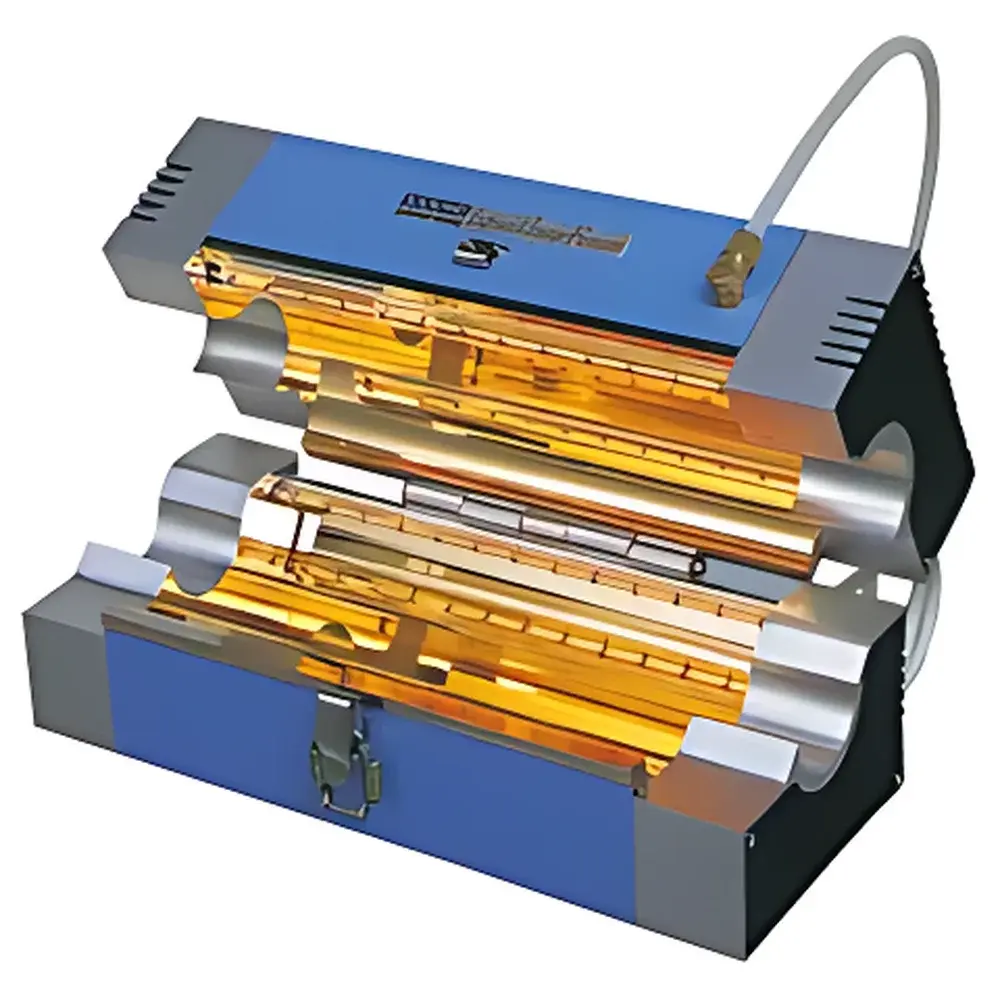
Advance Riko RHL-E Series Infrared Gold-Coated Reflective Furnace
| Brand | ADVANCE RIKO |
|---|---|
| Origin | Japan |
| Model | RHL-E Series |
| Heating Principle | Radiative heating via high-intensity near-infrared lamp array with water-cooled gold-coated elliptical reflector |
| Max Operating Temperature (E-type) | Up to 1200°C |
| Lamp Spectral Peak | ~1.15 µm |
| Reflector Material | Precision-polished aluminum substrate with vacuum-deposited Au coating |
| Cooling | Integrated water-circulation jacket for reflector and chamber housing |
| Sample Geometry Compatibility | Cylindrical/rod-shaped specimens |
| Reflective Geometry | Elliptical (E-series) |
| Compliance | Designed for ISO/IEC 17025-compliant lab environments |
Overview
The Advance Riko RHL-E Series Infrared Gold-Coated Reflective Furnace is an engineered thermal processing system designed for rapid, controllable, and spatially defined radiative heating of cylindrical or rod-shaped materials under inert or controlled atmospheres. Unlike conventional resistive or convection-based furnaces, the RHL-E leverages high-energy-density near-infrared radiation (centered at ~1.15 µm) emitted by tungsten-halogen lamps housed in fused quartz envelopes. This spectral output aligns closely with the absorption characteristics of many semiconductors, metals, and ceramics—enabling efficient energy coupling and minimizing thermal lag. The core innovation lies in its precision-machined elliptical gold-coated reflector, actively cooled via a closed-loop deionized water circuit. This architecture ensures stable optical geometry during repeated thermal cycling, maintains >98% specular reflectivity across the 0.8–2.5 µm range, and enables focused cylindrical heating zones with axial uniformity ±3% over lengths up to 100 mm. The furnace body is constructed from aerospace-grade anodized aluminum, providing structural rigidity, electromagnetic shielding, and optimized thermal mass distribution.
Key Features
- Elliptical gold-coated reflector geometry optimized for collimated focusing of infrared radiation onto rod-shaped samples, delivering localized heating rates exceeding 100°C/s
- Water-jacketed reflector assembly maintains reflector surface temperature below 60°C during continuous operation at 1200°C sample setpoint, preventing Au film degradation and thermal drift
- Modular mechanical design allows side-by-side or end-to-end alignment of multiple RHL-E units to extend effective heating length without compromising flux density or temperature homogeneity
- Integrated lamp power regulation with real-time voltage/current monitoring supports programmable ramp-hold-cool profiles compliant with ASTM E2924 and ISO 11357-3 thermal analysis protocols
- Front-access quartz viewport (optional MgF₂ upgrade) enables in situ pyrometric monitoring and synchronized optical diagnostics (e.g., reflectance spectroscopy, PL imaging)
- CE-marked control cabinet with SIL2-rated safety interlocks, emergency stop, and overtemperature cut-off per IEC 61508
Sample Compatibility & Compliance
The RHL-E series is validated for use with cylindrical substrates ranging from Ø1 mm to Ø25 mm and lengths up to 150 mm—including CIGS and CZTS absorber layers on molybdenum-coated soda-lime glass, SiC wafers, metallic foils (Cu, Ni, Fe-based alloys), and ceramic rods (Al₂O₃, Si₃N₄). Its open-ended chamber configuration permits direct integration with gas manifolds for reactive annealing (H₂/N₂ forming gas, H₂S, Se vapor) or vacuum pumping (<10⁻² mbar base pressure with optional turbomolecular pump). All electrical and thermal interfaces comply with IEC 61000-6-3 (EMC emission) and IEC 61000-6-2 (immunity). Firmware logs meet FDA 21 CFR Part 11 requirements for electronic records and signatures when paired with Advance Riko’s optional TraceLog™ software module.
Software & Data Management
Operation is managed through the cross-platform AdvanceControl™ GUI, supporting multi-channel PID tuning, real-time thermocouple/pyrometer fusion, and automated sequence scripting. Data acquisition runs at 10 Hz minimum, storing timestamped values for lamp voltage, current, coolant flow rate, chamber ambient temperature, and dual-point pyrometry (top/bottom of sample zone). Export formats include CSV, HDF5, and MATLAB .mat—structured to align with FAIR data principles. Audit trails record all parameter modifications, user logins, and calibration events with SHA-256 hashing. Optional integration with LabArchives ELN or Thermo Fisher SampleManager LIMS enables traceable chain-of-custody for QC/QA documentation in ISO 9001-certified facilities.
Applications
- Chalcogenide thin-film annealing: Controlled crystallization of CIGS and CZTS absorbers with minimized interfacial diffusion and secondary phase segregation
- SiC device activation: Rapid thermal annealing (RTA) of Al-implanted p⁺ regions at 1600–1700°C-equivalent kinetics using calibrated emissivity correction
- Metallurgical phase transformation studies: Isothermal hold experiments on Ti-6Al-4V and IN718 to quantify α→β transition kinetics under constrained thermal gradients
- Ceramic thermal shock qualification: Repeated 0→1000°C cycling of alumina insulators while monitoring microcrack nucleation via acoustic emission coupling
- Catalyst pre-conditioning: In situ reduction of Pt/Al₂O₃ and Ni/MgO under flowing H₂ prior to TPD/TPR analysis
FAQ
What is the maximum recommended sample diameter for the RHL-E series?
The standard configuration supports samples up to Ø25 mm. For diameters exceeding this, custom reflector curvature recalibration and lamp array repositioning are required—and must be performed by Advance Riko certified engineers.
Can the RHL-E operate under vacuum or reactive gas environments?
Yes. The furnace features dual KF-25 flanges for gas inlet/outlet and vacuum connection. Standard quartz tube configuration tolerates ≤10⁻² mbar; optional ceramic-lined variants support ≤10⁻⁵ mbar and halogen-containing atmospheres.
Is emissivity compensation supported for non-blackbody materials?
Yes. The integrated two-color pyrometer (650/900 nm) combined with user-defined emissivity tables enables real-time correction for polished metals, oxides, and nitrides across the operational temperature range.
How is temperature uniformity verified and documented?
Each unit ships with a NIST-traceable temperature mapping report generated using 9-point thermocouple array scans per ASTM E220, conducted at three setpoints (400°C, 800°C, 1200°C) under argon purge.
What maintenance intervals are specified for the gold reflector coating?
Under normal operation (≤1200°C, ≤500 cycles/year), no recoating is required within 5 years. Annual inspection includes reflectance spectroscopy at 1.15 µm and surface profilometry to verify RMS roughness <5 nm.



