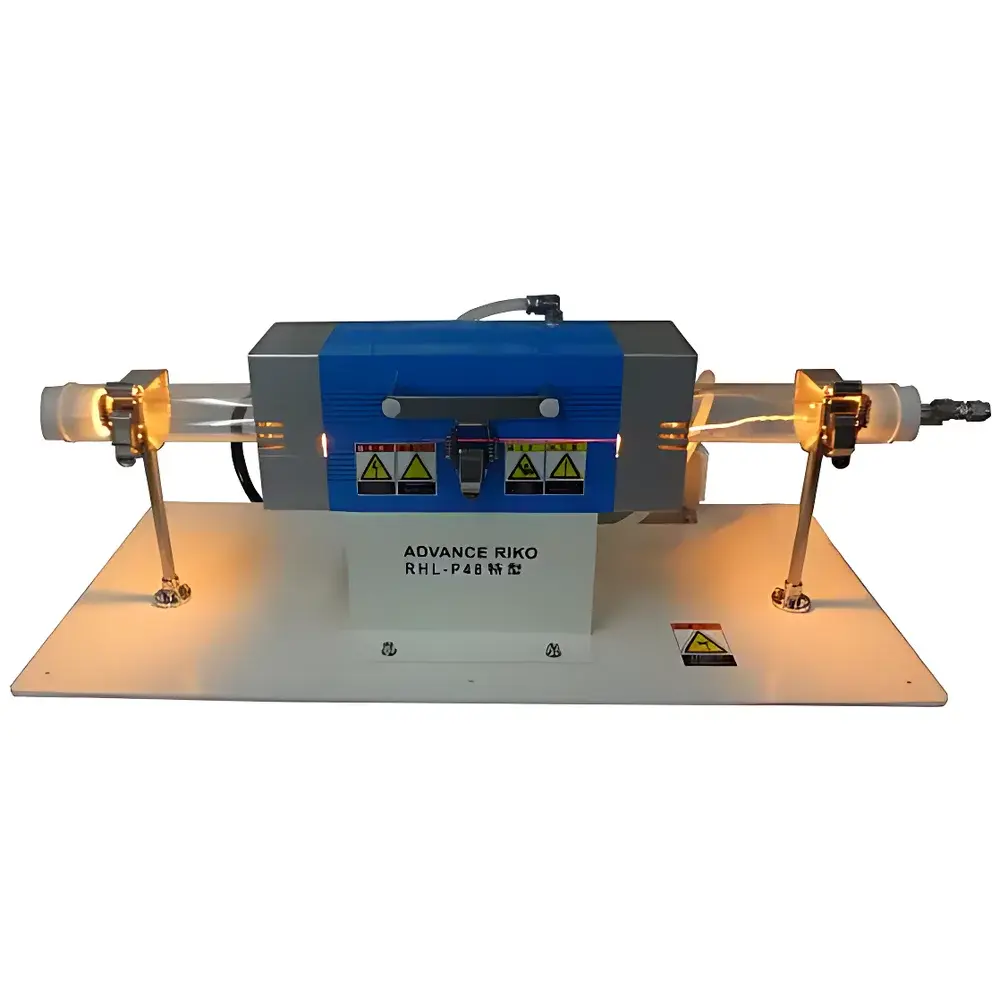
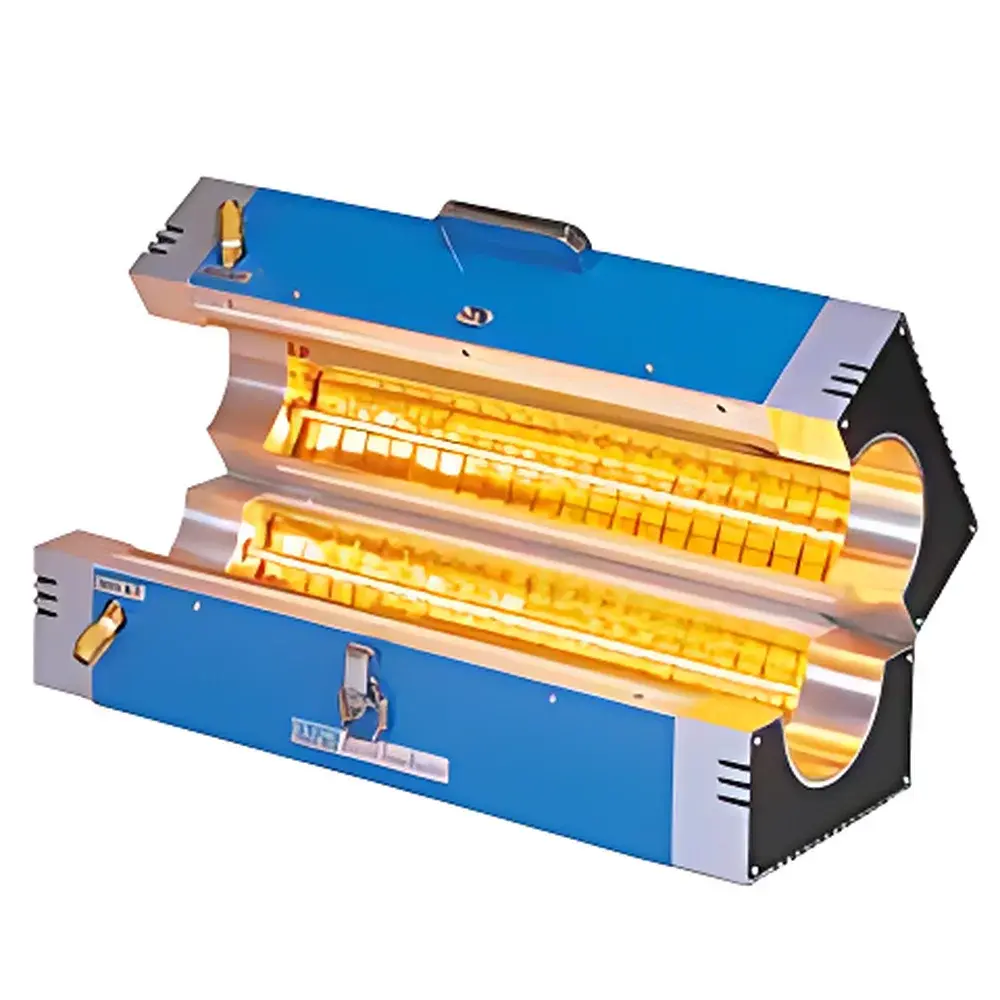
Advance Riko RHL-P Series Infrared Gold-Mirror Rapid Thermal Annealing Furnace
| Brand | ADVANCE RIKO |
|---|---|
| Origin | Japan |
| Model | RHL-P Series |
| Sample Size | 1.2-inch (30.5 mm) wafers |
| Temperature Range | RT to 1350 °C |
| Max. Heating Rate | 50 °C/s |
| Max. Cooling Rate | 30 °C/s |
| Temperature Accuracy | ±3 °C |
| Temperature Uniformity | ±3 °C |
| Chamber Dimensions (varies by model) | Ø20 mm × 80 mm to Ø50 mm × 80 mm |
| Cooling Requirement | External recirculating water chiller (required) |
Overview
The Advance Riko RHL-P Series Infrared Gold-Mirror Rapid Thermal Annealing Furnace is a high-precision, laboratory-scale thermal processing system engineered for controlled rapid thermal processing (RTP) of semiconductor wafers, thin films, and advanced functional materials. Utilizing high-intensity short-wavelength infrared lamps coupled with a parabolic gold-coated reflector geometry, the RHL-P series delivers highly directional radiant heating with exceptional spatial uniformity and temporal repeatability. Unlike conventional resistance-heated furnaces, this system operates on instantaneous radiative heat transfer—enabling sub-second thermal response, minimal thermal mass loading, and precise decoupling of heating/cooling dynamics from chamber environment. It is designed for applications demanding strict thermal budget control, such as dopant activation, silicide formation, oxide densification, and defect engineering in Si, SiC, GaN, and emerging 2D material systems.
Key Features
- Gold-mirror parabolic reflector architecture ensures collimated IR irradiation and minimizes thermal gradient across the sample surface—critical for uniform annealing of 1.2-inch (30.5 mm) substrates.
- Programmable thermal profiles with ramp rates up to 50 °C/s and controlled cooling down to 30 °C/s, enabling precise replication of industrial RTP cycles in research environments.
- Temperature accuracy of ±3 °C and spatial uniformity of ±3 °C over the active heating zone, verified via calibrated multi-point thermocouple mapping under inert or vacuum conditions.
- Modular chamber configurations (RHL-P410C to RHL-P810C) accommodate varying sample geometries—from Ø20 mm × 80 mm micro-reactor inserts to Ø50 mm × 80 mm extended-height zones—each optimized for specific thermal inertia requirements.
- Integrated water-cooling interface compatible with standard industrial recirculating chillers (recommended flow rate ≥ 4 L/min, ΔT ≤ 5 °C), ensuring stable reflector temperature and long-term lamp lifetime.
- Vacuum-compatible design (optional base pressure <10⁻³ Pa) supports annealing under inert gas (N₂, Ar), forming gas (N₂/H₂), or low-pressure ambient—essential for oxidation-sensitive or surface-reaction-controlled processes.
Sample Compatibility & Compliance
The RHL-P series accommodates rigid planar samples up to 1.2 inches in diameter—including silicon, sapphire, quartz, SiC, GaN, metal foils, ceramic substrates, and multilayer thin-film stacks deposited by sputtering, ALD, or CVD. Its open-loop radiant heating architecture eliminates convective interference, making it suitable for air-sensitive or volatile-layer processing when used with appropriate glovebox integration or vacuum interlocks. The system complies with IEC 61000-6-3 (EMC emission standards) and meets mechanical safety requirements per ISO 12100. While not certified for Class 100 cleanroom operation out-of-the-box, optional laminar-flow purge kits and stainless-steel chamber liners support GMP-aligned process validation workflows.
Software & Data Management
Control is executed via Advance Riko’s proprietary Windows-based RTP Control Suite, supporting full PID parameter tuning, multi-segment ramp-soak-cool sequencing, real-time temperature logging at 10 Hz resolution, and export of timestamped CSV datasets. The software implements audit-trail functionality compliant with FDA 21 CFR Part 11 guidelines—including user-level access control, electronic signatures, and immutable record archiving—facilitating GLP/GMP documentation for qualification studies. Optional Ethernet/IP or Modbus TCP interfaces enable integration into factory MES platforms or centralized lab automation systems.
Applications
- Dopant activation and junction formation in Si, Ge, and strained-Si heterostructures.
- Crystallization and phase transformation of amorphous metal oxides (e.g., IGZO, HfO₂) and chalcogenide glasses.
- Thermal stability assessment of catalytic nanoparticles, MXenes, and polymer-derived ceramics.
- In-situ high-temperature dilatometry for coefficient-of-thermal-expansion (CTE) profiling of composite laminates.
- Pre- and post-deposition annealing of ferroelectric (PZT, Hf₀.₅Zr₀.₅O₂) and piezoelectric thin films.
- Rapid oxidation/nitridation kinetics studies under controlled partial pressures of O₂ or NH₃.
FAQ
Is the RHL-P series compatible with vacuum processing?
Yes—standard models support base pressures down to 10⁻³ Pa with optional turbomolecular pumping; vacuum-rated quartz viewports and feedthroughs are available.
What cooling infrastructure is required?
A recirculating water chiller capable of maintaining ≤25 °C outlet temperature and ≥4 L/min flow rate is mandatory for reflector and lamp housing thermal management.
Can the system be integrated into automated wafer-handling platforms?
Yes—RS-232, Ethernet/IP, and digital I/O ports support synchronization with robotic loaders, end-effectors, and process sequencers.
Does the furnace support real-time emissivity compensation?
No—emissivity correction is applied offline during data analysis; users must calibrate against reference blackbody sources for quantitative radiometric interpretation.
Are calibration certificates traceable to NIST or JIS standards provided?
Yes—each unit ships with a factory calibration report traceable to JIS Z 8703, including thermocouple linearity verification and uniformity mapping data.