
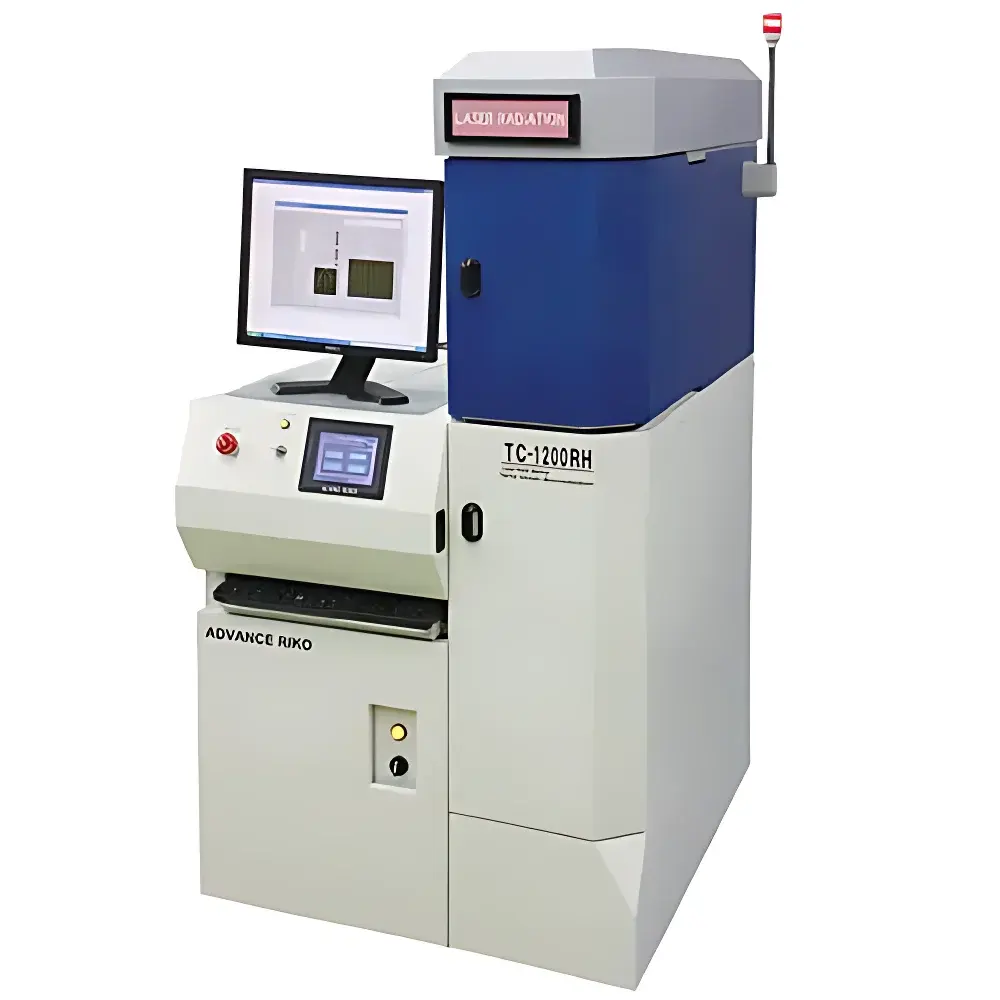
Advance Riko TC-1200RH Laser Flash Apparatus for Thermal Diffusivity, Specific Heat, and Thermal Conductivity Measurement
| Brand | Advance Riko |
|---|---|
| Origin | Japan |
| Model | TC-1200RH |
| Measurement Principle | Laser Flash Method (LFM) |
| Temperature Range | RT to 1150 °C (up to 1200 °C short-term) |
| Thermal Conductivity Range | 0.1–2000 W/m·K |
| Accuracy | ±5% |
| Repeatability | ±3% |
| Sample Dimensions | Ø10 mm × 1–3 mm (thickness), measured through-thickness |
| Atmosphere | Vacuum (standard) |
| Heating Rate | 10 °C/min (to 100 °C), 20 °C/min (to 300 °C), 50 °C/min (to 1150 °C) |
| Dimensions (W×D×H) | 900 × 1050 × 1700 mm |
| Weight | ~350 kg |
| Power Supply | AC200 V, single-phase, 8 kVA (main unit) |
| Cooling Water | ≥5 L/min, pressure ≥0.15 MPa |
| Compliance | JIS R 1611, JIS R 1650-3, JIS H 7801, ISO 13826, ASTM E1461 |
Overview
The Advance Riko TC-1200RH is a high-precision laser flash apparatus engineered for the simultaneous determination of thermal diffusivity (α), specific heat capacity (cp), and thermal conductivity (λ) across a broad temperature range—from ambient to 1150 °C (with short-term capability up to 1200 °C). It implements the standardized laser flash method (LFM), a non-contact, transient technique in which a thin, uniformly irradiated sample is subjected to a short energy pulse from a Nd:YAG or Xe flash lamp; the resulting rear-surface temperature rise is recorded via an infrared detector. Thermal diffusivity is calculated by fitting the time-dependent temperature response to analytical solutions of the heat conduction equation under defined boundary conditions. When combined with density (ρ) and independently measured cp, thermal conductivity is derived as λ = α·ρ·cp. The TC-1200RH replaces conventional resistive furnaces with an infrared gold-coated radiant heater—enabling rapid, uniform heating and enhanced thermal stability, particularly critical in low-temperature regimes where conventional systems suffer from sluggish response and drift.
Key Features
- Infrared gold-faced furnace delivering superior radiative efficiency, enabling heating rates up to 50 °C/min and significantly reduced thermal equilibration times—approximately one-quarter that of legacy resistive-heated LFM systems.
- High-stability temperature control with ±0.5 °C accuracy over extended dwell periods, achieved through closed-loop PID regulation and real-time thermocouple feedback integrated into the furnace wall and sample stage.
- Optimized optical path design with adjustable beam collimation, synchronized flash triggering, and calibrated InSb or MCT detectors ensuring signal-to-noise ratios >60 dB across the full operational temperature span.
- Vacuum-compatible measurement chamber (≤1×10⁻¹ Pa base pressure) with optional atmospheric operation below 150 °C—supporting inert, oxidative, or reducing atmospheres via gas inlet ports.
- Modular hardware architecture permitting field-upgradable components including high-temperature furnace variants (up to 1500 °C), multi-sample autoloaders (3-position), and square-sample holders for non-circular geometries.
Sample Compatibility & Compliance
The TC-1200RH accommodates disk-shaped specimens measuring Ø10 mm × 1–3 mm (thickness), with measurement performed exclusively in the through-thickness direction. Compatible material classes include dense ceramics (e.g., Al2O3, SiC, ZrO2), metals and alloys (Cu, Ni-based superalloys, Fe), intermetallics, graphite, C/C composites, polymer-matrix composites, and thermoelectric oxides (e.g., NaCo2O4, Bi2Te3). All measurements adhere strictly to international standards: JIS R 1611 (fine ceramics), JIS R 1650-3 (thermoelectric materials), JIS H 7801 (ferrous metals), ISO 13826 (general LFM methodology), and ASTM E1461 (standard test method for thermal diffusivity). Data acquisition and reporting support GLP/GMP traceability requirements, including electronic audit trails, user access logs, and calibration certificate linkage.
Software & Data Management
The system operates under Advance Riko’s proprietary TC-Analyzer software suite, compliant with FDA 21 CFR Part 11 for electronic records and signatures. The interface supports real-time curve visualization, automatic baseline correction, multi-layer thermal modeling (FML series), and iterative curve-fitting using both classical Parker and advanced numerical inversion algorithms. FML software enables quantitative analysis of bonded or coated multilayer structures—provided at least one constituent layer’s thermal properties are known—based on the analytical framework specified in JIS H 8453. Export formats include CSV, XML, and PDF reports with embedded metadata (operator ID, timestamp, calibration ID, environmental conditions). Raw data files are stored in HDF5 format for long-term archival integrity and third-party interoperability.
Applications
- Thermoelectric material development: evaluation of figure-of-merit (zT) components—α, cp, and λ—across operational temperature windows to guide composition optimization and microstructure engineering.
- Advanced ceramic qualification: thermal management validation for substrates, insulators, and refractory components used in aerospace turbine engines and nuclear fuel cladding.
- FPD and power electronics: characterization of heat spreaders (e.g., diamond films, AlN, BeO) and encapsulant materials under thermal cycling conditions.
- Thin-film and layered device analysis: extraction of interfacial thermal resistance (Rint) and layer-specific diffusivity in heterostructures such as Si/SiO2, GaN/AlN, or battery electrode stacks.
- Standards laboratory metrology: primary reference measurements supporting national metrology institutes’ certification of thermal reference materials (TRMs) per ISO Guide 34.
FAQ
What standards does the TC-1200RH comply with for thermal diffusivity measurement?
The instrument conforms to JIS R 1611, JIS R 1650-3, JIS H 7801, ISO 13826, and ASTM E1461—covering ceramics, thermoelectrics, ferrous metals, and general LFM practice.
Can the system measure anisotropic materials?
Standard configuration measures only through-thickness properties; in-plane anisotropy requires custom sample mounting fixtures and orthogonal orientation testing—not supported natively.
Is vacuum operation mandatory?
Vacuum is required above 150 °C to suppress convective heat loss and ensure accurate diffusivity calculation; measurements below 150 °C may be conducted in ambient air with documented uncertainty increase.
How is specific heat determined in this system?
cp is not measured directly by LFM; it must be supplied externally (e.g., via DSC per ISO 11357) or estimated using literature values—the TC-Analyzer software accepts user-input cp to compute λ.
Does the system support automated calibration routines?
Yes—built-in reference material protocols (e.g., NIST SRM 736, sapphire) enable periodic verification of diffusivity accuracy and detector linearity, with calibration history logged and reportable.



