
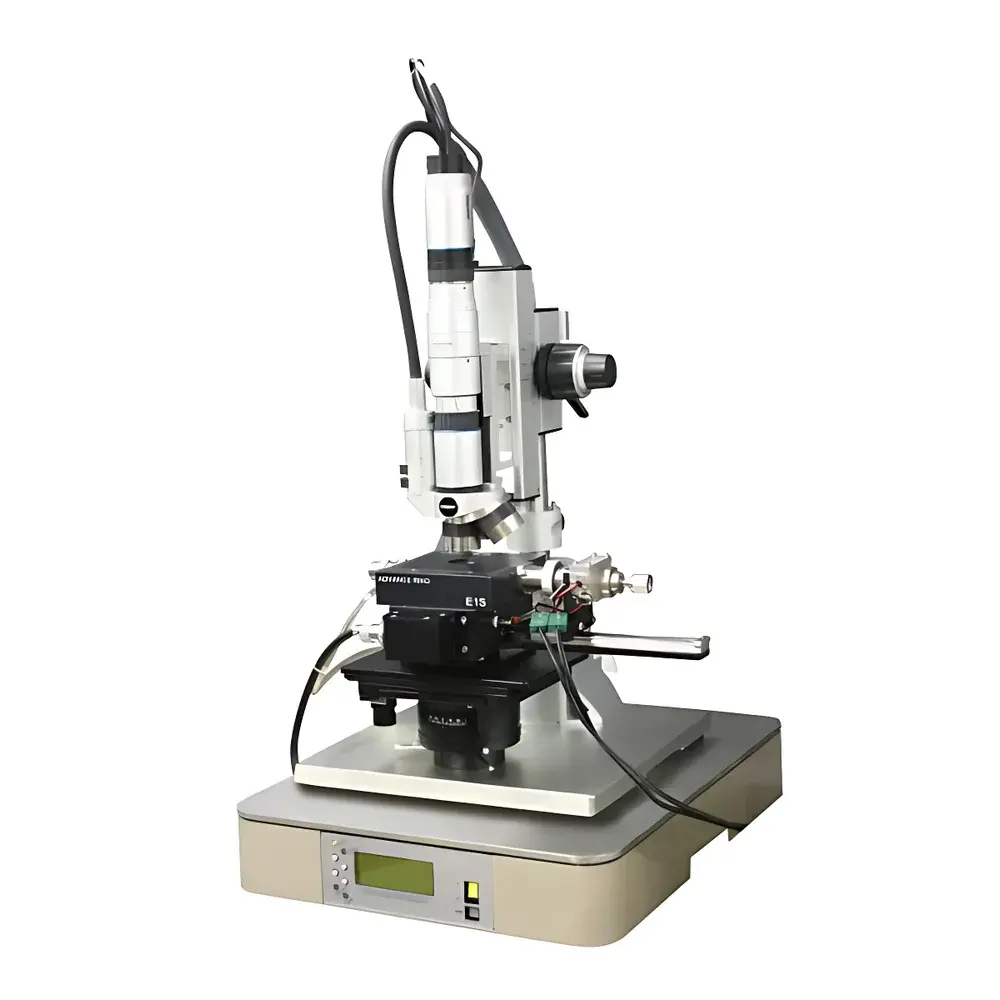
Advance Riko TMS-E1S High-Temperature Microscope System
| Brand | ADVANCE RIKO |
|---|---|
| Origin | Japan |
| Model | TMS-E1S |
| Temperature Range | RT to 1600 °C |
| Atmosphere Options | Air, Vacuum, or Controlled Flow Gas (e.g., N₂, Ar, H₂) |
| Sample Capacity | Ø ≤ 4 mm × Thickness ≤ 2 mm |
| Heating/Cooling Rate | Up to 100 °C/s (dependent on sample and atmosphere) |
| Optical Configuration | Integrated Long-Working-Distance Objective with Real-Time Video Capture |
| Core Technology | Infrared Gold-Mirror Reflective Furnace Coupled with High-Resolution Optical Microscopy |
Overview
The Advance Riko TMS-E1S High-Temperature Microscope System is an engineered solution for in situ microstructural observation under precisely controlled thermal and atmospheric conditions. It integrates a high-efficiency infrared gold-mirror reflective furnace with a stabilized optical microscope platform, enabling real-time visualization of phase transformations, grain evolution, melting/solidification behavior, and surface morphological changes in solid materials at elevated temperatures. Unlike conventional hot-stage microscopes relying on resistive heating elements, the TMS-E1S employs a focused infrared radiation source reflected via a gold-coated parabolic mirror—delivering rapid, uniform, and contamination-free heating directly to the sample surface. This design minimizes thermal lag, improves temperature homogeneity across the field of view, and supports dynamic thermal profiling compatible with time-resolved image acquisition. The system is purpose-built for metallurgical research, ceramic sintering studies, intermetallic reaction kinetics, and high-temperature failure analysis in academic laboratories and industrial R&D settings.
Key Features
- Infrared gold-mirror reflective furnace architecture ensuring fast thermal response (up to 100 °C/s heating/cooling rates) and minimal thermal gradient across the observed area
- Continuous temperature operation from ambient (RT) to 1600 °C with ±2 °C stability at steady state (calibrated per ASTM E220)
- Multi-atmosphere compatibility: fully sealed chamber supporting air, high vacuum (≤10⁻³ Pa), or continuous flow of inert/reducing gases (N₂, Ar, H₂, forming gas) with mass flow control integration
- Optical path optimized for long working distance (≥15 mm), accommodating thermal expansion of samples and enabling unobstructed imaging during thermal cycling
- Integrated high-sensitivity monochrome CMOS camera (12-bit dynamic range, 1920 × 1200 resolution) synchronized with temperature logging at up to 30 fps
- Modular stage design allowing optional integration of tensile/compression fixtures or electrical feedthroughs for simultaneous thermo-mechanical or electro-thermal characterization
Sample Compatibility & Compliance
The TMS-E1S accommodates disk-shaped specimens up to 4 mm in diameter and 2 mm in thickness—ideal for polished cross-sections, sputtered thin films, powder compacts, and small alloy coupons. Sample holders are fabricated from high-purity graphite or recrystallized alumina, selected to minimize background emission and chemical interaction at high temperatures. All furnace and optical components comply with IEC 61000-6-3 (EMC emissions) and IEC 61010-1 (safety requirements for laboratory equipment). The system supports GLP-compliant documentation workflows through timestamped image metadata, audit-trail-enabled temperature logs, and exportable CSV/TIFF datasets traceable to NIST-traceable calibration certificates (available upon request).
Software & Data Management
Operation is managed via Advance Riko’s proprietary TMS Control Suite—a Windows-based application supporting dual-channel synchronized acquisition (temperature + video), programmable ramp/soak profiles, and real-time ROI (region-of-interest) intensity tracking. Software features include automatic focus compensation algorithms for thermal drift correction, frame-averaged background subtraction, and calibrated grayscale-to-temperature mapping using Planck’s law with user-defined emissivity input (ε = 0.1–0.99). Export formats include AVI, TIFF sequence, HDF5, and MATLAB-compatible .mat files. For regulated environments, optional 21 CFR Part 11 compliance packages provide electronic signature support, role-based access control, and immutable audit trails.
Applications
- In situ observation of austenite–ferrite transformation kinetics in low-alloy steels
- Melting point determination and eutectic behavior analysis in solder alloys and high-entropy composites
- Grain boundary mobility measurement during high-temperature annealing of Ni-based superalloys
- Oxidation layer growth dynamics on TiAl and Mo–Si–B systems under controlled oxygen partial pressure
- Thermal shock resistance evaluation via rapid quenching cycles while monitoring crack initiation and propagation
- Interface reaction studies between ceramic substrates and metallic interconnects in SOFC assemblies
FAQ
What is the maximum recommended heating rate for reproducible microstructural observations?
For optimal image stability and thermal uniformity, a heating rate of ≤50 °C/s is recommended during phase transformation studies; higher rates (up to 100 °C/s) are supported for screening or thermal shock testing.
Can the system be integrated with external spectroscopic tools such as Raman or FTIR?
Yes—the optical port is equipped with standardized SM1-threaded flanges and optional beam-splitter modules to enable simultaneous or sequential multimodal analysis with third-party spectrometers.
Is vacuum-compatible sample loading possible without breaking vacuum?
The chamber utilizes a load-lock mechanism with magnetic-coupled transfer arm, permitting sample exchange while maintaining base vacuum below 10⁻² Pa.
Does the system meet ISO/IEC 17025 requirements for accredited testing labs?
While the TMS-E1S itself is not a certified testing instrument, its calibration traceability, data integrity features, and documented uncertainty budgets support alignment with ISO/IEC 17025 clause 6.4 (equipment) when operated within validated SOPs.
What maintenance intervals are specified for the gold mirror reflector?
Under standard inert-atmosphere operation, the gold-coated reflector requires inspection every 500 operational hours; cleaning is performed only with nitrogen purge and Class 100 cleanroom swabs—no solvents or abrasives permitted.




