
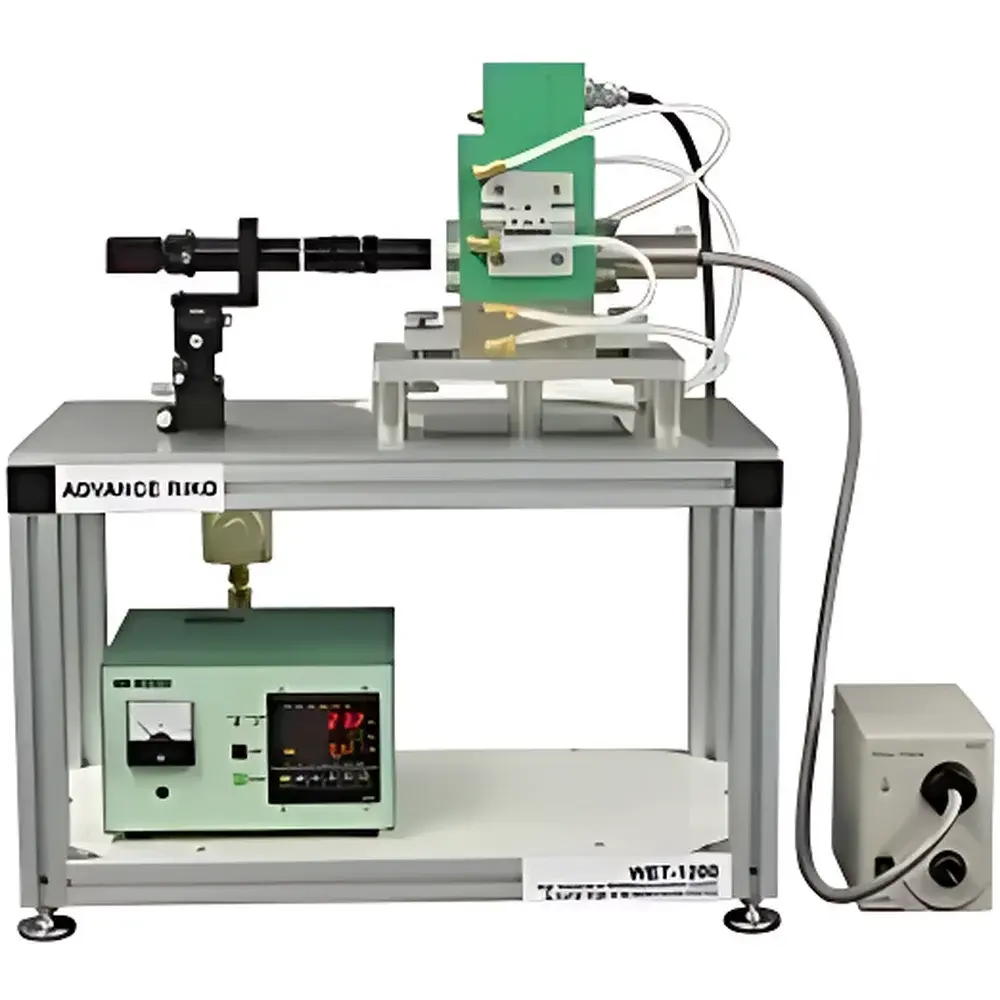
Advance Riko WET-1200 High-Temperature Wettability and Contact Angle Measurement System
| Brand | ADVANCE RIKO |
|---|---|
| Origin | Japan |
| Model | WET-1200 |
| Temperature Range (Static Drop) | Ambient to 1500 °C |
| Temperature Range (Extrusion Drop, optional) | Ambient to 1200 °C |
| Sample Substrate | Ø10 mm × 2 mm |
| Measurement Atmospheres | Vacuum, Controlled Gas Flow, Ambient Air |
| Measurement Methods | Static Drop Method, Optional Extrusion Drop Method |
| Application Scope | High-temperature wettability analysis of molten metals, alloys, glasses, and ceramics against solid substrates |
Overview
The Advance Riko WET-1200 is a precision-engineered high-temperature wettability and contact angle measurement system designed for quantitative interfacial characterization between molten phases and solid substrates under thermally and atmospherically controlled conditions. Based on instrumentation originally developed for Japan’s space development program in the early 1990s, the WET-1200 implements the sessile drop method—complemented by an optional extrusion drop module—to determine dynamic and equilibrium contact angles, spreading kinetics, and interfacial tension-derived wettability parameters at elevated temperatures. Its core functionality relies on high-resolution real-time video capture synchronized with calibrated thermal profiling, enabling reproducible measurement of contact angle evolution during heating, isothermal hold, and cooling cycles. The system is engineered for fundamental research and process development in metallurgy, ceramic engineering, and advanced packaging technologies where interfacial compatibility directly governs joint integrity, sintering behavior, and hermetic sealing performance.
Key Features
- Thermally stable furnace architecture supporting continuous operation from ambient temperature up to 1500 °C (static drop configuration) or 1200 °C (extrusion drop mode), with programmable ramp rates and multi-step thermal profiles.
- Dual-method capability: Standard sessile drop geometry for static and quasi-static measurements; optional extrusion module for controlled droplet formation directly from molten material reservoirs—enabling studies of non-wetting systems and reactive melts.
- Modular atmosphere control: Integrated vacuum chamber (≤10⁻³ Pa base pressure), mass-flow-controlled inert or reactive gas lines (N₂, Ar, H₂, forming gas), and atmospheric operation—all configurable without hardware reconfiguration.
- High-fidelity optical path: Telecentric imaging lens, 12-bit monochrome CMOS camera (≥60 fps), and LED illumination optimized for high-contrast silhouette capture of molten droplets on opaque or reflective substrates.
- Substrate holder designed for precise alignment and thermal decoupling, accommodating standard Ø10 mm × 2 mm disc-shaped samples with minimal thermal lag relative to furnace zone temperature.
Sample Compatibility & Compliance
The WET-1200 accommodates a broad range of substrate materials—including refractory metals (Mo, W, Ta), ceramics (Al₂O₃, SiC, ZrO₂), graphite, and technical oxides—as well as molten phases such as aluminum, copper, silver, lead-free solders, zinc alloys, borosilicate glasses, and low-melting-point metallic glasses. All structural and optical components conform to ISO 9001-certified manufacturing protocols. While the system itself does not carry CE or UL certification as a standalone unit, its subsystems (furnace controller, power supply, vacuum pump interface) comply with IEC 61000-6-3 (EMC) and IEC 61000-6-4 standards. Data acquisition and thermal calibration procedures support traceability to NIST-traceable reference materials, facilitating GLP-compliant reporting for R&D documentation and internal quality audits.
Software & Data Management
Acquisition and analysis are performed using WET-View™ v4.x software, a Windows-based application providing synchronized thermal logging, frame-by-frame droplet contour detection via edge-enhanced thresholding, and automated Young–Laplace fitting for contact angle calculation. The software supports batch processing of time-lapse sequences, export of raw image stacks (TIFF/AVI), and generation of ASTM E2546-compliant wettability reports—including contact angle vs. time, spreading diameter evolution, and derived surface energy estimates via Owens–Wendt–Rabel–Kaelble (OWRK) methodology. Audit trail functionality records user actions, parameter changes, and calibration events in encrypted log files, satisfying basic requirements for 21 CFR Part 11-aligned data integrity in regulated development environments.
Applications
- Optimization of brazing filler metal selection and joint design through quantitative assessment of wetting kinetics on base alloys (e.g., Ni-based superalloys, stainless steels, Ti-6Al-4V).
- Development of investment casting shell materials by evaluating interfacial reactivity and infiltration behavior of Al–Si, Mg–Al, and Cu–Sn melts.
- Process window definition for liquid-phase sintering of tungsten heavy alloys and WC–Co composites, correlating contact angle hysteresis with densification onset temperature.
- Hermeticity validation of glass-to-metal seals used in vacuum electronics and MEMS packaging, particularly under thermal cycling conditions that induce interfacial dewetting.
- Fundamental investigation of oxide layer disruption mechanisms during high-temperature wetting, supported by in situ observation of droplet fragmentation and substrate oxidation fronts.
FAQ
What substrates are compatible with the WET-1200?
Standard testing uses Ø10 mm × 2 mm disc-shaped substrates; custom holders can accommodate rectangular or irregular geometries up to 15 mm diagonal, provided thermal mass remains within furnace stabilization limits.
Can the system measure contact angles on rough or porous surfaces?
Yes—surface topography effects are accounted for via comparative analysis using multiple droplet positions and post-test SEM/FIB cross-sectioning of solidified interfaces.
Is the extrusion drop module required for all applications?
No—the static drop method suffices for most non-reactive systems; extrusion is recommended when handling volatile melts, reactive metals (e.g., Ti, Mg), or when substrate pre-wetting must be avoided.
How is temperature calibrated across the sample zone?
Calibration employs dual-point verification using melting point standards (e.g., Ag at 961.78 °C, Au at 1064.18 °C) observed in situ via pyrometric imaging, with spatial uniformity mapped using embedded thermocouples.
Does the system support automated data export for LIMS integration?
Yes—CSV and XML exports include metadata headers compliant with ASTM E1482 and ISO/IEC 17025 reporting frameworks, enabling direct ingestion into laboratory information management systems.



