
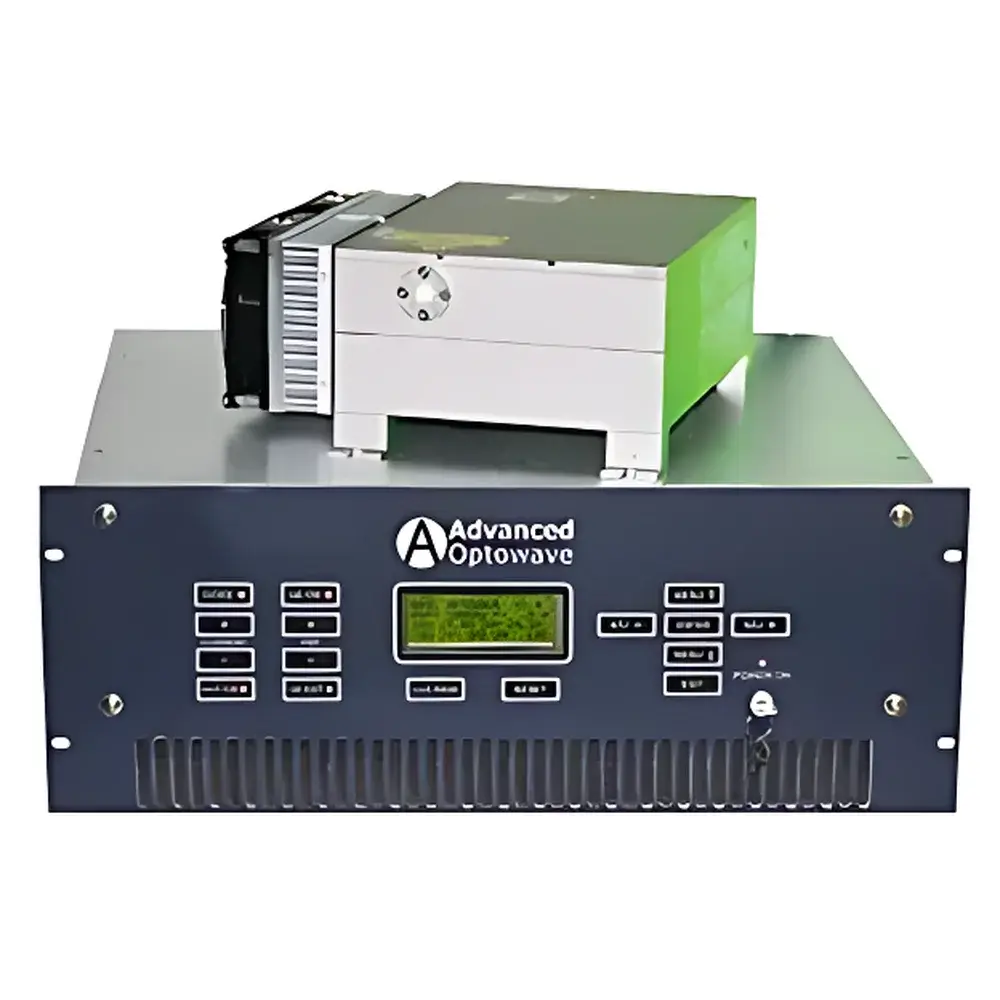
Advanced Optowave AW-HP Series High-Power Diode-Pumped Solid-State (DPSS) Laser
| Brand | Advanced Optowave |
|---|---|
| Origin | USA |
| Model | AW-HP Series |
| Wavelength Options | 266 nm, 355 nm, 532 nm, 1064 nm |
| Output Power Range | 5–100 W (depending on wavelength & configuration) |
| Pulse Repetition Rate | 1–300 kHz (or CW for IR variant) |
| Pulse Width | <15 ns to <60 ns (wavelength- and frequency-dependent) |
| Beam Quality (M²) | <1.2–<1.3 |
| Pulse Energy Stability | <2% RMS |
| Beam Pointing Stability | 20 µrad/°C |
| Average Power Stability | <3% over 12 h |
| Spatial Mode | TEM₀₀ |
| Pump Source | Integrated diode modules (field-replaceable) |
Overview
The Advanced Optowave AW-HP Series is a family of high-power, diode-pumped solid-state (DPSS) lasers engineered for demanding scientific and industrial applications requiring stable nanosecond pulses, diffraction-limited beam quality, and robust continuous operation. Based on end-pumped Nd:YAG or Nd:YVO₄ gain media with harmonic generation stages, these Q-switched lasers operate across four fundamental and harmonic wavelengths—266 nm (fourth harmonic), 355 nm (third harmonic), 532 nm (second harmonic), and 1064 nm (fundamental)—enabling broad compatibility with nonlinear optical processes. The system architecture integrates the pump diodes directly into the laser controller chassis, eliminating external pump modules and enhancing thermal management, mechanical rigidity, and long-term alignment retention. Designed for 24/7 duty cycles in laboratory, OEM integration, and production environments, the AW-HP Series delivers up to 100 W average power (at 1064 nm) and up to 10 mJ pulse energy, with pulse durations tightly controlled between 15 ns and 60 ns depending on operating wavelength and repetition rate.
Key Features
- End-pumped solid-state architecture for superior thermal efficiency and reduced thermal lensing
- TEM₀₀ spatial mode output with M² < 1.3 across all wavelengths—ensuring optimal focusability for precision ablation and nonlinear conversion
- Integrated, field-replaceable laser diode modules housed within the controller unit—minimizing downtime during maintenance
- High pulse-to-pulse stability (<2% RMS) and pointing stability (20 µrad/°C), critical for time-resolved spectroscopy and interferometric applications
- Low average power drift (<3% over 12 hours) enabled by active temperature stabilization and closed-loop power monitoring
- Compact, modular mechanical design—optimized for integration into vacuum chambers, optical tables, and turnkey instrumentation platforms
- Flexible repetition rate control from single-shot to 300 kHz (with CW option available for 1064 nm configuration)
Sample Compatibility & Compliance
The AW-HP Series is compatible with standard optical components rated for UV–NIR spectral ranges, including fused silica lenses, dielectric mirrors, BBO/LBO nonlinear crystals, and photodetectors with appropriate damage thresholds. All models comply with IEC 60825-1:2014 (Laser Product Safety) and are classified as Class IV lasers—requiring interlocked enclosures, beam shutters, and appropriate laser safety officer (LSO) protocols per ANSI Z136.1. The control electronics meet CE marking requirements for EMC (EN 55011) and low-voltage directive (2014/35/EU). For regulated environments—including GLP-compliant laboratories and medical device manufacturing—the system supports optional audit-trail-enabled firmware (aligned with FDA 21 CFR Part 11 principles) when paired with Advanced Optowave’s certified software suite.
Software & Data Management
Control and monitoring are executed via Advanced Optowave’s AW-Control Suite—a Windows-based application offering real-time parameter logging, remote triggering (TTL, USB, Ethernet), and scriptable pulse sequencing. The software provides full access to internal diagnostics: diode current/voltage, crystal temperature, cavity alignment status, and pulse energy feedback (when equipped with integrated calorimeter or photodiode monitor). Data export is supported in CSV and HDF5 formats, ensuring seamless integration with MATLAB, Python (via PyAWSDK), and LabVIEW environments. Optional SDKs enable OEM-level integration into custom DAQ or motion-control systems, with deterministic latency (<100 µs) for synchronized scanning or gated detection.
Applications
- Pumping Ti:sapphire and optical parametric amplifiers (OPAs) for ultrafast laser systems
- Photoacoustic imaging excitation—leveraging high peak power and UV–visible absorption cross-sections in biological chromophores
- Nonlinear optical characterization—including SHG/THG microscopy, Z-scan measurements, and two-photon absorption studies
- LIDAR transmitter sources for atmospheric sensing and wind profiling—benefiting from narrow linewidth and pointing stability
- Micromachining of polymers, ceramics, and thin-film solar cells—where precise pulse energy control minimizes HAZ (heat-affected zone)
- Time-of-flight mass spectrometry (TOF-MS) ionization sources, particularly in MALDI configurations requiring ns-scale UV pulses
FAQ
What cooling method is required for continuous operation?
All AW-HP models utilize forced-air cooling with redundant thermal sensors; water cooling is optional for high-duty-cycle (>80%) deployments at maximum power.
Can the laser be operated in CW mode?
Only the AW1-HP-IR (1064 nm) variant supports true CW operation; other wavelengths are Q-switched pulsed only.
Is remote interlock and shutter control supported?
Yes—standard TTL-compatible interlock inputs and shutter outputs are provided on the rear panel, compliant with EN 61511 functional safety requirements.
What is the typical warm-up time to achieve specified stability?
Less than 30 minutes from cold start to meet <3% power stability and <20 µrad pointing drift specifications.
Are OEM integration kits available?
Yes—Advanced Optowave offers mounting flanges, beam-height adapters, fiber-coupling options (for 1064/532 nm), and custom control interface boards (RS-422, CAN bus) upon request.





