
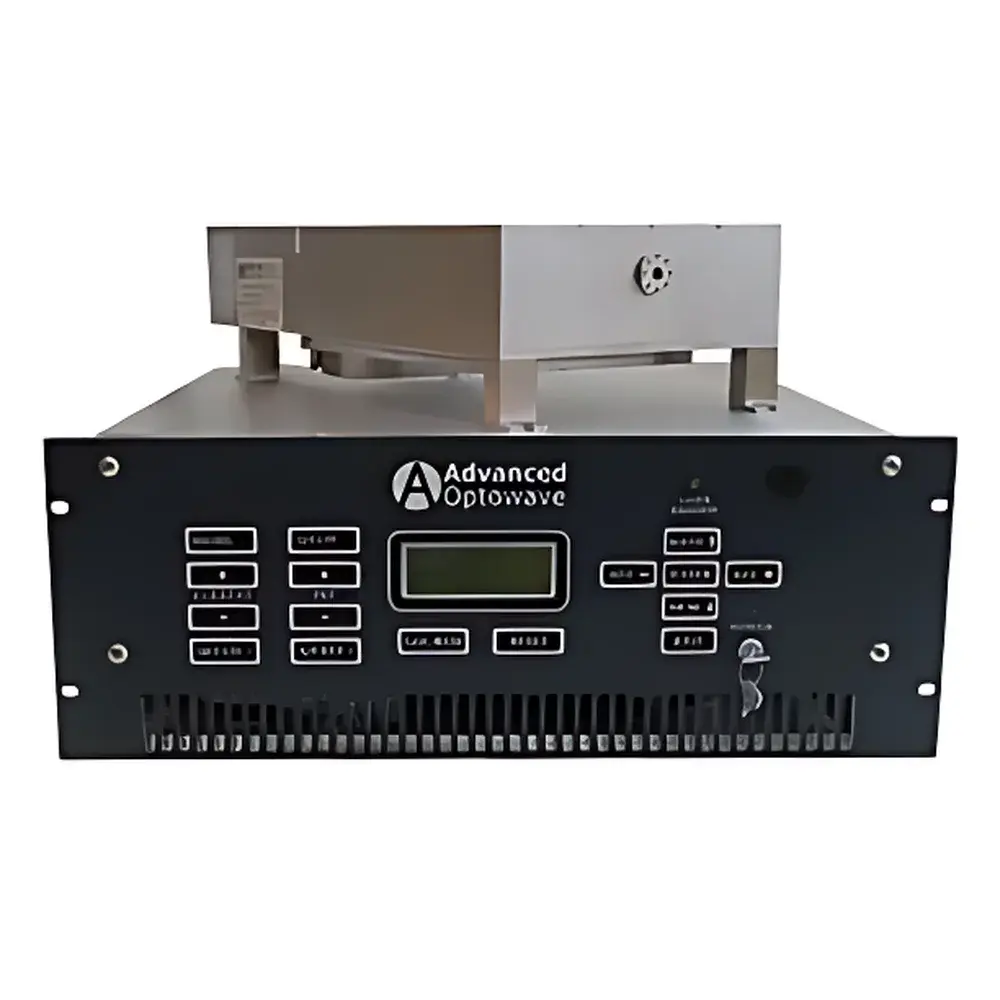
Advanced Optowave AWAVE Series Q-Switched DPSS Nanosecond Laser Systems
| Brand | Advanced Optowave |
|---|---|
| Origin | USA |
| Manufacturer Type | Authorized Distributor |
| Import Status | Imported |
| Model Series | AWAVE |
| Core Technology | Diode-Pumped Solid-State (DPSS) Laser |
| Operating Modes | Q-Switched Nanosecond Pulsed, TEM₀₀ |
| Max Average Power | 40 W |
| Max Pulse Energy | 10 mJ |
| Wavelength Options | 209 / 213 / 263 / 266 / 351 / 355 / 527 / 532 / 1053 / 1064 nm |
| Repetition Rate | 1–300 kHz (model-dependent, up to CW for IR variants) |
| Pulse Width | 10–100 ns |
| Beam Quality (M²) | <1.3 |
| Pulse Stability | <3% RMS |
| Power Stability | <3% over 12 h |
| Cooling | Air-Cooled (majority of models) |
| Duty Cycle | 24/7 Industrial Operation |
| Compliance | RoHS, CE, FDA 21 CFR Part 1040.10 (Laser Product Safety) |
Overview
The Advanced Optowave AWAVE Series represents a family of high-reliability, diode-pumped solid-state (DPSS) nanosecond pulsed lasers engineered for precision industrial manufacturing, scientific research, and advanced photonics applications. Based on Q-switched Nd:YAG, Nd:YVO₄, and Nd:YLF gain media, these lasers deliver diffraction-limited TEM₀₀ output across deep ultraviolet (DUV), ultraviolet (UV), visible (VIS), and near-infrared (NIR) spectral bands — from 209 nm to 1064 nm. Unlike flashlamp-pumped systems, the AWAVE platform employs end-pumping architecture with integrated laser diodes housed directly within the controller enclosure, enabling superior thermal management, reduced alignment sensitivity, and long-term pointing stability. Each system is designed for continuous-duty operation in factory-floor environments, meeting stringent requirements for uptime, reproducibility, and maintenance predictability. The fundamental lasing transition occurs in crystalline gain media under precise diode excitation, followed by harmonic generation via proprietary nonlinear crystal assemblies — ensuring high conversion efficiency and spectral purity without compromising beam fidelity.
Key Features
- End-pumped DPSS architecture with monolithic resonator design for minimal mode instability and high spatial coherence
- Air-cooled operation across >85% of standard models — eliminating dependency on chiller infrastructure and reducing total cost of ownership
- Patented harmonic generation modules delivering stable, low-noise output at 2nd, 3rd, 4th, and 5th harmonics with optimized phase-matching and thermal compensation
- PWF (Pulse Width & Frequency) linear power control — enables real-time, analog-adjustable output power without altering pulse duration, M², divergence, or focal spot geometry
- Integrated laser diode module mounted inside the controller — field-replaceable in under 15 minutes with no optical realignment required
- Industrial-grade mechanical housing with IP54-rated enclosure options, shock/vibration resistance per MIL-STD-810G, and EMI-compliant power electronics
- Comprehensive onboard diagnostics including diode current monitoring, cavity temperature logging, and pulse energy feedback loop (optional)
Sample Compatibility & Compliance
The AWAVE Series supports interaction with a broad range of materials including silicon wafers, sapphire substrates, copper foils, polyimide films, ceramic matrices, and nonlinear optical crystals such as BBO, LBO, and CLBO. Its nanosecond pulse regime enables controlled ablation, selective photothermal modification, and efficient nonlinear frequency conversion — critical for processes requiring minimal heat-affected zones. All systems comply with IEC 60825-1:2014 (Edition 3.2) for laser product safety classification and are certified CE-marked per Directive 2014/35/EU (Low Voltage) and 2014/30/EU (EMC). For regulated laboratory environments, optional firmware upgrades support audit-trail-enabled operation compliant with FDA 21 CFR Part 11 and GLP/GMP data integrity requirements.
Software & Data Management
AWAVE lasers integrate seamlessly with third-party motion controllers and machine vision systems via industry-standard interfaces: RS-232, USB 2.0, Ethernet (TCP/IP), and TTL-triggered external synchronization (sync-in/sync-out). The included AW-LabControl GUI provides full parameter configuration — including repetition rate, PWF setpoint, burst mode sequencing, and interlock status monitoring — with programmable ramping profiles and script-based automation (Python/LabVIEW SDKs available). All operational logs — pulse count, average power, diode drive current, head temperature — are timestamped and exportable in CSV or HDF5 format. Optional remote monitoring via MQTT or OPC UA enables integration into Industry 4.0 MES platforms for predictive maintenance scheduling and process traceability.
Applications
- Microstructuring of thin-film photovoltaic cells (CIGS, perovskite) via selective ablation and edge isolation
- Laser-induced forward transfer (LIFT) of functional nanomaterials in printed electronics fabrication
- High-precision trimming of thick-film resistors and RF/microwave circuits (laser trimmer pump source)
- Nonlinear optics experiments requiring tunable UV/VIS pump sources for OPO/OPA seeding and ultrafast amplifier pumping
- Time-resolved photoacoustic imaging (PAI) with sub-ns temporal resolution and high pulse-to-pulse consistency
- PCB depaneling and flex circuit singulation using cold ablation at 266 nm and 355 nm
- LED wafer marking and scribing with <5 µm feature resolution and zero substrate cracking
- Lidar transmitter development for atmospheric sensing and autonomous vehicle ranging (1064 nm / 532 nm variants)
FAQ
What cooling method is required for AWAVE lasers?
Most AWAVE models operate with forced-air cooling only; water cooling is optional and reserved for select high-power IR variants (>25 W @ 1064 nm).
Can the AWAVE series be used for continuous-wave (CW) operation?
Yes — the AWAVE-IR models (1053 nm and 1064 nm) support both Q-switched pulsed and true CW output modes, selectable via software.
Is harmonic generation internal or external?
All harmonic wavelengths (213 nm through 532 nm) are generated internally using temperature-stabilized, angle-tuned nonlinear crystals; no external doubling stages are required.
How is beam pointing stability maintained over extended operation?
Through monolithic resonator construction, low-CTE mechanical mounts, active cavity temperature regulation (±0.1°C), and passive athermal design of harmonic modules.
Does the PWF control affect beam quality or focusability?
No — PWF adjusts only diode drive current and Q-switch timing; M² remains constant (<1.3), divergence is unaffected, and focal spot size varies by <0.3% across full power range.





