
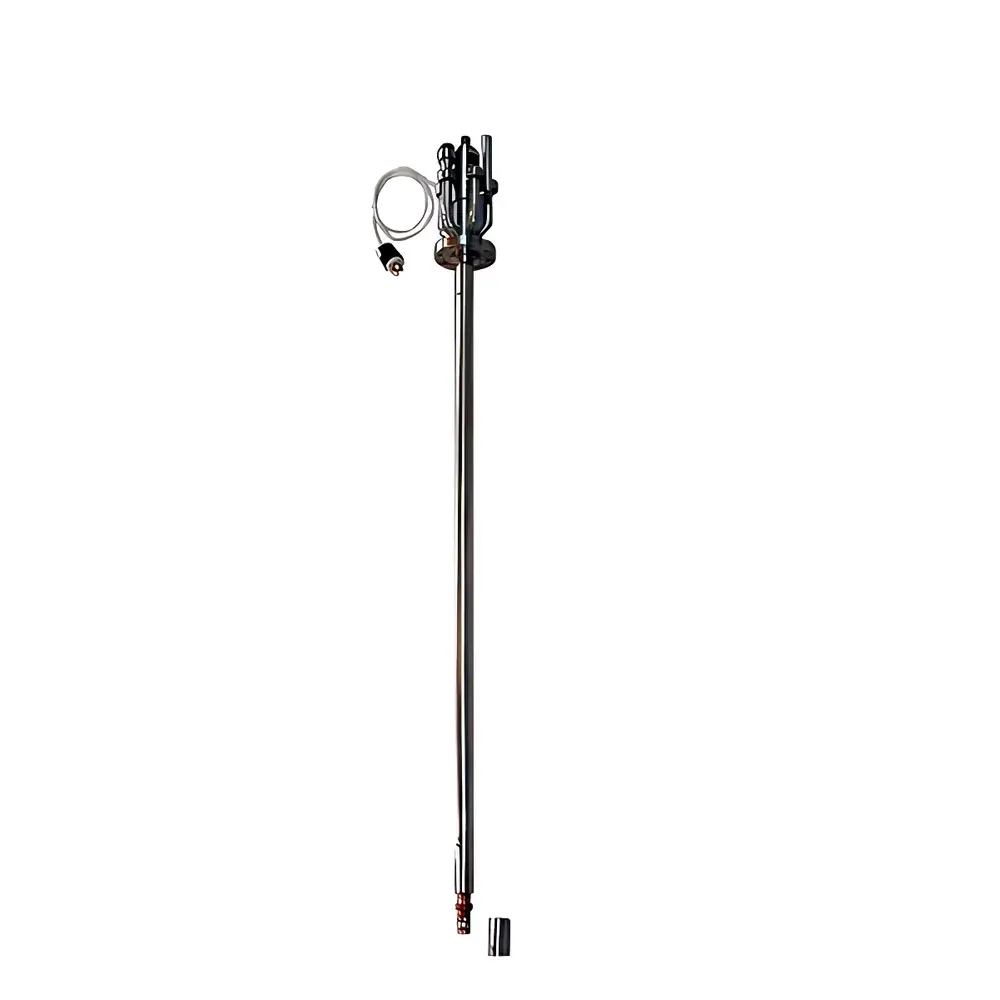
Advanced Research Systems (ARS) LT3M Helitran® UHV Liquid Helium Flow Cryogenic Thermostat
| Brand | ARS |
|---|---|
| Origin | USA |
| Model | LT3M |
| Instrument Type | Vertical |
| Temperature Stability | ±50 mK |
| Temperature Uniformity | 50 mK |
| Operating Temperature Range | <2 K (pumped) to 350 K |
| Base Temperature | 1.7 K (with pumping), 4.2 K (liquid helium bath) |
| Helium Consumption | 0.7 L/hr at 4.2 K |
| Cooling Power | 0.5 W @ 4.2 K, 3.0 W @ 20 K, 7 W @ 50 K |
| Vibration Level | Sub-ångström (sub-Å) RMS |
| Vacuum Compatibility | UHV ≤1×10⁻¹¹ Torr |
| Flange Options | Standard 4.5" CF, Optional 6" or 8" CF |
| Radiation Shield | Nickel-plated OFHC copper, positioned 0.125" from cold tip |
| Customization | Extendable cold finger, rigid support mounts, custom sensor wiring, sample stage configurations |
Overview
The Advanced Research Systems (ARS) LT3M Helitran® UHV Liquid Helium Flow Cryogenic Thermostat is a high-performance, vertically oriented open-cycle cryostat engineered for ultra-high vacuum (UHV) and ultra-low vibration applications in surface science, quantum transport, and scanning probe microscopy. It operates on the principle of continuous liquid helium flow through a thermally optimized coaxial transfer line, enabling stable base temperatures down to 1.7 K under pumped conditions and 4.2 K in static bath mode. Unlike closed-cycle refrigerators, the LT3M avoids mechanical compressor-induced vibrations by eliminating moving parts at the cold stage—making it uniquely suited for atomic-resolution STM, MBE-integrated characterization, and low-noise electronic measurements. Its fully welded stainless-steel vacuum architecture achieves and maintains pressures ≤1×10⁻¹¹ Torr, with full compatibility for UHV bakeout up to 200 °C. The system integrates a high-efficiency matrix heat exchanger within the coaxial helium delivery line, minimizing thermal gradients and maximizing cooling power density while suppressing vibrational coupling into the sample space.
Key Features
- True UHV-rated construction with all-metal seals and hermetically welded joints—no elastomers or epoxies in vacuum path
- Sub-ångström RMS vibration performance at 4.2 K, validated via STM imaging (e.g., <3 Å noise floor in 62 Å × 62 Å scans)
- Modular cold finger design: standard length configurable; optional extensions with reinforced rigid support brackets
- Optimized coaxial helium flow line with integrated radiation shield (nickel-plated OFHC copper, 0.125″ from cold tip)
- Integrated helium mass flow control panel with precision needle valves and digital flow monitoring for reproducible thermal settling
- Bakeable to 200 °C without disassembly; compatible with UHV chamber integration and in-situ annealing protocols
- Open sample geometry with large-diameter, unobstructed access—ideal for optical alignment, multi-probe electrical wiring, and custom sample holders
- Optional high-temperature stages: 450 K and 800 K heated platforms (operating range extends from base temperature +2 K to rated max)
Sample Compatibility & Compliance
The LT3M supports a broad spectrum of sample geometries and experimental configurations—including planar substrates (e.g., Si(111), Au(111), graphene-on-Cu), mesoscopic devices, nanowires, and molecular monolayers. Its open architecture accommodates standard UHV-compatible sample carriers (e.g., Ta or Mo hearths), as well as user-fabricated fixtures with custom electrical feedthroughs or optical windows. All wetted and vacuum-facing components comply with ASTM F1319 (UHV material outgassing standards) and are certified for use in GLP/GMP-adjacent research environments requiring traceable thermal history. The system meets ISO 27492 requirements for cryogenic instrumentation stability reporting and supports audit-ready temperature logging when paired with ARS’s calibrated Cernox® or RuO₂ sensor suite.
Software & Data Management
Temperature regulation is managed via ARS’s proprietary CryoConsole™ software, which interfaces with programmable PID controllers and dual-channel Lake Shore 372 AC resistance bridges or 336 temperature controllers. The platform enables automated ramp-and-soak profiles, real-time delta-T trending (<0.002 K stability verified over 24 h under no-load conditions), and synchronized data logging with timestamped metadata (sensor ID, setpoint, helium flow rate, pressure). Export formats include CSV and HDF5, ensuring compatibility with Python-based analysis pipelines (e.g., NumPy, SciPy, Matplotlib) and LabVIEW-based DAQ systems. For regulated environments, optional 21 CFR Part 11-compliant audit trail modules provide electronic signature support, user-level access controls, and immutable record retention.
Applications
- Scanning Tunneling Microscopy (STM) and Atomic Force Microscopy (AFM) requiring sub-ångström stability at T < 4.2 K
- Angle-Resolved Photoemission Spectroscopy (ARPES) and low-energy electron diffraction (LEED) in UHV beamlines
- Quantum transport studies of topological insulators, 2D materials, and superconducting heterostructures
- In-situ molecular self-assembly and surface reaction kinetics monitored via QCM or TPD
- Cryogenic photoluminescence and Raman spectroscopy with confocal optical access
- Calibration of primary thermometry standards (e.g., fixed-point cells, noise thermometry setups)
FAQ
What vacuum level does the LT3M achieve, and how is it maintained?
The LT3M achieves and sustains ≤1×10⁻¹¹ Torr in its native configuration using ion pumps and titanium sublimation pumps; all internal surfaces are electropolished stainless steel with zero organic sealants.
Can the LT3M operate with liquid nitrogen instead of liquid helium?
Yes—the system is fully compatible with LN₂ flow for operation between 77 K and 350 K, though base temperature and cooling power specifications apply only to He-mode operation.
Is remote operation supported?
Yes—CryoConsole™ supports Ethernet-based TCP/IP communication, enabling full control and monitoring from external workstations without local GUI dependency.
How is temperature uniformity measured across the sample platform?
Uniformity is characterized using an array of calibrated Cernox sensors mounted on a reference copper plate; 50 mK peak-to-peak variation is measured over a 25 mm diameter area under steady-state He-flow conditions.
Are custom sensor configurations available for specialized experiments?
Yes—ARS offers factory-integrated options including dual-sensor redundancy, differential thermometry pairs, and embedded Hall probes for concurrent magnetic field mapping; lead times and calibration documentation provided upon request.



