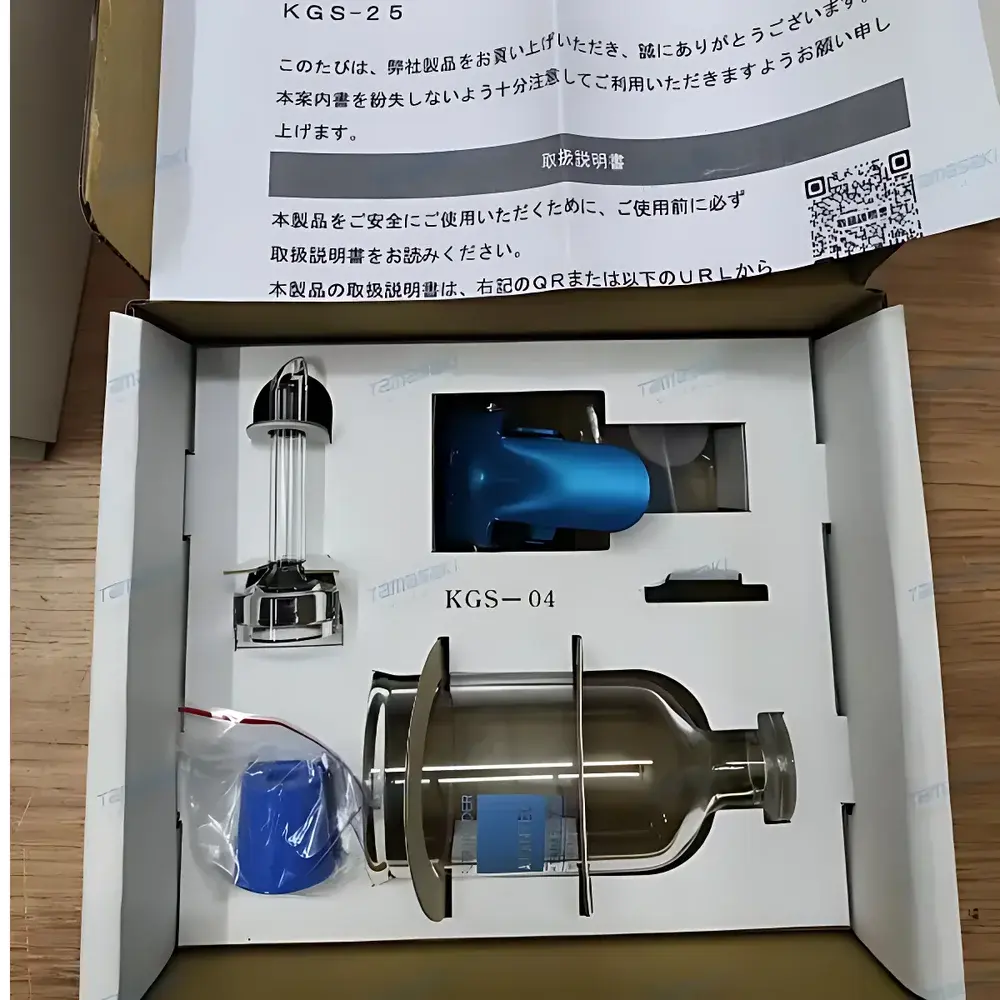
ADVANTEC KGS-04 Glass Vacuum Filtration Stand with Filter Holder
| Brand | ADVANTEC |
|---|---|
| Origin | Japan |
| Model | KGS-04 |
| Filter Diameter | 25 mm |
| Effective Filtration Area | 0.13 cm² |
| Funnel Capacity | 110 mL |
| Support Mesh | PTFE (0.6 mm wire diameter) |
| Weight | 370 g |
| Packaging Dimensions | 215 × 180 × 90 mm |
| Net Weight | 370 g |
| Gross Weight | 410 g |
Overview
The ADVANTEC KGS-04 Glass Vacuum Filtration Stand is a precision-engineered laboratory filtration system designed for quantitative particulate matter analysis in pharmaceutical and quality control laboratories. Built on the principles of controlled vacuum-assisted membrane filtration, the KGS-04 enables standardized recovery and enumeration of insoluble particles from parenteral solutions—specifically aligned with pharmacopoeial test methods including the Japanese Pharmacopoeia (JP) General Test for Particulate Matter in Injections and Ophthalmic Solutions. Its all-glass construction (borosilicate 3.3) ensures chemical inertness, thermal stability, and optical clarity, supporting visual inspection and minimizing adsorption artifacts during low-volume sample processing (e.g., small-volume injections ≤10 mL and single-dose ophthalmic preparations). The unit operates as a complete filtration assembly comprising a calibrated glass funnel, PTFE support mesh, and compatible filter holder—designed to maintain laminar flow dynamics and prevent membrane distortion under vacuum.
Key Features
- Borosilicate glass construction (DIN ISO 3585 compliant) for resistance to thermal shock, alkali corrosion, and organic solvents.
- Precision-machined PTFE support mesh (0.6 mm wire diameter) ensuring uniform membrane support without clogging or particle entrapment beneath the mesh.
- Optimized funnel geometry with 110 mL capacity and conical taper to minimize residual volume and facilitate complete particle retention on the filter surface.
- Standardized Φ25 mm filter interface compatible with common membrane filters (e.g., mixed cellulose ester, polycarbonate, nylon) used in pharmacopoeial particulate testing.
- Effective filtration area precisely defined at 0.13 cm²—calibrated to meet JP XIX Annex 5 requirements for particle counting reproducibility.
- Autoclavable and cleanroom-compatible design; suitable for use in ISO Class 5–7 environments when handled under aseptic conditions.
Sample Compatibility & Compliance
The KGS-04 is validated for use with aqueous and mildly organic formulations typical of injectables and ophthalmic solutions. It supports filtration of samples up to 100 mL per run, though primary applications focus on volumes ≤10 mL to comply with JP and USP <788> limits for small-volume parenterals. The system conforms to key regulatory expectations for particulate testing instrumentation: it enables traceable, operator-independent filtration parameters (vacuum level, dwell time, rinse protocol), supports GLP-compliant documentation via associated lab notebooks or LIMS integration, and meets material compatibility requirements outlined in JP General Notices and ICH Q5C. While the KGS-04 itself is not an electronic measuring instrument, its mechanical design directly influences measurement integrity in light microscopy–based particle enumeration workflows—making it an essential component in FDA 21 CFR Part 11–aligned QC laboratories performing compendial testing.
Software & Data Management
The KGS-04 is a manually operated, non-electronic filtration device and does not incorporate embedded firmware, digital controls, or data output interfaces. However, its dimensional and functional consistency enables seamless integration into structured data capture workflows. Laboratories routinely pair the KGS-04 with validated particle counters (e.g., HIAC, Light Obscuration systems) or microscopy-based enumeration platforms. When used within computerized systems, procedural parameters—including filter lot number, vacuum pressure (measured externally via analog gauge), filtration duration, and post-filtration rinse volume—are recorded in electronic batch records or LIMS modules compliant with ALCOA+ principles. No proprietary software is required; documentation adheres to standard SOPs referencing JP XIX, USP <788>, and EP 2.9.19.
Applications
- Quantitative insoluble particle testing of small-volume parenterals (SVPs) per Japanese Pharmacopoeia General Test for Particulate Matter.
- Particulate evaluation of single-dose ophthalmic solutions prior to release testing.
- Filter validation studies involving membrane integrity assessment and extractables screening.
- Pre-filtration concentration of suspended particulates for SEM-EDS or Raman microanalysis.
- Method development and transfer for pharmacopoeial particulate assays across global manufacturing sites.
FAQ
Is the KGS-04 compatible with USP <788> and EP 2.9.19 test methods?
Yes—the geometry, effective filtration area, and material specifications align with the physical constraints defined in both monographs for membrane filtration-based particle enumeration.
Can the glass funnel be sterilized using autoclaving?
Yes, the borosilicate glass components are rated for repeated autoclaving at 121°C for 20 minutes; PTFE mesh remains stable under these conditions.
What filter membranes are recommended for JP-compliant testing?
Mixed cellulose ester (MCE) membranes with 0.45 µm pore size are most commonly used; polycarbonate track-etch membranes may be selected for higher-resolution microscopy.
Does the KGS-04 include vacuum tubing or a vacuum source?
No—it is supplied as a standalone filtration stand; users must provide a regulated vacuum source (typically ≤−0.08 MPa) and compatible tubing per laboratory SOPs.
How is calibration verified for the KGS-04?
Calibration is performed via dimensional verification (filter diameter, funnel volume) and functional testing (flow rate consistency under fixed vacuum); no periodic recalibration is required per manufacturer specifications.