
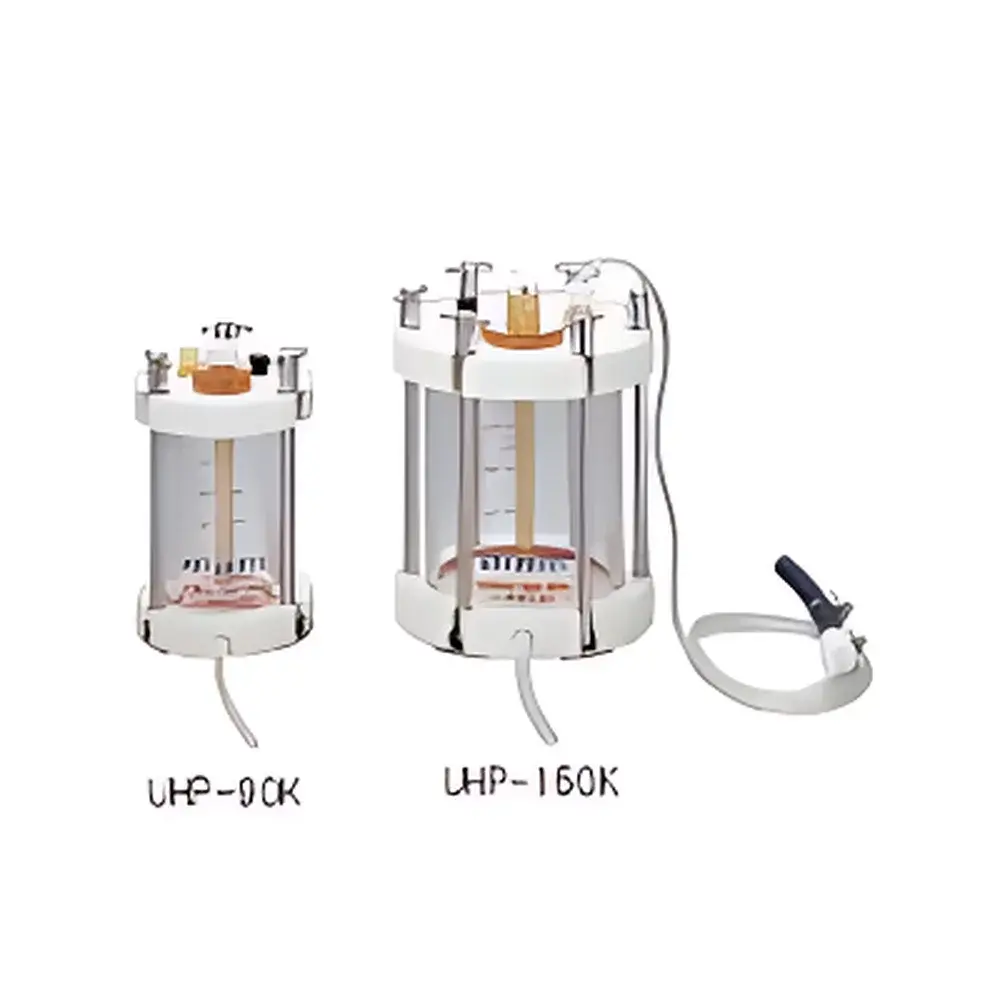
ADVANTEC UHP-90K Stirred Ultrafiltration Cell
| Brand | ADVANTEC (Toyo Roshi Kaisha, Ltd.) |
|---|---|
| Origin | Japan |
| Model | UHP-90K |
| Filter Diameter | 90 mm |
| Chamber Capacity | 600 mL |
| Minimum Concentration Volume | 15 mL |
| Residual Liquid Volume | 0.6 mL |
| Effective Filtration Area | 50.7 cm² |
| Operating Speed Range | 0–100 rpm |
| Max Working Pressure | 0.49 MPa |
| Safety Valve Set Pressure | 0.39 ± 0.09 MPa |
| Materials | Body/Acrylic, Top & Bottom Plates/Polysulfone, O-rings/Silicone, Structural Components/SUS304, Polyacetal, FPM |
| Outlet Tubing Adapter ID | 3 mm |
| Dimensions (H × W) | 222 × 144 mm |
| Weight | 1.8 kg |
| Packaging | 160 × 260 × 160 mm, 2.0 kg |
Overview
The ADVANTEC UHP-90K Stirred Ultrafiltration Cell is a precision-engineered, benchtop ultrafiltration system designed for laboratory-scale concentration, diafiltration, and buffer exchange of biomolecular solutions—including proteins, antibodies, viruses, nucleic acids, and nanoparticles. It operates on the principle of tangential flow filtration (TFF) with integrated magnetic stirring, enabling efficient mass transfer across the membrane surface while minimizing concentration polarization and fouling. Unlike static dead-end systems, the UHP-90K’s recirculation loop and controlled agitation (up to 100 rpm) maintain uniform shear conditions and stable transmembrane pressure (TMP), supporting reproducible recovery yields and consistent molecular weight cutoff (MWCO) performance. Its modular acrylic body and polysulfone endplates provide optical clarity for real-time process monitoring and chemical compatibility with common aqueous buffers, mild organic solvents, and sanitizing agents (e.g., 0.5 M NaOH, 20% ethanol). The cell is intended for use with standard ADVANTEC or third-party ultrafiltration membranes (e.g., regenerated cellulose, polyethersulfone) in disk format (90 mm diameter), and is compatible with external peristaltic pumps, pressure controllers, and temperature-regulated recirculation manifolds.
Key Features
- Stirred ultrafiltration architecture with built-in magnetic stir bar drive—optimized for low-shear, high-recovery processing of shear-sensitive biologics
- Large 600 mL sample chamber volume with 15 mL minimum concentration endpoint, enabling scalable downstream processing from discovery to preclinical development
- Low residual volume design (0.6 mL) minimizes product loss and improves yield—critical for high-value therapeutic candidates and limited clinical samples
- Robust mechanical construction: SUS304 stainless steel shaft and hardware, FPM seals for broad chemical resistance, and autoclavable polysulfone top/bottom plates (121°C, 20 min)
- Integrated safety valve (set at 0.39 ± 0.09 MPa) and pressure-rated housing (max 0.49 MPa) compliant with ISO 8536-4 and JIS T 0901 for safe operation under regulated lab environments
- Standard 3 mm OD outlet tubing adapter facilitates seamless integration with fraction collectors, conductivity/pH probes, and inline UV-Vis flow cells
Sample Compatibility & Compliance
The UHP-90K supports a wide range of biological and synthetic macromolecules, including monoclonal antibodies (mAbs), IgG fragments, plasmid DNA, mRNA-LNPs, viral vectors (AAV, lentivirus), and polymer-based nanocarriers. Its material composition meets USP Class VI and ISO 10993-5 cytotoxicity requirements. All wetted surfaces are extractables- and leachables-tested per ICH Q5C and Q5D guidelines. The device is suitable for GLP-compliant workflows when used with validated membranes and documented cleaning procedures (e.g., water-for-injection rinse, 0.1 N NaOH hold, DI water flush). It does not incorporate electronic components or data logging; therefore, it is inherently 21 CFR Part 11–neutral—ideal for labs requiring manual audit trails or integration into validated chromatography or filtration platforms.
Software & Data Management
As a purely mechanical, non-electronic ultrafiltration cell, the UHP-90K requires no proprietary software or firmware. Process parameters—including stir speed (0–100 rpm), TMP, feed volume, permeate flux, and temperature—are monitored and recorded externally using standard lab instrumentation (e.g., digital tachometers, pressure transducers, balance-integrated fraction collectors). Users may implement electronic batch records (EBRs) via LIMS or ELN systems (e.g., LabWare, Benchling) by referencing standardized SOPs aligned with ASTM D8012-16 (Standard Guide for Ultrafiltration System Performance Testing) and ISO 21501-4 (Particle size analysis—Ultrasound attenuation spectroscopy). Calibration certificates for ancillary devices (e.g., pressure sensors traceable to NIST) are recommended for GMP-aligned applications.
Applications
- Concentration and formulation of therapeutic proteins prior to analytical characterization (SEC-MALS, DLS, CD)
- Diafiltration of viral vector harvests to remove host cell proteins and media components
- Buffer exchange of CRISPR-Cas ribonucleoprotein complexes into electroporation-compatible media
- Size-based fractionation of extracellular vesicles (EVs) using sequential MWCO membranes (e.g., 100 kDa → 300 kDa)
- Preparative purification of synthetic polymers and dendrimers in academic polymer chemistry labs
- Process development studies supporting Tech Transfer to single-use TFF cassettes in manufacturing
FAQ
What membrane types and MWCOs are compatible with the UHP-90K?
The cell accepts standard 90 mm disk membranes made of regenerated cellulose (RC), polyethersulfone (PES), or hydrophilic PVDF, with MWCOs ranging from 3 kDa to 1,000 kDa. Membrane selection must account for protein binding affinity and solvent compatibility.
Is the UHP-90K suitable for sterile processing?
Yes—when assembled with pre-sterilized membranes and autoclaved components (polysulfone plates, silicone O-rings), the unit supports aseptic ultrafiltration under laminar flow hoods or isolators. Sterility validation per ISO 11137 is user-responsible.
Can the stir speed be adjusted during operation?
Yes—external magnetic stirrers with variable speed control (0–100 rpm) allow real-time adjustment to optimize flux without compromising integrity of fragile analytes.
What cleaning protocols are recommended between runs?
A three-step protocol is advised: (1) DI water flush (2× chamber volume), (2) 0.1 N NaOH hold (30 min), (3) final DI water rinse (3× chamber volume). Validate cleanliness via TOC or protein assay if required for GxP work.
Does ADVANTEC supply certified calibration documentation?
No—the UHP-90K is a passive mechanical device and does not require factory calibration. Users must qualify associated instrumentation (e.g., pressure gauges, balances) per internal SOPs and regulatory expectations.



