
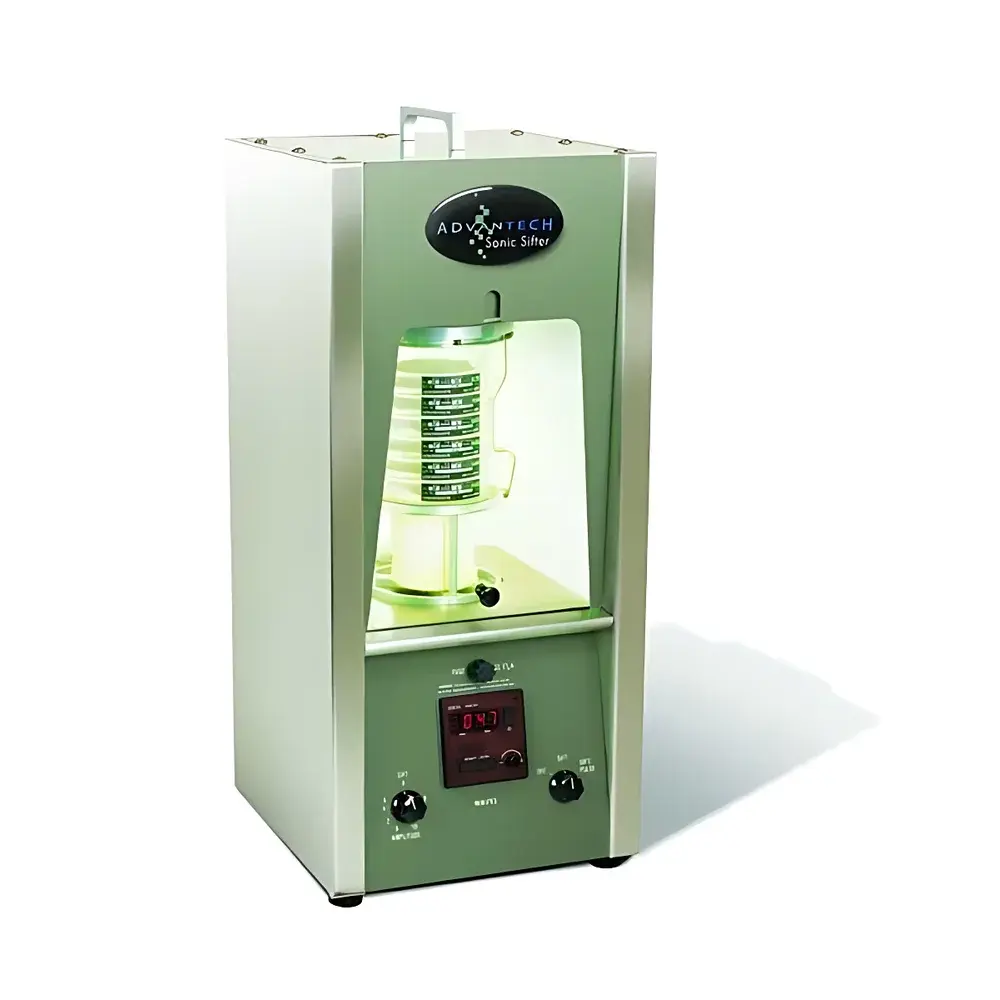
Advantech L3P-25 Sonic Sifter
| Brand | Advantech |
|---|---|
| Origin | USA |
| Model | L3P-25 |
| Operating Temperature | −18 °C to 49 °C |
| Operating Humidity | Non-condensing |
| Timer Accuracy | ±2 s per 24 h |
| Dimensions | 25 cm × 31 cm × 61 cm |
| Weight | 20 kg |
| Power Supply | 240 VAC, 50 Hz |
| Sieve Diameter | 76.2 mm (3″) |
| Particle Separation Range | 3 µm to 5.6 mm |
| Max. Sieves per Run | 6 standard airflow sieves or 3 precision sieves |
| Vibration Frequency | 60 Hz vertical oscillatory air column |
| Compliance | ASTM E11 certified sieves with full traceability |
Overview
The Advantech L3P-25 Sonic Sifter is an advanced dry-sieving instrument engineered for high-efficiency, high-reproducibility particle size distribution analysis in laboratory, R&D, and quality control environments. Unlike conventional mechanical or vacuum-assisted sieve shakers, the L3P-25 employs a vertically oriented, resonant air column driven at 60 Hz to generate controlled mechanical pulses that fluidize and shear particle agglomerates in real time. This sonic energy mechanism enables rapid stratification and separation of fine and ultrafine powders without moisture, surfactants, or external vacuum sources—making it ideal for hygroscopic, electrostatic, or heat-sensitive materials where wet sieving is impractical or prohibited.
Its core principle relies on acoustic resonance within a precisely tuned air cavity, inducing transient lift forces and repositioning particles relative to sieve apertures. The result is a dramatic reduction in blinding, clogging, and static adhesion—common failure modes in traditional dry sieving. With typical separation completion in under 10 seconds per fraction, the L3P-25 delivers up to 90% time savings versus rotary or vibratory shakers, while maintaining strict compliance with ISO 9276-1, ASTM E11, and USP <786> for particle size analysis instrumentation.
Key Features
- Patented 60 Hz vertical oscillatory air column eliminates need for vacuum pumps or mechanical shaking mechanisms
- Transparent acrylic 3″ (76.2 mm) sieve frames allow real-time visual monitoring of particle fluidization and endpoint determination
- Adjustable amplitude control enables optimization for diverse material properties—including density, aspect ratio, surface charge, and cohesivity
- Integrated digital timer with ±2 s/24 h accuracy ensures method reproducibility across operators and shifts
- Modular stack design accommodates up to six 3″ airflow sieves or three precision-grade sieves per run
- Zero-contact particle handling: no sieve mesh wear, no sample loss, and no cross-contamination between fractions
- Compact footprint (25 × 31 × 61 cm) and low-maintenance architecture support benchtop deployment in regulated QC labs
Sample Compatibility & Compliance
The L3P-25 is validated for dry sieving of free-flowing and marginally cohesive powders—including pharmaceutical actives, catalysts, metal powders, ceramic precursors, food ingredients, and polymer granules. It achieves reliable separations from 3 µm (L3-S500) to 5.6 mm (L3-S3.5), covering all standard ASTM E11 nominal aperture sizes. Each serialized sieve includes a Certificate of Conformance referencing ASTM E11, listing the mesh cloth batch number, manufacturing date, and shipment details—ensuring full metrological traceability per ISO/IEC 17025 and FDA 21 CFR Part 11 requirements for audit-ready documentation.
All acrylic frames are manufactured to dimensional tolerances ≤±0.05 mm, and stainless steel mesh is tensioned and bonded using solvent-free, non-outgassing adhesives compatible with cleanroom Class 1000 environments. The unit operates safely within ambient conditions ranging from −18 °C to 49 °C at non-condensing humidity levels, supporting use in climate-controlled stability chambers and cold-room QA workflows.
Software & Data Management
The L3P-25 operates as a standalone hardware platform with embedded microcontroller-based timing and power regulation—no proprietary software or PC interface is required for basic operation. However, its deterministic timing protocol and standardized sieve geometry make it fully compatible with third-party LIMS and ELN systems via manual data entry or barcode-scanned sieve ID logging. Serialized sieve IDs enable automated linkage to calibration records, usage logs, and maintenance history in GxP-compliant quality management systems (QMS). For laboratories implementing 21 CFR Part 11 compliance, the device supports electronic signature–enabled SOP execution when paired with validated electronic notebooks or paperless QA platforms.
Applications
- Pharmaceutical: API particle sizing per USP <786>; excipient blend uniformity assessment; inhalation powder aerodynamic cut-points
- Materials Science: Metal additive manufacturing feedstock qualification; battery cathode/anode powder classification; nanocellulose dispersion grading
- Food & Agriculture: Flour fineness testing; spice particle homogeneity; feed pellet fines analysis
- Geotechnical & Environmental: Soil grain-size distribution (ASTM D422); fly ash classification; sediment silt-clay separation
- Quality Assurance: Incoming raw material verification; lot release testing; stability study timepoint sampling
FAQ
Does the L3P-25 require vacuum or compressed air?
No. It operates solely on electrical input (240 VAC, 50 Hz) and generates oscillatory airflow internally via electromagnetic actuation—no external gas supply or vacuum pump is needed.
Are sieves included with the base unit?
No. Sieves must be ordered separately. All Advantech sieves are serialized and supplied with ASTM E11 Certificates of Conformance.
Can the L3P-25 be used for regulatory submissions?
Yes. Its design, traceable sieve certification, and deterministic timing support validation per ICH Q5A, USP <786>, and ISO 13320 for dry particle sizing in GMP environments.
What maintenance is required?
None beyond periodic visual inspection of sieve frames and cleaning of the air column housing with lint-free wipes. There are no moving parts subject to wear.
Is the unit suitable for hazardous or explosive dust environments?
The L3P-25 is not intrinsically safe or ATEX-certified. It must be operated in non-hazardous locations per NEC Class I, Division 2 guidelines unless installed within an approved containment enclosure.
Related Products



