
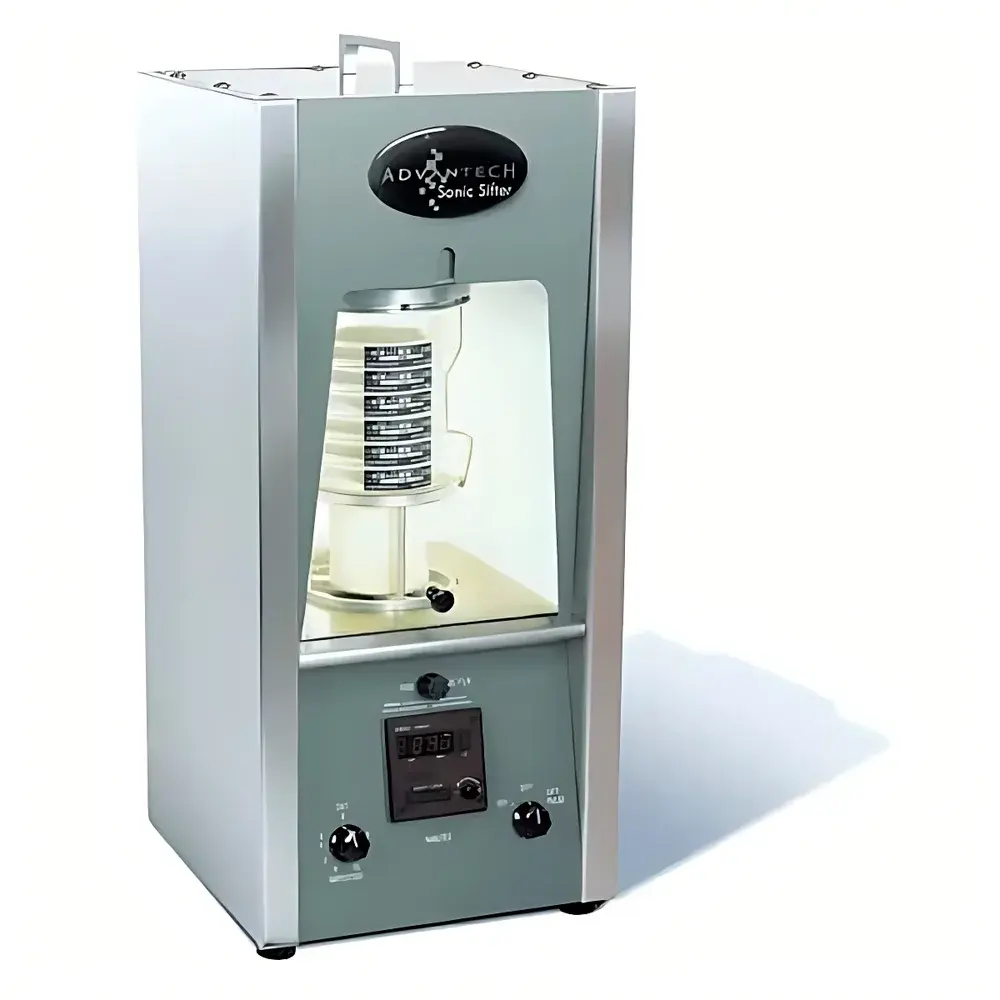
Advantech L3P-25 Ultrasonic Vibratory Sieve Analyzer
| Brand | Advantech |
|---|---|
| Origin | USA |
| Manufacturer Type | Authorized Distributor |
| Origin Category | Imported |
| Model | L3P-25 |
| Price | Upon Request |
| Sieve Compatibility | 3-inch (76 mm) diameter |
| Timer Accuracy | ±2 sec per 24 hr |
| Processing Efficiency | >90% in ≤10 sec |
| Max Sieve Capacity | 6 standard sieves or 3 precision electroformed sieves |
| Particle Size Range | 3 µm – 5.6 mm |
| Standard Sieve Compliance | ASTM E11, ISO 3310-1 |
| Precision Sieve Material | Electroplated Nickel |
| Precision Sieve Compliance | ASTM E161, ISO 3310-2 |
| Vibration Frequency | 60 Hz |
| Operating Temperature | −18 °C to +49 °C (0 °F to 120 °F) |
| Non-Condensing Humidity Tolerance | Full Range |
| Storage Temperature Limit | −43 °C to +52 °C (−45 °F to +125 °F) |
| Dimensions (W×H×D) | 25 × 31 × 61 cm |
| Weight | 20 kg |
| Power Supply | 240 VAC, 50 Hz |
| Optional Accessory | L3-N8 Horizontal Pulse Generator (disaggregates clusters <45 µm) |
| Traceability | Serialized test sieves with batch-specific calibration metadata per ISO/IEC 17025-aligned QA system |
Overview
The Advantech L3P-25 Ultrasonic Vibratory Sieve Analyzer is an engineered solution for high-fidelity dry and wet particle size distribution analysis in regulated laboratory and quality control environments. Unlike conventional mechanical shakers relying solely on orbital or linear motion, the L3P-25 integrates ultrasonic energy—delivered at a fixed 60 Hz frequency—into a precisely controlled vibratory field. This dual-mode excitation mitigates particle agglomeration, static adhesion, and blinding effects common in fine and cohesive powders (e.g., pharmaceutical APIs, nanoscale ceramics, metal oxides, and electrostatically charged polymers). The instrument operates on the principle of resonant energy coupling: ultrasonic waves induce micro-vibrations at the sieve mesh surface, reducing interparticle friction and enabling efficient stratification and passage of particles down the sieve stack. Its design conforms to the physical separation mechanics defined in ASTM D6913, ISO 13320, and USP <786>, supporting method validation under GLP and GMP frameworks.
Key Features
- Ultrasonic-assisted vibration at 60 Hz ensures consistent energy transfer across the full 3-inch (76 mm) sieve diameter, minimizing edge effects and improving reproducibility between replicates.
- Digitally calibrated electronic timer with ±2-second accuracy over 24 hours enables strict adherence to standardized test durations per ASTM E11 and ISO 3310-1 protocols.
- Adjustable power output allows users to optimize energy delivery for material-specific characteristics—including density, moisture content, aspect ratio, and surface charge—without mechanical recalibration.
- Modular sieve carriage accommodates either six standard stacked sieves (5/8″ height) or three precision electroformed nickel sieves (ASTM E161-compliant), facilitating both routine QC and R&D-grade resolution.
- Stainless steel housing provides corrosion resistance and structural rigidity, while integrated leveling feet ensure stable operation on non-resonant surfaces—critical for maintaining uniform particle layer thickness across all sieve levels.
- Serialized traceability system assigns unique identifiers to each supplied sieve, recording manufacturing date, wire cloth batch number, and conformance certification to ASTM E11—supporting audit readiness under ISO/IEC 17025 and FDA 21 CFR Part 11 data integrity requirements.
Sample Compatibility & Compliance
The L3P-25 is validated for use with dry free-flowing powders, granules, and friable solids ranging from 3 µm to 5.6 mm. It supports wet-sieving applications when paired with compatible liquid dispersion media and sealed containment accessories. Materials exhibiting high electrostatic potential (e.g., lactose, silica fume, micronized APIs) demonstrate significantly improved recovery and reduced mass loss compared to rotary or tap sievers. All standard sieves comply with ASTM E11 and ISO 3310-1 for aperture tolerance and wire diameter specifications; electroformed sieves meet ASTM E161 and ISO 3310-2 for sub-45 µm resolution. The system’s operational envelope (−18 °C to +49 °C) permits deployment in ambient lab environments, though temperature and humidity control is recommended to maintain measurement repeatability per ISO 4787. Sieves are rated for storage between −43 °C and +52 °C but must not be exposed to temperatures exceeding these limits during operation or cleaning.
Software & Data Management
The L3P-25 operates as a standalone hardware platform without embedded software or touchscreen interface. Data acquisition and reporting are performed externally using validated spreadsheet templates or LIMS-integrated workflows. Each serialized sieve carries machine-readable metadata enabling manual or barcode-assisted entry into electronic lab notebooks (ELNs) compliant with ALCOA+ principles. When used in conjunction with Advantech’s optional L3-N8 Horizontal Pulse Generator, disaggregation events below 45 µm can be correlated with sieve residue weights to support cluster-breakage modeling—a capability referenced in ASTM D7927 for agglomerate-sensitive materials. Audit trails for sieve usage, calibration history, and environmental logs (temperature/humidity) must be maintained per internal SOPs aligned with FDA 21 CFR Part 11 Annex 11 and EU GMP Annex 11.
Applications
- Pharmaceutical solid dosage development: granule size distribution for direct compression, blend uniformity assessment, and excipient classification.
- Advanced ceramics and battery materials: classification of LiCoO₂, Si anode powders, and alumina feedstocks where electrostatic interference compromises conventional sieving.
- Food & nutraceutical QC: flour, spice, and protein powder fineness testing per AACC Method 28-10 and ISO 7664.
- Geotechnical and mineral processing labs: soil particle analysis per ASTM D422 and ASTM D6913, including silt/clay fraction separation with minimized attrition.
- Research on nanoparticle agglomeration behavior: combined use of L3P-25 and L3-N8 enables quantitative evaluation of dispersion efficiency across surfactant formulations.
FAQ
Does the L3P-25 include sieve meshes?
No. Sieves are sold separately and must be selected based on application requirements (standard ASTM E11 or precision electroformed ASTM E161).
Can the L3P-25 perform wet sieving?
Yes—when used with appropriate liquid-tight accessories and non-reactive dispersion media; however, post-test drying and sieve cleaning procedures must follow validated protocols.
What is the purpose of the L3-N8 Horizontal Pulse Generator?
It delivers low-energy lateral impulses to disrupt weakly bound particle clusters smaller than 45 µm, enhancing sieve passage without introducing mechanical degradation.
Is the timer programmable beyond 24 hours?
No—the built-in timer is fixed at a maximum 24-hour range with ±2-second cumulative accuracy; extended durations require external timing control.
How is traceability ensured for individual sieves?
Each sieve bears a permanent serial number linked to a certificate of conformance, wire cloth batch ID, and manufacturing timestamp—fully documented for ISO/IEC 17025 audits.



