
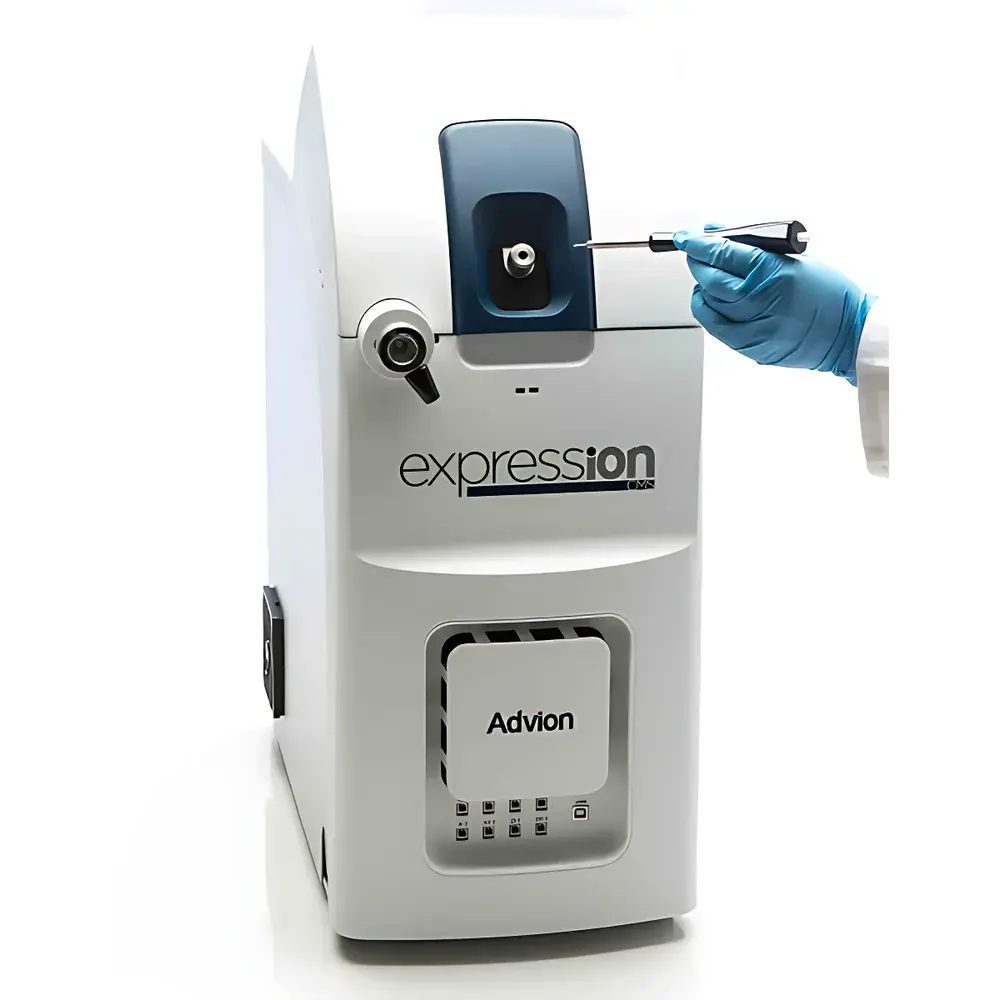
Advion Interchim Scientific ASAP Atmospheric Pressure Solids Analysis Probe
| Brand | Advion Interchim Scientific |
|---|---|
| Origin | USA |
| Manufacturer Type | Authorized Distributor |
| Origin Category | Imported |
| Model | ASAP |
| Pricing | Available Upon Request |
Overview
The Advion Interchim Scientific ASAP (Atmospheric Pressure Solids Analysis Probe) is a robust, ambient ionization source designed for direct analysis of solid and liquid samples under atmospheric pressure conditions. Engineered to complement existing electrospray ionization (ESI) and atmospheric pressure chemical ionization (APCI) sources on the same mass spectrometer platform, the ASAP probe operates on a modified APCI principle—utilizing thermal desorption coupled with corona discharge ionization. In this process, analytes are thermally volatilized from the sample surface via resistively heated nitrogen gas (typically 100–550 °C), followed by gas-phase proton transfer or charge exchange initiated by a high-voltage corona needle. This enables rapid, matrix-free ionization without solvent or matrix additives, making it especially suitable for high-throughput screening in synthetic chemistry, natural product characterization, and quality control laboratories.
Key Features
- Modular design compatible with standard API source interfaces on Advion expression® compact mass spectrometers and other commercial LC-MS platforms equipped with interchangeable ion sources.
- Real-time, non-destructive sampling: minimal sample consumption (sub-microgram quantities) with no derivatization, extraction, or chromatographic separation required.
- Sub-30-second analysis cycle—from probe loading to spectral acquisition—enabling near real-time reaction monitoring during synthetic workflows.
- Source-switching capability: seamless mechanical and electrical integration allows rapid toggling between ASAP, ESI, and APCI modes without venting the mass spectrometer or recalibrating the instrument.
- Thermal control precision: digitally regulated heater with ±2 °C stability across the full operating range (100–550 °C), ensuring reproducible desorption kinetics and minimizing thermal degradation of labile compounds.
- Corona discharge optimization: adjustable voltage and current parameters facilitate tuning for diverse compound classes—including small molecules, alkaloids, lipids, and pharmaceutical intermediates—while maintaining low background noise.
Sample Compatibility & Compliance
The ASAP probe accepts a broad spectrum of sample formats: crystalline solids, thin films, reaction mixtures, crude extracts, powders, tablets, and viscous liquids. It has been validated for use in compliance-supporting environments, including laboratories adhering to GLP (Good Laboratory Practice) and GMP (Good Manufacturing Practice) frameworks. While ASAP itself does not constitute a regulated analytical method, its data output supports method development aligned with ICH Q2(R2) guidelines for analytical procedure validation. Instrument control and data acquisition comply with FDA 21 CFR Part 11 requirements when deployed with Advion’s expression® software suite featuring audit trail, electronic signatures, and user access controls.
Software & Data Management
Controlled via Advion’s proprietary expression® CMS software, the ASAP probe integrates fully into the instrument’s method editor, allowing synchronized temperature ramping, corona voltage modulation, and MS acquisition parameter linking. All raw data files (.raw) are stored in vendor-neutral, open-format directories compliant with mzML standards. The software supports batch processing, spectral library matching (NIST, Wiley, custom libraries), and comparative peak tracking across time-series experiments—critical for kinetic profiling of synthetic reactions. Data integrity is preserved through embedded metadata logging (operator ID, timestamp, probe temperature, gas flow rate, voltage settings), satisfying traceability requirements for internal QA/QC and external audits.
Applications
- Real-time reaction monitoring: Direct probing of aliquots withdrawn from refluxing or stirred reaction vessels to track intermediate formation, byproduct evolution, or endpoint determination.
- Rapid identity confirmation of purified fractions from flash chromatography or preparative HPLC—eliminating the need for re-dissolution and LC-MS injection.
- High-throughput screening of combinatorial libraries, catalyst performance assays, and impurity profiling in early-stage drug discovery.
- Field-deployable analysis of food adulterants, environmental contaminants (e.g., pesticides on plant surfaces), and botanical extracts without sample preparation.
- Forensic and academic applications involving seized materials, ink analysis, polymer additives, and counterfeit pharmaceutical verification.
FAQ
Can the ASAP probe be used simultaneously with ESI or APCI on the same instrument?
No—ASAP operates as a discrete ion source module; however, it shares the same API interface port and can be physically swapped in under vacuum lock conditions, enabling rapid (<5 min) source exchange without breaking vacuum.
What sample forms are incompatible with ASAP analysis?
Highly non-volatile, thermally labile biopolymers (e.g., intact proteins, oligonucleotides) and inorganic salts with negligible vapor pressure at ≤550 °C generally yield poor or no signal; such samples remain better suited to MALDI or ESI-based workflows.
Is method validation required when implementing ASAP for QC release testing?
Yes—per ICH Q2(R2), any new analytical procedure—including ambient ionization methods—must undergo specificity, accuracy, precision, linearity, range, and robustness assessment prior to regulatory submission or routine use in GxP environments.
Does ASAP require calibration standards for quantitative work?
Quantitative analysis requires matrix-matched calibration curves and internal standards, as ionization efficiency varies significantly with sample morphology, surface energy, and thermal behavior—unlike solution-phase ESI where concentration-response relationships are more predictable.
How is probe cleaning performed between analyses?
A standardized solvent rinse (e.g., methanol, acetone, or dichloromethane) followed by thermal bake-out at 400 °C for 2 minutes effectively removes residual analyte and minimizes carryover; cleaning protocols are programmable within expression® CMS.
Related Products





